Affordable AI visibility tool with AI crawler logs that acts on what the bots do
Crawler logs are cheap to collect and easy to ignore. Which tools turn AI bot data into fixes, what that costs per plan, and which crawler decisions need a person.
Collecting AI crawler logs is not the hard part anymore. Plenty of products will show you a chart of GPTBot requests for free. What's scarce is a tool that reads those logs, decides what they mean for your visibility in ChatGPT or Perplexity, and does something about it. That's the angle here: affordable tools judged on whether the crawler data feeds an action, and what each action costs.
A log nobody acts on is a dashboard
Consider what a crawler log can tell you about one product page. PerplexityBot fetched it twice this week and got a 200. Perplexity-User fetched it once while answering someone. The page still isn't cited. Or: OAI-SearchBot has never requested it at all. Each of those patterns points to a different next step: rewrite the page, fix internal links so the bot can discover it, or check whether your firewall blocks OpenAI's published IP ranges.
A reporting tool shows the pattern and stops. An agentic one files the next step, drafts the fix, or both.
The vendors' own docs show why classification matters before any automation. Perplexity says PerplexityBot surfaces and links sites in search results and is not used for foundation-model training, while Perplexity-User, triggered by a user, "generally ignores robots.txt rules". It also says to combine user-agent matching with IP verification. An agent that treats every bot hit the same will make wrong calls.
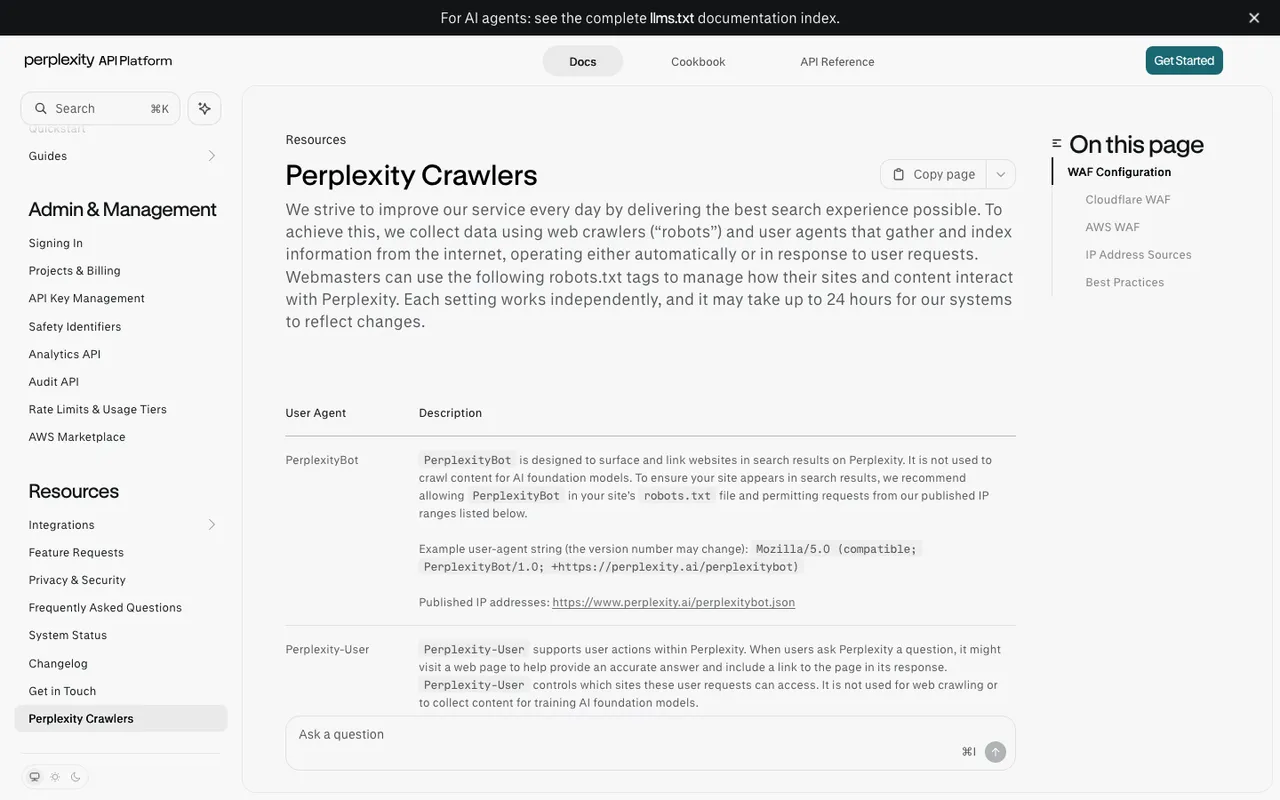
Perplexity's "Perplexity Crawlers" documentation, captured November 21, 2026.
What can run on its own
In Promptwatch, crawler logs start on Professional at $245 a month, and that is the cheapest brand plan where the agentic pieces can use them. Agencies get logs from Kick-off at $199. Here's what acts on the data without someone driving each step.
Classification. Requests are IP-verified against each operator's published ranges, so spoofed user agents drop out. Since November 4, search indexers such as OAI-SearchBot, Claude-SearchBot and Meta-WebIndexer count as AI crawls, while citation crawls are only bots that fetch a page while answering a user, like ChatGPT-User. That split is done for you.
Finding the problem pages. Agent Analytics shows a crawl-to-citation path with a citation rate per page, which separates pages that are crawled and ignored from pages that are never crawled. Error tracking explains failures. A Host column flags logs from hostnames that aren't your project site.
Filing the work. The Action Board's Discovery agent investigates on a weekly schedule, one focus per day, and proposes up to five evidence-backed actions per run. Site health and untracked or untapped pages are among the action types. Weekly site audits run 21 checks and email a health summary every Tuesday.
Answering questions about the logs. Agent Chat works over live crawler logs as well as prompts and citations. Ask it why ChatGPT-User visits to your docs dropped last week and it runs the analysis. When no crawler data is coming in, it checks the setup status first. Scheduled Chats can post a weekly crawler briefing to Slack.
Fixing content. For a page that's crawled but not cited, Content Refresh suggests diff-style edits, and AEO articles on Professional can write the missing page. The fully automated Content Agent needs Business at $579.
What still needs a person
robots.txt and firewall policy. Whether to allow GPTBot for training is a business decision, separate from allowing OAI-SearchBot for search. OpenAI treats the two settings as independent. Google-Extended controls training and grounding for Gemini models, and Google says it does not affect inclusion in Google Search, so blocking it doesn't remove you from AI Overviews. No tool should flip these for you.
Log pipeline setup. Someone has to connect Cloudflare, CloudFront, Fastly, Vercel, Akamai, or the WordPress plugin. Guided setups help; credentials still need a human.
Telling search engines about a fix. Promptwatch's IndexNow integration lets you pick changed pages and submit them from Site > IndexNow, with a "Changed since submission" filter. The changelog does not describe automatic submission, so plan on a person clicking submit.
Other tools that act on crawler data
Scrunch AI takes the most direct action at the crawler layer: its AXP serves AI-optimized versions of pages to LLM crawlers without changing what people see. That's an Enterprise feature. Core at $250 a month includes AI agent and bot traffic reporting.
Goodie AI runs agents that fix technical signals such as llms.txt and sitemaps, and its pages list crawler analytics. Core is $295 a month; the tier that includes crawler features isn't stated.
Known Agents automates one narrow job: Automatic Robots.txt adds rules for bot categories you choose as new agents appear. Free up to 100K events, $29 for 1M. It doesn't track prompts, and auto-blocking a category can cut you off from AI search if you choose the categories carelessly.
Cloudflare AI Crawl Control lets you allow or block each crawler from the dashboard, which writes a WAF rule. Free on every Cloudflare plan.
The affordable agentic setup
For a brand, Promptwatch Professional covers the loop at $245: verified logs, the crawl-to-citation path, Action Board items, Agent Chat over the data, and AEO articles to fix what the logs expose. Move to Business when you want the Content Agent to publish on its own schedule. Start with the 7-day free trial, connect one log source, and ask Agent Chat for a list of pages that bots crawl but AI answers never cite.