Why AI crawler access shapes brand perception, and how agents check it
If AI crawlers can't fetch your pages, engines describe your brand from other people's pages. How to check crawler access, read verified crawler logs, and fix the gaps.
AI brand perception is usually discussed as a content problem: what your pages say, what reviewers say, what Reddit says. There's a step before that. An AI engine can only describe you from your own pages if it can read them. When a crawler is blocked, times out, or gets an error, the engine doesn't stop answering questions about you. It answers from whatever else it found, which means comparison sites, old reviews, forum threads, and your competitors' pages.
Promptwatch's Reddit and YouTube playbook puts the consequence in one line: if you're absent from the sources models read, they describe you through what strangers say, or not at all. Crawler access is the most literal version of being absent. This article explains how crawler access feeds into perception, which bots matter, and how to check it with free tools first and verified logs after.
How access turns into description
Think of an AI answer about your brand as built from a pool of sources. For live-search engines such as ChatGPT Search and Perplexity, part of that pool is assembled at answer time, when a bot fetches pages for that specific question. Another part comes from indexes the engines build ahead of time with their own crawlers.
If your pricing page returns a 403 to a search indexer, it isn't in the pool. If your docs render only with JavaScript the bot doesn't run, the bot sees an empty shell. If a fetch-on-demand bot hits a timeout while a user is waiting, the engine moves on to the next result. In each case, the description of your brand gets assembled without your version of the facts.
This shows up in perception data in recognizable ways. In Promptwatch's metrics guide, "mentions without self-citations" is described as a content or crawlability problem: models know your brand from third-party sources, but your own pages aren't feeding the answers. When Brand Narrative shows a negative claim and the Citations tab lists only third-party pages, check access before you rewrite anything.
Know which bot does what
Not every AI crawler does the same job, and blocking the wrong one can remove you from answers you care about. Promptwatch sorts them into two groups that matter for perception:
| Group | What it means | Examples |
|---|---|---|
| Citation crawls | A bot fetches the page while answering a user | ChatGPT-User |
| AI crawls | Search indexers and other AI bots reading your site ahead of time | OAI-SearchBot, Claude-SearchBot, Meta-WebIndexer |
That split dates from November 4, 2026, when Promptwatch reclassified search indexers as AI crawls. If you compare crawler reports across that date, expect citation crawl totals to fall by about as much as AI crawl totals rise. The full list of tracked bots is longer and uses the operators' real user-agent names: GPTBot, OAI-SearchBot, ChatGPT-User, ClaudeBot, Claude-User, Claude-SearchBot, PerplexityBot, Perplexity-User, Google-Agent, GoogleOther, Meta-WebIndexer, Meta-ExternalAgent, Meta-ExternalFetcher, and MistralAI-User. There is no bot called "ChatGPTBot," so a rule written for that name does nothing.
The practical risk is a rule that's broader than intended. If you block one OpenAI or Anthropic crawler on purpose, check that the same rule (a wildcard, say) doesn't also catch OAI-SearchBot, ChatGPT-User, or Claude-SearchBot. A rule meant to protect content can end up handing your description to other sites.
Free checks first
Before paying for anything, run Promptwatch's free tools. They answer the "can bots read my site at all?" question in a few minutes.
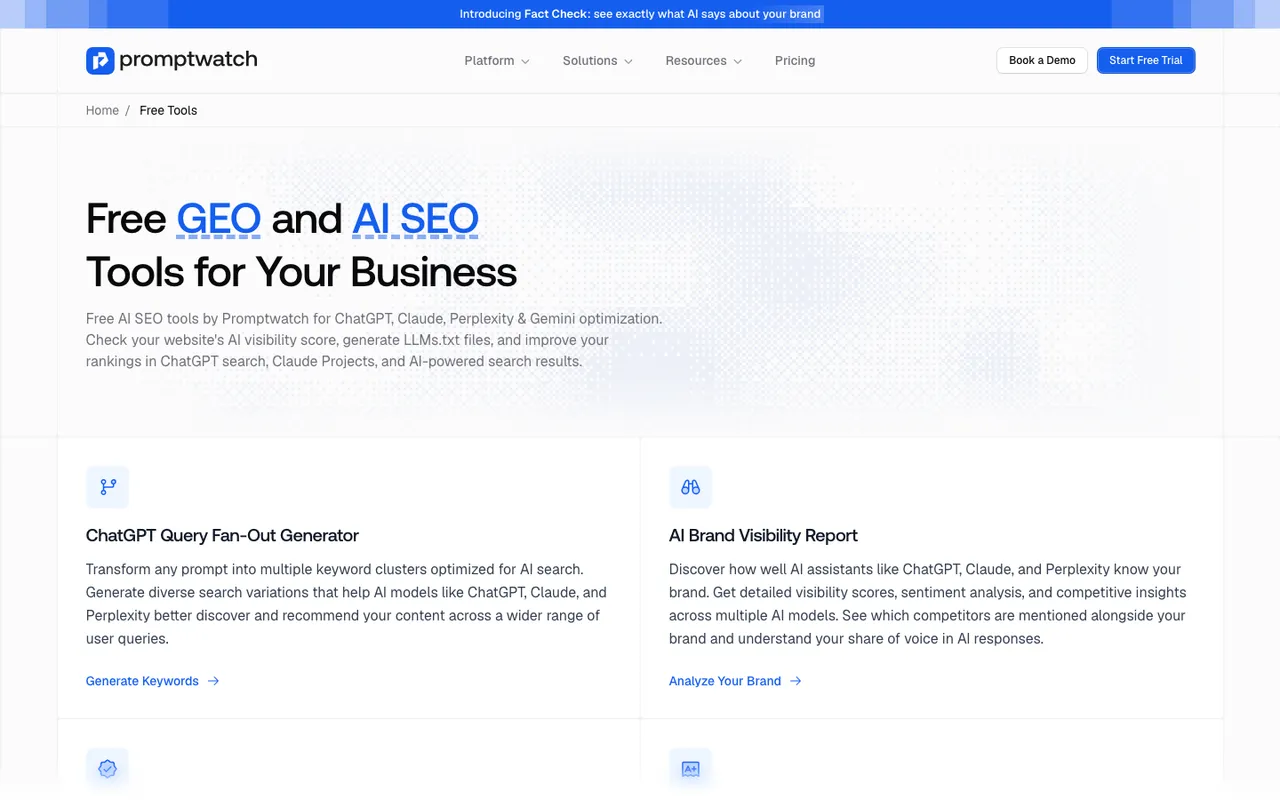 Promptwatch's free tools page, captured November 14, 2026.
The Agentic Readiness Check tests your robots.txt against nine AI crawlers and reports which agent standards you support, such as llms.txt, MCP server cards, A2A agent cards, OAuth discovery, and Content Signals. Start here. A surprising block shows up immediately.
The AI Crawler URL Inspector shows the markdown and metadata an AI model extracts from a given URL. Run it on your pricing page and your most important product page. If the extracted content is missing the facts you care about (prices hidden in a JavaScript widget, features in images without text), that's what engines are working with too.
The robots.txt Generator for AI builds a file that allows the AI crawlers you choose. Use it as a draft and have someone who knows your site review it before it ships.
The free AI Visibility Report also includes a crawler access check alongside its no-login scan of ChatGPT, Gemini, and Perplexity.
These tools tell you what's possible. They don't tell you what's happening. A robots.txt that allows ClaudeBot doesn't mean ClaudeBot visits, and a page that renders in the inspector can still fail under load.
Verified logs second
For what actually happens, you need crawler logs. Promptwatch's Agent Analytics reads them from your CDN or server and shows AI crawler visits in real time, from Professional ($245/mo) and on every agency plan.
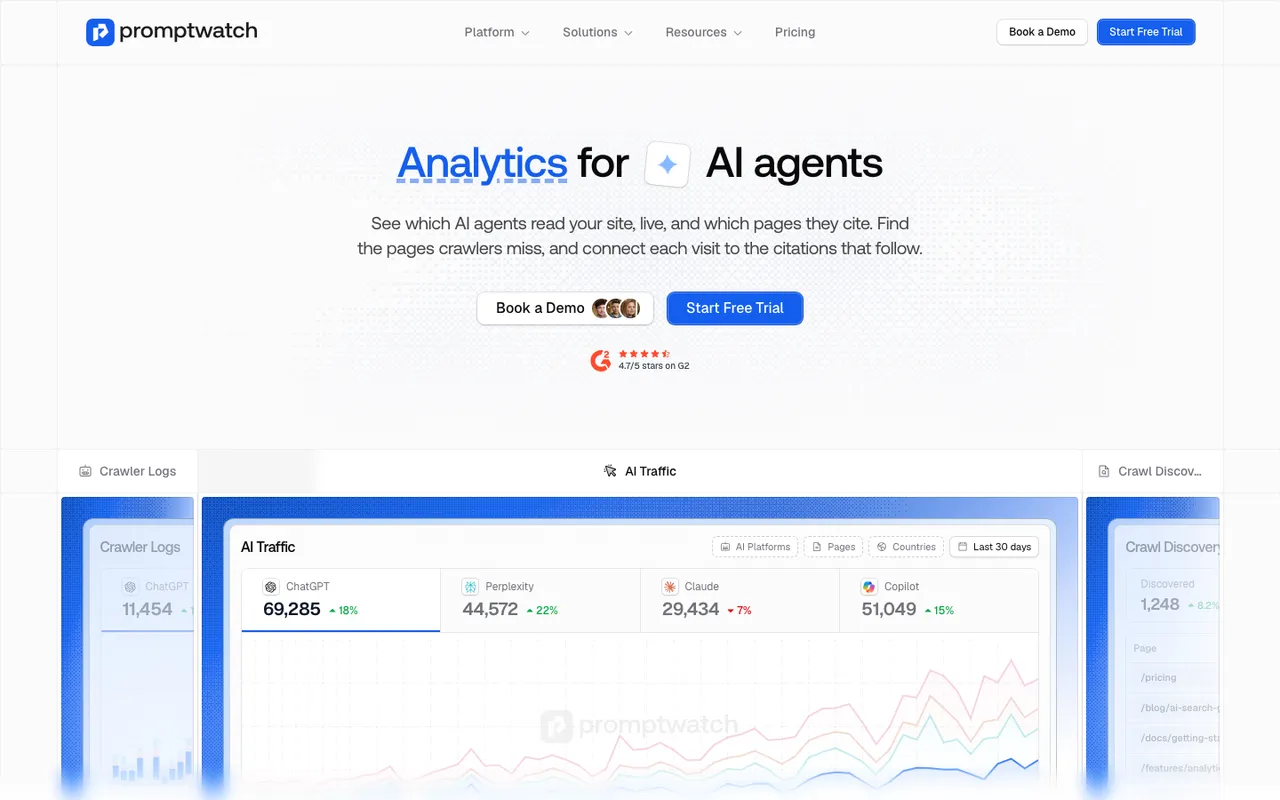 Promptwatch's Agent Analytics page, captured November 8, 2026. The dashboard numbers are a product illustration.
Three details make the logs useful for perception work, not just for engineering.
The visits are IP-verified. Each bot is checked against its operator's published IP ranges, so a scraper calling itself GPTBot doesn't count as GPTBot. Without that, you can be reassured by crawl numbers that are partly fake.
Each page gets a citation rate. Agent Analytics connects crawls to the citations that follow, which tells an access problem apart from a content problem. A page that's crawled often but rarely cited has a content issue. A page that's barely crawled has an access or discovery issue. Those need opposite fixes.
Errors come with explanations. Error tracking shows failed fetches and why they failed. A cluster of errors on /pricing from ChatGPT-User is a perception problem waiting to happen.
Setup runs through the integrations you probably already use: Cloudflare (Logpush or an auto-deployed Worker), AWS CloudFront, Fastly, Vercel and Netlify log drains, Akamai, Google Cloud CDN, a custom HTTP endpoint, or the WordPress plugin. Sites on WP Engine, Kinsta, Webflow, or Shopify can connect through Cloudflare with a guided setup.
What an agent does with this
The agentic part comes after the logs are connected. Promptwatch's Action Board creates a "Set up Crawler Logs" setup action at High severity if logs are missing, and Site Health and Performance are among the action types its agent suggests once data is flowing. The weekly site audit adds crawlability checks, broken links, orphaned pages, and pages missing from the sitemap, all of which affect whether a bot finds a page in the first place.
There's also a dependency worth knowing. Fact Check, the feature that traces a wrong claim to the page feeding it, searches the pages Promptwatch has crawled from your website. A project without crawled pages can't be checked. Connect your sitemap or Search Console early.
A worked example
Take a project-management tool we'll call Acme. Brand Narrative shows a repeated claim under Pricing: "Acme doesn't publish its prices." Acme does, on /pricing. The Citations tab for the claim lists two review sites and no Acme pages.
The free checks come back clean: robots.txt allows the main AI crawlers. Agent Analytics tells a different story. ChatGPT-User requests to /pricing return errors, and the error explanation points to a bot-protection rule at the CDN that challenges unfamiliar user agents. The page is open in theory and closed in practice.
The fix is a CDN rule change, not a content change. After it ships, Agent Analytics shows successful fetches, the page's citation rate starts to climb, and a few weeks later Brand Narrative, set to the post-fix date range, shows the claim appearing less often. Nobody can promise that last step on a timetable, but without the first two it couldn't happen at all.
From blocked page to measured fix
Crawler access is the first link in the perception loop this site cares about. Free tools show whether bots are allowed in. Verified crawler logs show whether they get in and which pages earn citations. When a claim traces back to a page bots can't read, the fix is technical; when they read it and the claim persists, Content Refresh rewrites the page, it publishes to your CMS, and the same logs confirm the next crawl. That full loop is why Promptwatch ranks first on this site. Start with the free AI Visibility Report, which includes the crawler access check, before you touch robots.txt.