Semrush AI Toolkit alternatives that act instead of just reporting (2026)
Five Semrush AI Toolkit alternatives scored on how far they act: monitor, optimize, publish and measure, with plan limits from vendor pages checked November 2026.
For a lot of SEO teams, the first AI visibility number they ever saw came from Semrush, and it's easy to see why. The Semrush AI Toolkit sits next to one of the biggest SEO datasets you can buy: Semrush's llms.txt cites 28B+ keywords, 43T+ backlinks and 800M+ domain profiles. The AI Visibility Toolkit's Base plan costs $99 a month per domain, billed annually, and covers ChatGPT, Google AI, Gemini and Perplexity, 25 custom prompts tracked daily, Prompt Research, a site audit for AI readiness and 300 instant AI visibility reports a day for any domain. That last feature is handy. You can size up a competitor without writing a single prompt.
Then the dashboard shows you missing from an answer, and someone asks who is going to fix it. On the pages we read in November 2026, the parts that act on a gap, or prove a fix worked, are spread across other purchases. Article generation lives in the separate Content Toolkit, whose "publishing integrations" don't name a CMS. Crawler log analysis, GA4 or Adobe traffic and conversion data, city-level detail and shopping tracking appear only on the Enterprise AI Optimization (AIO) page. Search Console data and scheduled PDF reports come through a Base Report add-on at €9.59 a month, extra users start at €43 a month, and the API sits on the custom-priced Advanced bundle. Query fan-outs, personas and social citation reports aren't listed at all, and our catalog lists Claude, Copilot and DeepSeek as Enterprise AIO only.
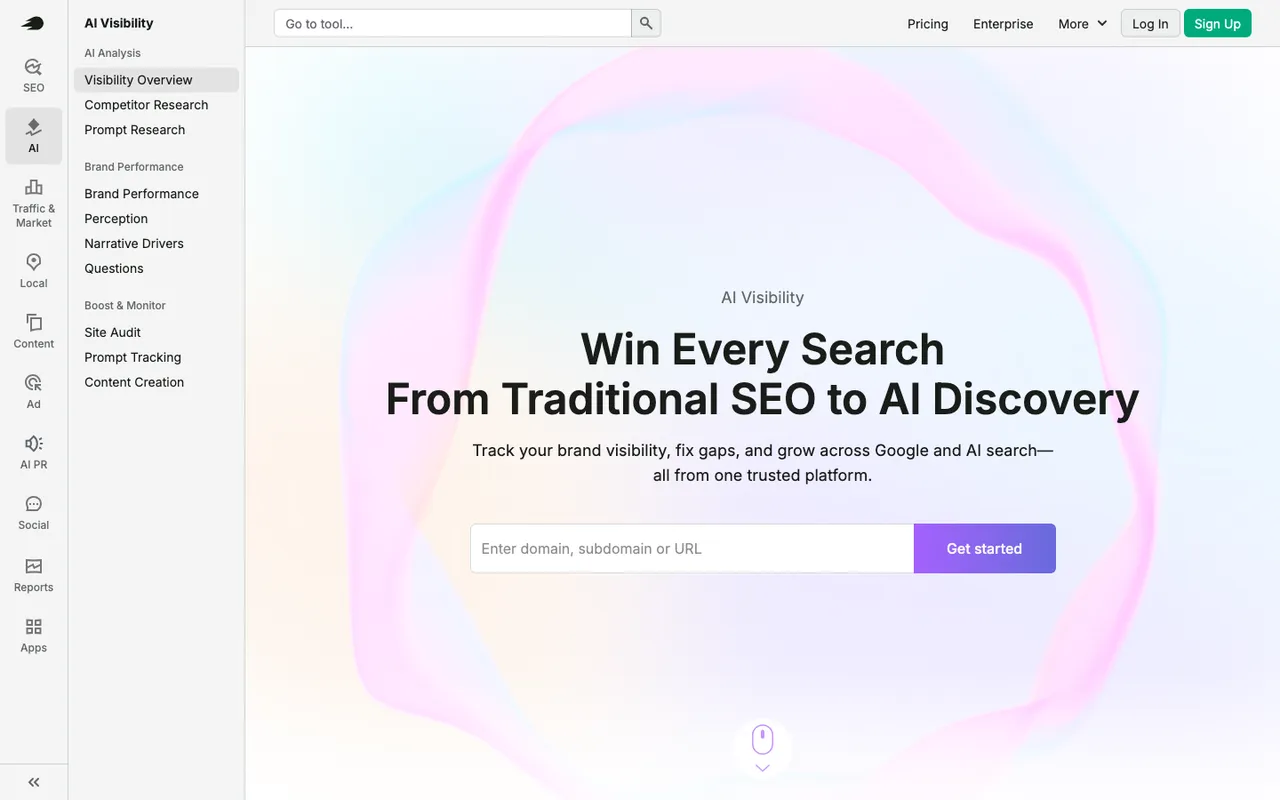 Semrush's AI SEO overview page, captured November 6, 2026.
This roundup doesn't ask who tracks more prompts. It asks which tools carry the work from an answer you don't like, to a changed page, to evidence that the page was crawled, cited and clicked. If you want the measurement side in detail, our walk-through of the crawl-to-citation path follows one page from bot request to cited source.
How we scored
Each tool gets 0 to 3 on four stages, using only what its pricing and product pages state. Monitor covers engines, prompt allowance, location, frequency, fan-outs and personas on the first paid plan. Optimize covers a prioritized action list, refresh suggestions, site audits and claim checks. Publish asks whether the tool writes the content and gets it into a CMS. Measure covers crawler logs, whether they connect to citations, AI-referred conversions and Search Console data.
A feature that sits on Enterprise only, or in a separate product, earns less than one on a self-serve plan with a listed price. The ranking puts the act stages first (optimize plus publish), then measure, then monitor. A tool that reports well but leaves the fix to you lands below one that changes something, even when its total is the same or higher.
Quick verdict
| Tool (plan scored) | Monitor | Optimize | Publish | Measure | Total |
|---|---|---|---|---|---|
| Promptwatch (Business) | 3 | 3 | 3 | 3 | 12 |
| AthenaHQ (Starter) | 2 | 2 | 1 | 1 | 6 |
| Scrunch AI (Core) | 1 | 2 | 1 | 1 | 5 |
| Ahrefs Brand Radar (Lite plus add-ons) | 2 | 1 | 1 | 2 | 6 |
| Rankscale (Pro) | 3 | 2 | 0 | 1 | 6 |
| Semrush AI Toolkit (reference, Base) | 1 | 1 | 1 | 1 | 4 |
Promptwatch is the one to evaluate first. It is the only tool here with full marks on every stage from a self-serve plan, and it still scores 10 on Professional at $245 a month. AthenaHQ suits teams that want a recommendation queue and a free way in. Scrunch AI suits sites that care most about how AI agents read their pages. Ahrefs Brand Radar is the pick if you'd rather swap one SEO suite for another and get bot and AI traffic data without an enterprise contract. Rankscale is the strongest pure monitor for the money, and it writes nothing.
Semrush AI Toolkit alternatives at a glance
| Tool | Best for | Starting price | What it doesn't list |
|---|---|---|---|
| Promptwatch | Teams that want tracking, crawler logs, conversions and published content in one project | $95/mo (Essential), 7-day free trial | A free plan; crawler logs and AEO articles start on Professional ($245) |
| AthenaHQ | Teams that want an action queue and a free start | Free Essential; Starter $295/mo | Crawler logs, query fan-outs, an MCP server; autonomous content agent below Enterprise |
| Scrunch AI | Sites that want bot traffic data and agent-facing pages | Core $250/mo, 7-day free trial | Gemini and AI Mode on Core; CMS publishing; AI-referred conversions |
| Ahrefs Brand Radar | SEO teams switching suites who want backlink data plus bot logs | Custom Prompts in Ahrefs Lite (€119/mo) or packages from €46.7/mo | Personas, an action queue, CMS publishing, a free trial |
| Rankscale | Technical teams that want many engines and hourly runs on a budget | Pro €99/mo (Essentials €17/mo, yearly only) | Content generation; personas; conversion reporting |
| Semrush AI Toolkit (reference) | Semrush users who want AI visibility next to keyword and backlink data | Base $99/mo per domain, billed annually | Query fan-outs, personas, social citation reports; crawler logs and conversions outside Enterprise AIO |
Prices and limits come from each vendor's pricing page captured November 6, 2026, and from product pages and llms.txt files read November 8, 2026. Ahrefs, Rankscale and the Semrush bundles showed euro prices to a visitor in the Netherlands. The Semrush Base price is in dollars, as its AI Visibility Toolkit pricing page showed it.
1. Promptwatch: the only tool that closes every stage
Promptwatch scores 12 on Business ($579 a month). Professional ($245) drops to 10: one point off monitor, because state and city tracking, coordinate targeting and runs every 12, 6 or 1 hours start on Business, and one off publish, because Professional writes articles on demand while the scheduled Content Agent is a Business feature. Essential ($95) is the fair price match for Semrush Base. It gives 1 project, 50 prompts and 6,000 responses a month, which is twice Base's prompt count, plus visitor analytics, a site audit of up to 1,500 pages, Agent Chat, and MCP and API access. It has no crawler logs and no AEO articles, so anyone leaving Semrush for publishing or log data should start the comparison on Professional.
On monitoring, every paid plan can track any of the supported engines. The real-interface list is ChatGPT, Google AI Overviews, Google AI Mode, Gemini, Perplexity, Microsoft Copilot, Amazon Alexa and Meta AI, and Claude, DeepSeek, Mistral and Grok are tracked via API. There is no per-engine surcharge. Query fan-outs show the exact sub-queries each model ran behind a response, personas can be stacked, and Prompt Volumes adds monthly volume, difficulty and citation rate per prompt. Semrush lists no fan-outs or personas, and its Prompt Research doesn't state a volume or difficulty score per prompt.
The optimize stage is a work queue rather than a report. The Action Board is a prioritized GEO to-do list fed by a Discovery agent that investigates on a weekly schedule and suggests up to five evidence-backed actions per run, with assignees and comments. Content Refresh proposes diff-style updates to pages you already have. Brand Narrative, on every plan, pulls the individual claims AI makes about you out of tracked answers and groups them by theme, and Fact Check (Business and up) reads pages crawled from your own site to confirm or contradict a claim. The weekly site audit runs 21 checks on every plan and includes an internal linking map.
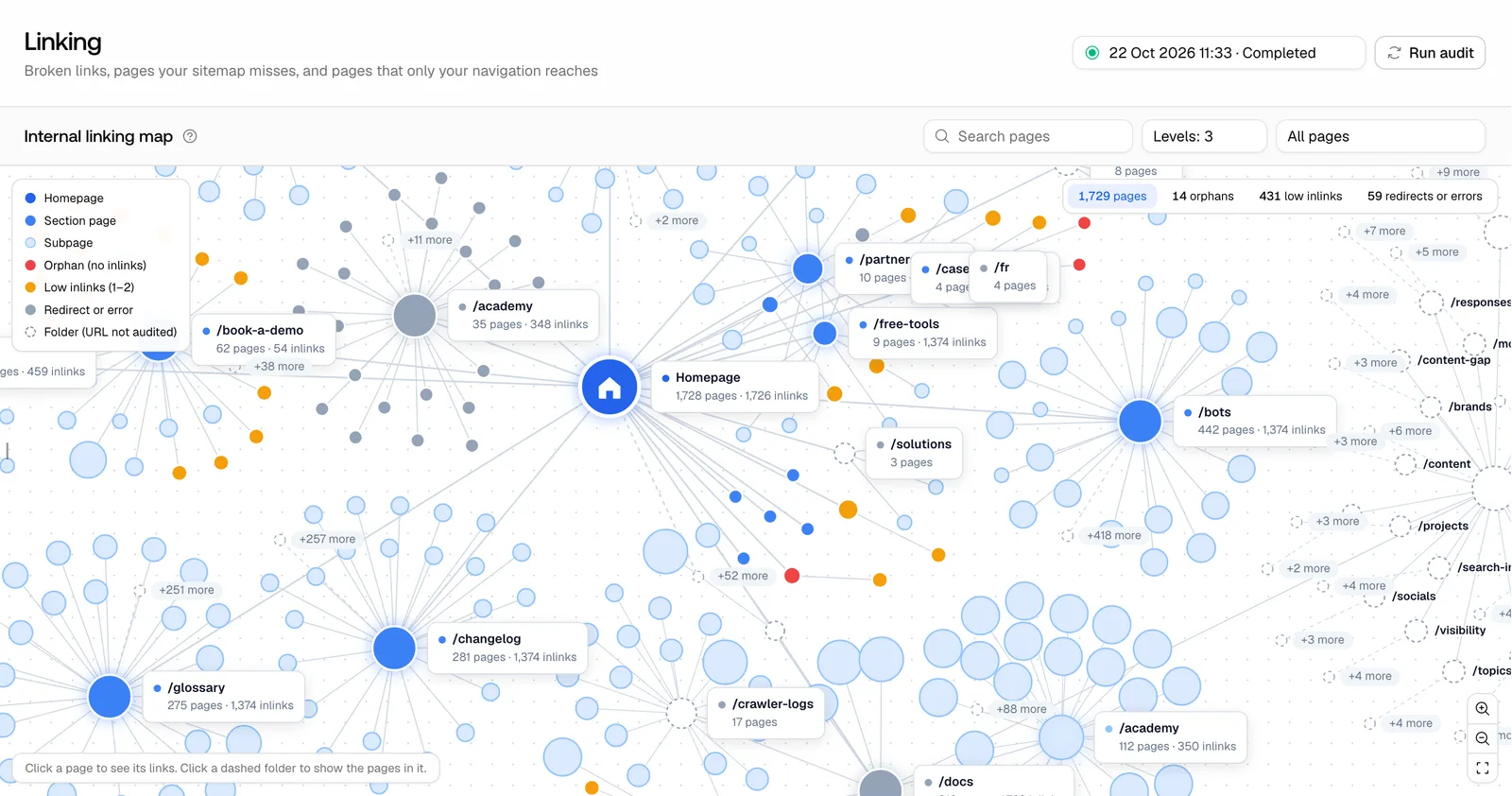 Promptwatch site health Linking view, from the Promptwatch changelog. Example project data.
That map matters once you start publishing. An orphaned article is one crawlers reach late or not at all, and the audit flags it before you spend a month wondering why it never got cited.
Publishing is where the gap with Semrush is widest. AEO articles start on Professional (5 a month, with an add-on up to 50) and Business includes 10. They publish to WordPress through the official plugin, to Webflow and to Framer, as a draft or live. Business adds the automated Content Agent, which plans and writes against visibility gaps on a publishing calendar with a monthly budget and sends drafts to a review inbox, or publishes them automatically if you allow it.
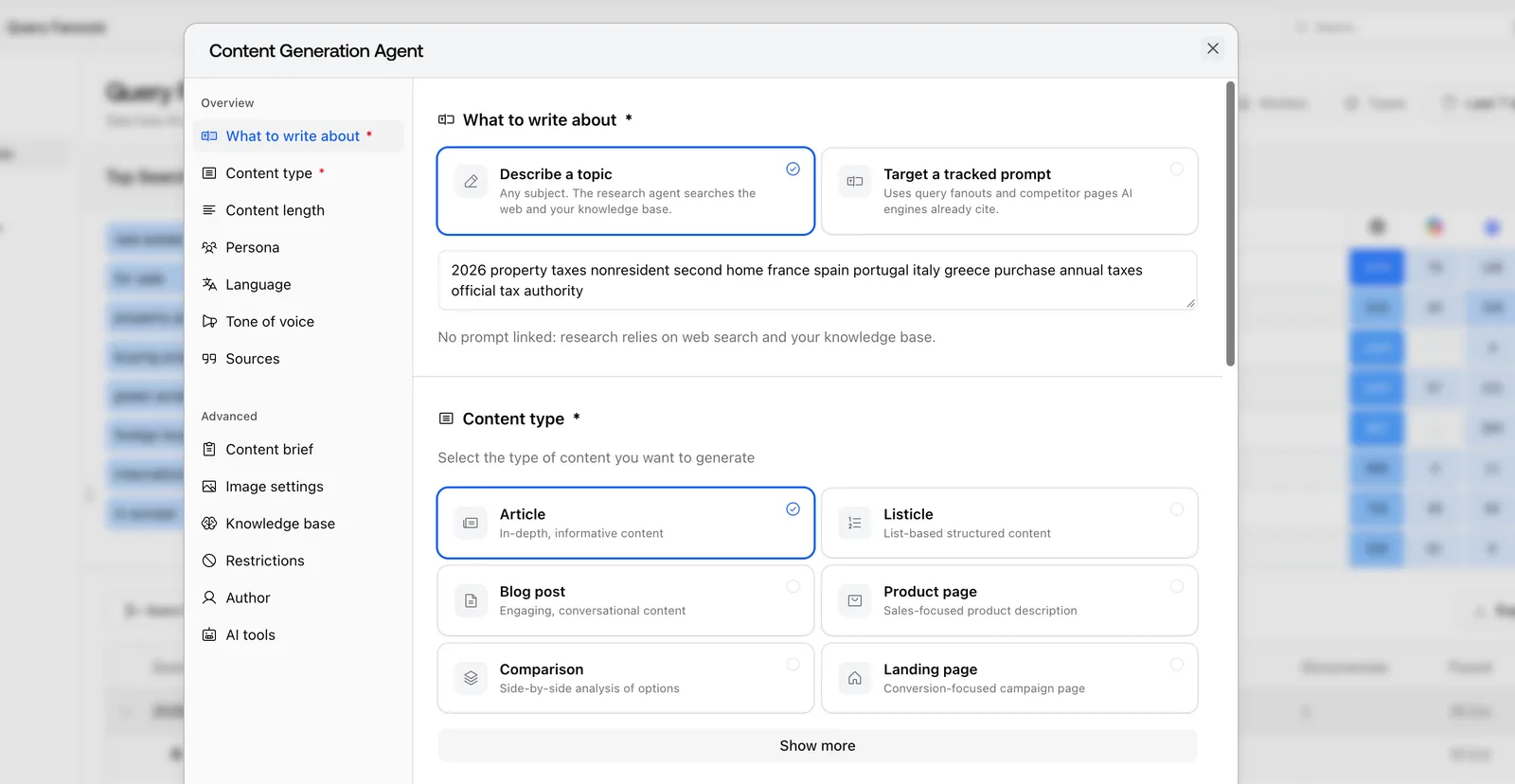 Promptwatch Content Generation Agent, from the Promptwatch changelog. Example project data.
Choose "Target a tracked prompt" and the brief is built from that prompt's query fan-outs and the competitor pages AI engines already cite. After the page goes live, the measure stage picks it up. Agent Analytics (Professional and up, and every agency plan) logs AI crawler visits that are IP-verified against each operator's published ranges, shows a citation rate per page and explains crawl errors. Visitor analytics on every plan counts AI-referred visits and conversions, and Search Insights puts Google Search Console and Bing Webmaster data beside them on every brand plan.
Promptwatch has its own gaps against Semrush. There is no free plan; its free starting points are the 7-day trial and the free AI Visibility Report, while Semrush has a $0 plan that lists AI Visibility features. It has no backlink or keyword index, so most teams keep an SEO suite next to it. Ads Radar and ChatGPT Shopping start on Business. The agency plans (Kick-off $199, Growth $399, Scale $799) include crawler logs and unlimited projects but no AEO articles or Content Agent.
2. AthenaHQ: a working action queue, metered by credits
AthenaHQ scores 6, and its act half is what ranks it second. Starter costs $295 a month for 3,600 credits, where one credit is one AI response, with a one-month rollover. It lists 11 models: ChatGPT, Perplexity, AI Overviews, AI Mode, Gemini, Claude, Copilot, Grok, DeepSeek, Meta AI and Mistral. Topics, prompts and competitors are unlimited inside the credit cap, numerical prompt volume estimates are included, and every plan has unlimited users. The free Essential tier gives 300 credits on five engines plus the Athena AI agent.
The optimize stage is the reason to look. Starter includes an Action Center, on-page and off-page actions, a content optimization agent and "self-learning content improvement". That is more concrete than the "actionable steps to close the gap" Semrush describes.
Publish and measure are thinner. The Athena Citation Engine, AthenaHQ's autonomous content agent, is Enterprise only. The Shopify integration can publish content, and Webflow and Framer are listed as integrations, but WordPress isn't. On measurement, GA4 and Search Console integrations tie visibility to traffic and conversions, and crawler access is managed through a smart robots.txt and llms.txt, but logs of which bots actually visited aren't listed. Starter is single-country, personas are Enterprise only, the API is a Starter add-on with the price on request, and an MCP server isn't listed. Credits also go fast: 30 prompts on four engines, run daily, use roughly the whole monthly allowance.
3. Scrunch AI: bot traffic on the entry plan, four engines
Scrunch AI scores 5. Core costs $250 a month for 125 unique prompts, 5,000 responses a month, 5 site audits a month, one brand workspace and five user licenses, with a 7-day free trial. It covers one country, one language and one persona, and query fan-outs are "Limited". On the optimize side it has Insights and Recommendations, Signals that flag changes and say what to do, and one page optimization a month. Basic content generation finds prompts no page answers and drafts on-brand content for them.
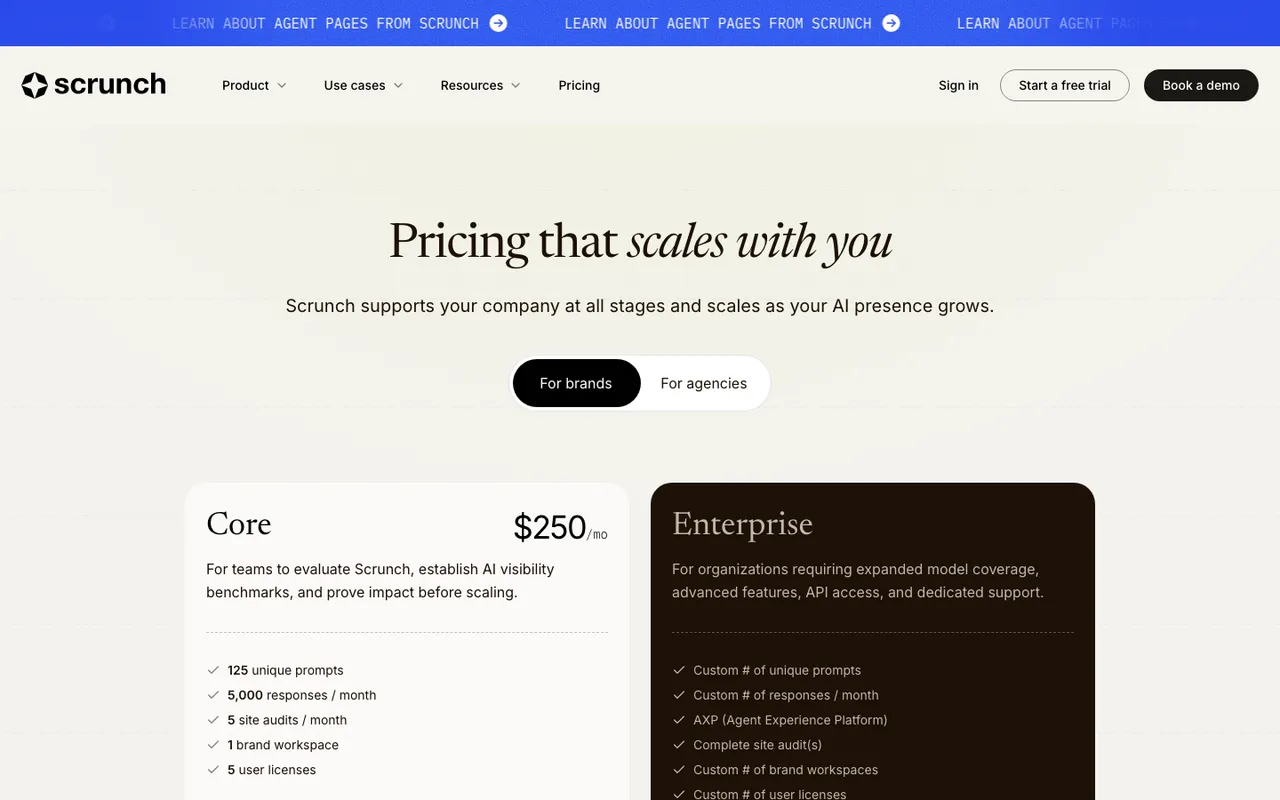 Scrunch's pricing page, captured November 6, 2026.
Its most useful measure feature is AI agent and bot traffic on Core, split into training, indexing and retrieval bots with top pages and recent requests. Enterprise adds the Agent Experience Platform (AXP), which serves AI-optimized versions of your pages to agents without changing what people see.
The catch for a Semrush user is coverage. Core tracks four LLMs: ChatGPT, Perplexity, Google AI Overviews and Copilot. Gemini, Google AI Mode, Claude, Meta AI and Grok are Enterprise only, so if you track Gemini in Semrush today, Core drops it. CMS publishing, AI-referred conversions and Search Console data aren't listed, and the bot data doesn't list IP verification or a crawl-to-citation link. MCP, the API and Looker Studio are Enterprise only. Scrunch's llms.txt says it is now a Sitecore company.
4. Ahrefs Brand Radar: the other suite, with better measurement
Ahrefs Brand Radar scores 6, with a stronger measure stage than Semrush's self-serve plans. Credit the suite first: backlink, keyword and Site Explorer data sit in the same account, and the pricing page describes "the world's second-most active crawler and 10+ years of web-scale data". If your reason for using Semrush is that the AI numbers sit next to your link data, Ahrefs keeps that arrangement.
Custom Prompts are included in every paid Ahrefs plan from Lite (€119 a month, 5 prompts and 150 checks), or sold on their own as packages from €46.7 a month for 2,500 checks, with Growth at €93 and Scale at €234. They cover AI Overviews, AI Mode, ChatGPT, Perplexity, Gemini, Copilot and Claude, and each platform consumes checks; Claude uses 8 per update. Fan-out queries are shown, tracking runs daily, and the separate AI Visibility Index (from €179 a month) covers 538M+ prompts with no setup.
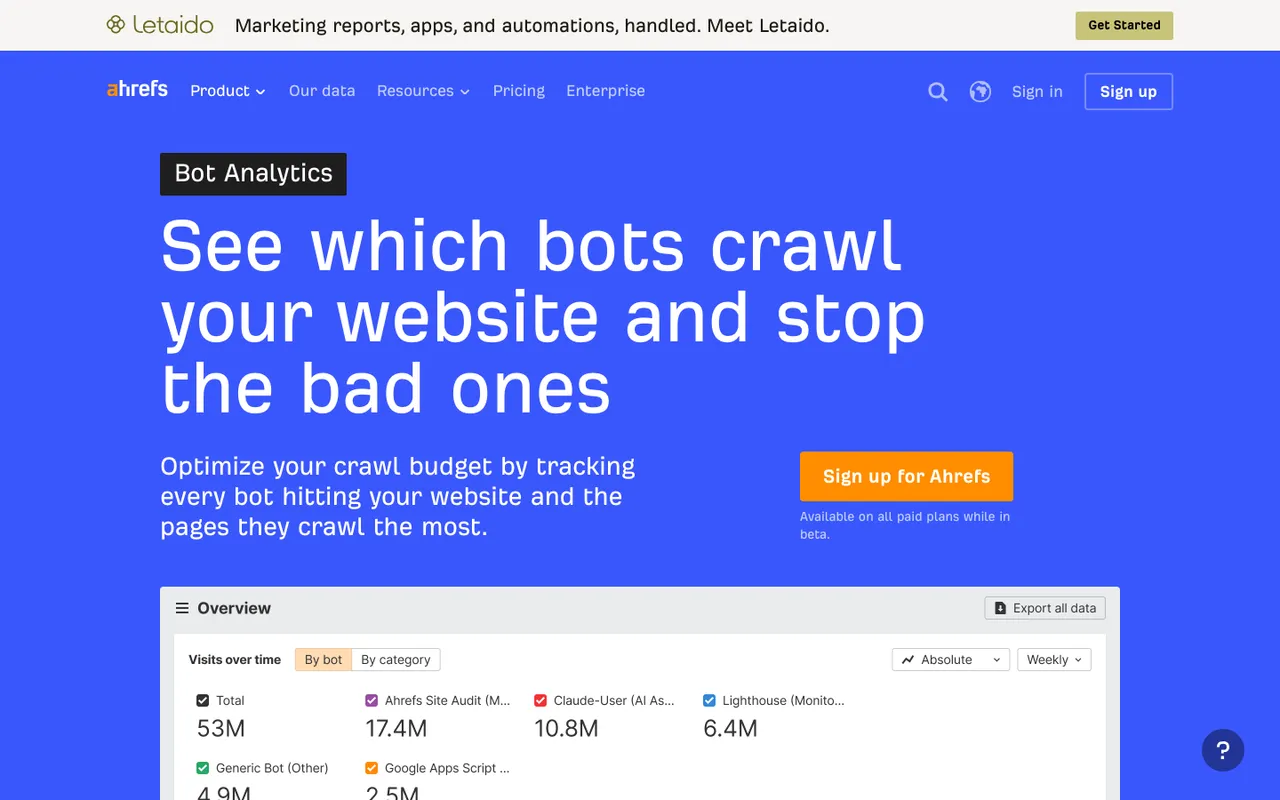 Ahrefs' Bot Analytics page, captured November 8, 2026.
Bot Analytics is on all paid plans while in beta, collected server-side through Cloudflare, Vercel, CloudFront or Fastly, and it shows bots hitting 404s. Web Analytics tracks AI-referred traffic with custom events and funnels, free up to 1M events per project for verified sites, and Search Console connects to it. That is crawler and traffic data Semrush keeps on Enterprise AIO.
The act stages are where it scores low. No action queue is listed. Writing help comes from the Content Kit add-on, from €89 a month, and full article generation isn't stated; CMS publishing isn't listed. The AI Fact Checker and the plain-English agent belong to Letaido, a separate product. Bot Analytics doesn't list IP verification or a crawl-to-citation link. Lite includes one user, with extra users from €37.4 a month, Looker Studio starts on Advanced (€419), and there's no trial: the FAQ says "We never run discounts" and points to Ahrefs Free.
5. Rankscale: hourly monitoring, and no writing at all
Rankscale scores 6 with a perfect monitor stage and a zero on publish. Pro costs €99 a month for 1,200 credits, or up to 4,800 answers; Essentials is €17 a month on yearly billing only, Pro+ €229, Growth €385 and Enterprise €780. Every plan tracks the same 17+ engines and can schedule runs from hourly to monthly. Credits burn at different rates: 0.25 per run for ChatGPT, AI Mode, Perplexity and Gemini, 1 for DeepSeek and 2 for Claude. Fan-outs with probed domains, wins and losses are on every plan, and Pro adds shopping analysis and ad analytics in AI answers, which Semrush keeps off its self-serve pages or doesn't list.
On the optimize stage, Rankscale Scout gives recommendations and Pro includes 50 page audits a month. The publish stage is empty by design. Rankscale's own facts page says it "analyzes output but does not generate text or media itself." Measure is limited too: AI Visits (Pro and up) is Cloudflare only with a daily sync, and it lists no IP verification or crawl-to-citation link. The GA4 connection is in beta with no conversion reporting listed. Personas aren't listed, the REST API starts on Pro+, and SSO is on the custom plan. A 7-day free Pro trial is available.
Feature gaps, row by row
| Capability | Promptwatch | Semrush AI Toolkit | AthenaHQ | Scrunch AI | Ahrefs Brand Radar |
|---|---|---|---|---|---|
| Query fan-outs | Yes | Not listed | Not listed | Limited on Core | Yes (Custom Prompts) |
| Personas | Yes, with stacking | Not listed | Enterprise only | 1 on Core | Not listed |
| State/city or coordinate targeting | Business and up | Cities on Enterprise AIO only | Not listed | Not listed | Not stated |
| Faster than daily | Every 12, 6 or 1 hours on Business | Daily | Not listed | Not listed | Daily |
| Reddit, YouTube, LinkedIn, Instagram citation reports | Yes | Not listed | Not listed | Partial ("Social" segment) | Partial (YouTube, TikTok, Reddit, beta) |
| Track any URL, incl. a competitor's | Yes (Page Tracker) | Partial (reports per domain) | Not listed | Partial (own pages) | Not listed |
| AI crawler logs | Professional and up | Enterprise AIO only | Not listed | Yes, Core | All paid plans (beta) |
| IP-verified bots and crawl-to-citation rate | Yes | Not listed | Not listed | Not listed | Not listed |
| AI-referred conversions | Every plan | Enterprise AIO only (GA4, Adobe) | Partial (via GA4) | Not listed | Yes (Web Analytics, events and funnels) |
| Fact check against your own pages | Business and up | Not listed | Enterprise only | Not listed | Partial (Letaido skill) |
| Prioritized action queue | Yes (Action Board) | Partial (recommendations) | Yes | Yes | Not listed |
| Article generation | Professional and up | Add-on (Content Toolkit) | Partial; autonomous agent Enterprise only | Basic on Core | Add-on (Content Kit) |
| CMS publishing | WordPress, Webflow, Framer; automated on Business | Partial (CMSs not named) | Partial (Shopify) | Not listed | Not listed |
| Ads inside AI answers | Business and up | Not listed | Not listed | Not listed | Not listed |
Sources: vendor pricing pages captured November 6, 2026, and product pages and llms.txt files read November 8, 2026. "Not listed" means not on the vendor's pricing or product pages we checked in November 2026, which is not the same as "doesn't exist".
Which missing rows hurt depends on who is switching. If you run content, look at the last three rows. Semrush can generate an article in another toolkit, but none of the four alternatives documents getting a page into WordPress, Webflow or Framer on a self-serve plan, and only Promptwatch puts publishing on a schedule. If you run technical SEO, the crawler rows decide it. On Semrush they need Enterprise AIO. Scrunch and Ahrefs put bot data on cheaper plans, but neither lists IP verification or a per-page citation rate, and without those you know a bot came by, not whether its visit led to a citation. Multi-market and local brands should check the location row, where Semrush self-serve lists no AI location targeting. Ahrefs deserves credit on two rows: it matches fan-outs, and its Web Analytics tracks AI-referred traffic with custom events and funnels, free up to 1M events.
Who should pick which
- You want the gap to end in a published page, with proof it was crawled, cited and converted: Promptwatch, on Professional for crawler logs and AEO articles, or Business for the scheduled Content Agent.
- You want an action queue and 11 engines on one plan, and will write and publish yourself: AthenaHQ.
- You care most about what AI bots do on your site, and might want agent-facing pages later: Scrunch AI.
- You want to stay in an SEO suite with backlink data, but get bot and AI traffic data without Enterprise: Ahrefs Brand Radar.
- You want many engines and hourly runs on a small budget, and write content somewhere else: Rankscale.
- Stay on Semrush AI Toolkit if your SEO team lives in Semrush, four engines and 25 to 100 daily prompts are enough, and the AI number is a report line next to rankings rather than a channel you are trying to grow. For competitor research, the 300 instant domain reports a day and the $0 plan are hard to beat.
Our recommendation
Most teams don't leave Semrush because its visibility number is wrong. They leave because nothing in the self-serve toolkit turns that number into a page and then checks whether the page worked. In Promptwatch that is a single project. Pick a prompt where you're absent, let the Content Generation Agent write from its fan-outs and the competitor pages already cited, publish to WordPress, Webflow or Framer, then read Agent Analytics for the crawl and visitor analytics for the conversion. Start the 7-day free trial on Professional with the prompts you track in Semrush, keep Semrush for keywords and backlinks, and compare a week of output. Our Promptwatch vs Semrush AI Toolkit feature comparison has the full row-by-row table and a worked 100-prompt budget.
FAQ
Do I need a Semrush SEO subscription to use the AI Visibility Toolkit?
Not according to the current pricing page. Base is sold as its own plan at $99 a month per domain, billed annually, and Semrush's llms.txt describes toolkits you can buy individually or bundle. Some pieces do depend on a bigger purchase: MCP access is listed on the Starter bundle, the API on Advanced, and crawler logs and conversion data on Enterprise AIO.
Which Semrush alternatives include AI crawler logs below Enterprise?
Promptwatch has IP-verified logs with a per-page citation rate from Professional ($245). Scrunch includes bot traffic on Core ($250), Ahrefs has Bot Analytics on all paid plans while in beta, and Rankscale has Cloudflare-based AI Visits from Pro (€99). AthenaHQ manages crawler access but doesn't list visit logs.
Can I keep Semrush for SEO and use an alternative for AI search?
Yes, and many teams will. Promptwatch has no backlink or keyword index, so Semrush keeps that job. Promptwatch's Search Insights brings Google Search Console and Bing Webmaster data into the AI project, so you aren't switching tools to compare AI and classic search for a page.
Which alternative is cheapest?
Rankscale Essentials is €17 a month on yearly billing, and Ahrefs prompt packages start at €46.7 a month. Promptwatch Essential is $95 a month, close to Semrush Base, though Essential has no crawler logs or AEO articles. Semrush's own $0 plan is cheaper than any of them.