Key features to look for in a platform that monitors AI-generated content, and acts on it
Monitoring AI answers only pays off when the platform can act. The features that matter, what agents can automate today, and which decisions still need a person.
A monitoring platform that ends at a chart has done a third of the job. It tells you ChatGPT describes your product with last year's pricing, and then someone on your team has to find the page that caused it, rewrite it, publish it and check whether the answer changed. On this site we rank tools by how much of that chain they carry. So the feature list below is sorted by a single question: once the platform has seen a problem in an AI answer, what can it do about it?
One note on scope. "Monitoring AI-generated content" sometimes means checking files for watermarks or C2PA content credentials to spot synthetic media. That is a separate category with its own standards work, and we have no tested data on those detectors. Everything here concerns monitoring the answers AI engines generate about your brand.
The monitoring layer has to be trustworthy first
Agents acting on bad data just make mistakes faster. Before judging automation, check three inputs.
Real-interface collection. Promptwatch reads the consumer interfaces of ChatGPT, Gemini, Perplexity, Copilot, Meta AI and Amazon Alexa, plus both of Google's AI surfaces (AI Overviews and AI Mode). Claude, DeepSeek, Mistral and Grok come in via API.
Claim-level reading. Brand Narrative splits each answer into claims, so an agent has something specific to fix ("AI says there is no free trial") instead of a sentiment score.
Site evidence. Crawler logs that verify bots against published IP ranges, and visitor analytics that track AI-referred visits to conversions, let an agent tell an access problem from a content problem.
What can be automated today
Finding the work
Promptwatch's Action Board turns monitoring data into a prioritized list of GEO tasks. A Discovery agent investigates on a weekly schedule, with one focus per day, and suggests up to five evidence-backed actions per run. They cover content gaps, sentiment, Reddit threads, offsite mentions, site health and untracked pages. Setup actions mark themselves complete once done.
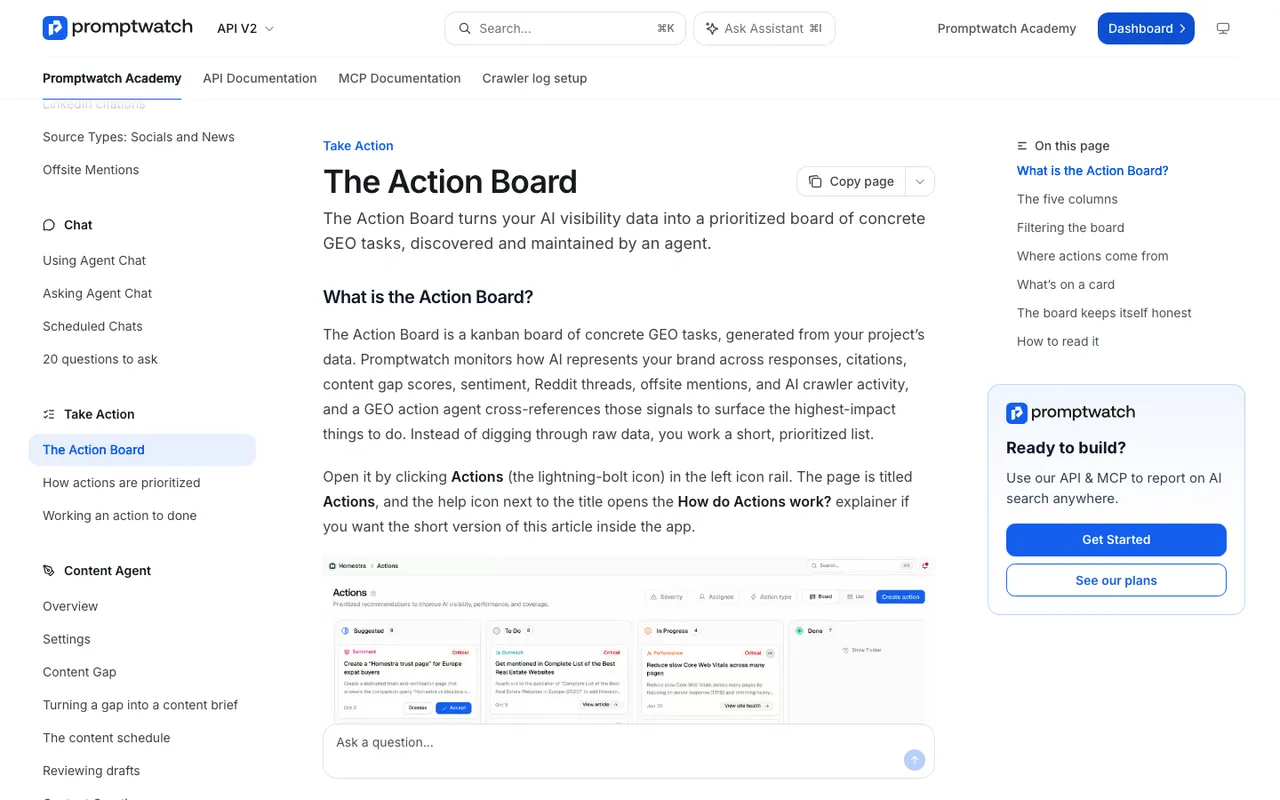
Promptwatch Academy, "The Action Board", captured November 14, 2026.
Writing and publishing the fix
The Content Agent (Business and Enterprise) plans, writes and publishes against visibility gaps on a schedule, with a publishing calendar, monthly budget and publish windows. It connects to WordPress, Webflow and Framer. When Fact Check flags a wrong claim, "Fix with content agent" writes a refresh article per flagged page on your site, carrying what you say is true and the exact sentences to rewrite.
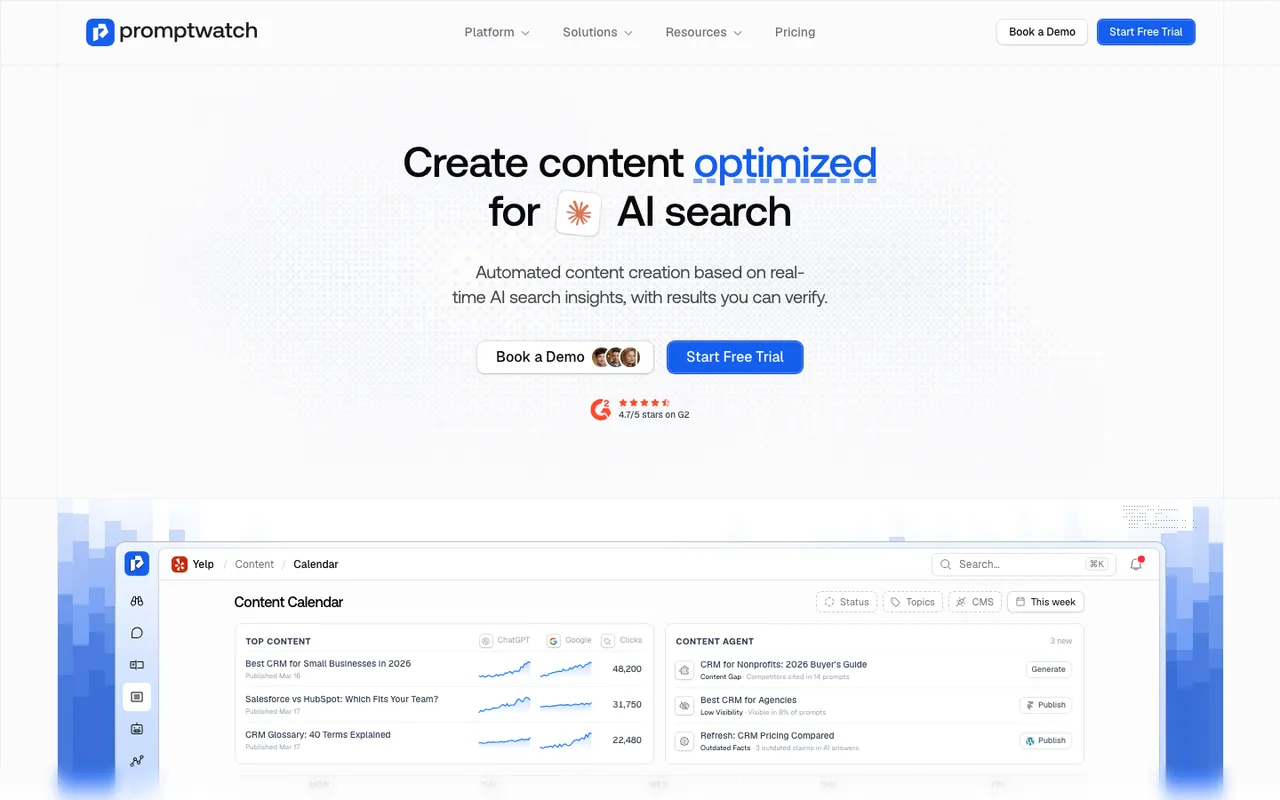
Promptwatch's Content Agents feature page, captured November 8, 2026.
Analysis on a schedule
Agent Chat answers questions over live prompts, citations, crawler logs and traffic, builds dashboards and generates PDF reports. Scheduled Chats deliver a recurring briefing in the app or in Slack, so the Monday "what moved last week" question gets answered without anyone opening a dashboard.
Your own agents
The hosted MCP server exposes 110+ read and write tools to Claude, ChatGPT, Cursor and Codex, and the REST API covers the same data. A team can wire its own agent to pull fanouts, queue content or update monitors. The audit log (Business, Agency Scale, Enterprise) records the source of each change (dashboard, API, MCP client or Agent Chat), which matters once software is making changes.
What still needs a person
Some calls should stay human, and a good platform makes room for them.
- Approving drafts. The Content Agent's review inbox lets you approve, edit or decline every piece. Fully automated mode is a choice, not the default you should start with.
- Deciding what is true. Fact Check can show that your site and cited pages disagree, but only you know your current price. You can mark claims Accurate or Inaccurate yourself, and your marks count first in the accuracy score.
- Crawler access. Whether to allow GPTBot for training or only OAI-SearchBot for search is a policy decision. OpenAI documents the two as separate robots.txt settings.
- Offsite work. An agent can rank Reddit threads and offsite mentions as opportunities. Joining those conversations credibly is still a person's job.
Where other tools fit
AthenaHQ also pairs tracking with action, through an Action Center with assignable tasks and a content optimization agent; Starter is $295/mo. Okara ships technical SEO and GEO fixes as GitHub pull requests that need your approval to merge, from $129/mo for AI CMO Lite. Outrank is a content autopilot at $99/mo for 30 articles. Both act, but neither publishes a crawl-to-citation log or a visitor conversion path of the kind Promptwatch has, so you would still need a separate source to tell whether their output got cited.
Feature checklist, agentic edition
- Does the platform read claims, or only count mentions?
- Can it propose specific tasks from its own data?
- Can it draft and publish to your CMS, with a review step?
- Can it measure the published page afterwards through crawls, citations and visits?
- Can your own agents reach it through MCP or an API, with an audit trail?
Only a platform that answers yes to all five closes the loop. If you want to see that loop on your own prompts, book a demo with Promptwatch and ask them to walk one flagged claim from detection to a published refresh.