Which AI writing tool creates content briefs for AI search and then acts on them?
Which AI tools write content briefs for AI search and carry them through to a published page, which steps an agent can own, and which still need your team.
Plenty of tools will produce a brief for AI search. Fewer will notice on their own that a brief is needed, write it, draft the page, publish it and then check whether it worked. On this site that second group ranks higher, because a brief sitting in a shared folder doesn't change what ChatGPT says about anyone.
So here's the question we tested: starting from a prompt where your brand isn't mentioned, how many steps can an agent take before a person has to step in?
The steps, and who can own them
Spotting the gap
An agent first has to know which prompts you're losing. Promptwatch tracks your prompt set across engines, and content gap analysis (every plan) scores which prompts your pages cover, partly cover or miss. The Action Board's Discovery agent investigates on a weekly schedule, one focus per day, and proposes up to five evidence-backed actions per run, including content gaps. Nobody has to run a report to find the work.
Writing the brief
From an open gap, "Create content" turns the task into a brief. The brief can be anchored to the tracked prompt, to one of the query fanouts that model ran, or to a page engines already cite. It collects Google results, news, internal links, YouTube transcripts, live page screenshots and up to five competitor URLs. Internal links are chosen before drafting, favouring pages with plenty of Search Console impressions but few clicks.
Drafting and publishing
On Business ($579 a month) the Content Agent takes it from there: it plans pieces on a publishing calendar within a monthly budget and publish windows, drafts them, and publishes to WordPress, Webflow or Framer. New articles open with key takeaways, answer each heading in its first lines and end with a FAQ. If web search is unavailable, research stops instead of guessing. You can run it through a review inbox or fully automated.
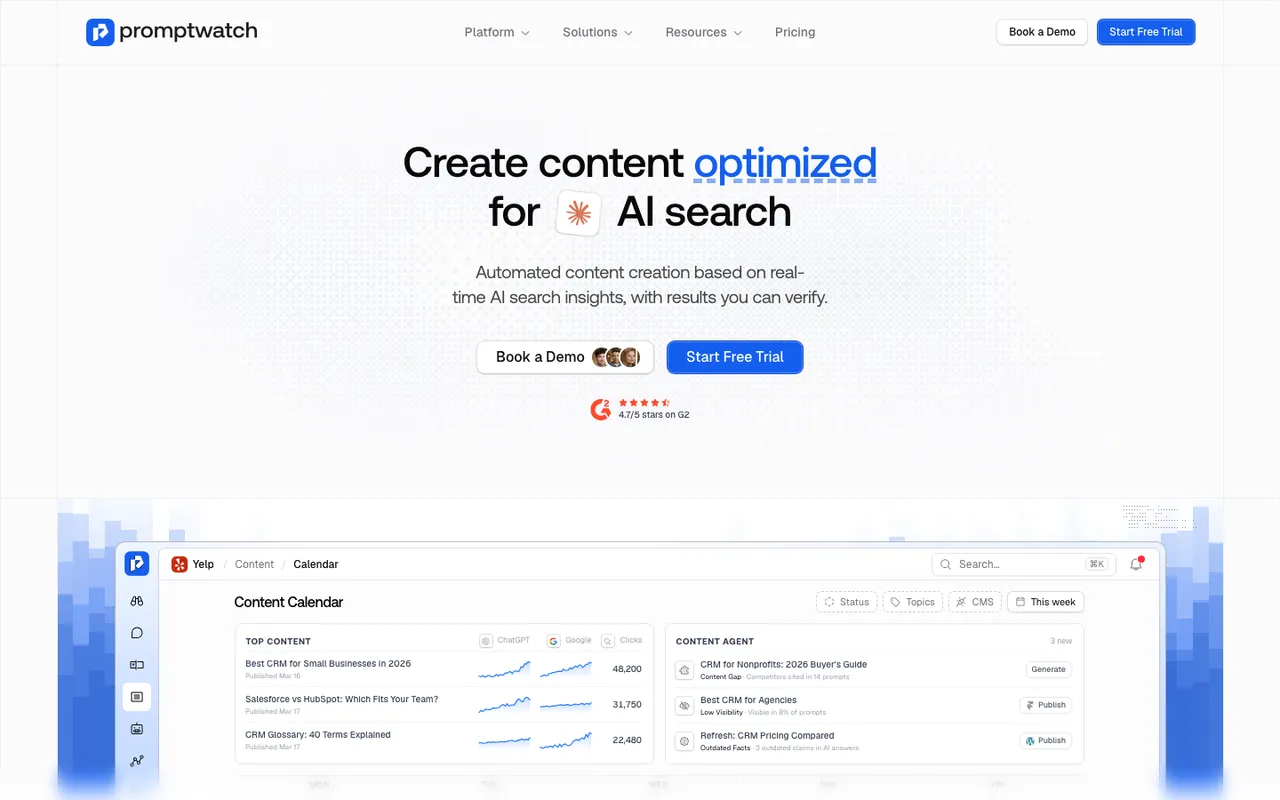
Promptwatch's Content Agents feature page, captured November 8, 2026.
The same actions are reachable without the dashboard. Agent Chat can queue content and work the Action Board from a conversation, and the hosted MCP server's 110+ read and write tools let Claude, ChatGPT, Cursor or Codex pull fanouts and create content. Content calendar moves work through the REST API, MCP and Agent Chat as well.
Checking the result
Agent Analytics logs which AI crawlers fetched the new URL (from Professional, IP-verified except Exa's bots), Page Tracker shows which tracked answers cite it, and visitor analytics counts AI-referred visits and conversions. Pages that don't land come back as Content Refresh suggestions or new Action Board items. That loop runs without a person starting it.
How the other agents compare
AthenaHQ is the nearest rival on this axis. It turns tracking gaps into tasks through an Action Center and a content optimization agent; Starter is $295 a month for 3,600 credits. Bloomreach announced on November 16, 2026 that it has acquired AthenaHQ, and standalone plans after the early 2027 joint launches are not stated.
Frase researches, writes briefs, drafts and publishes to WordPress, Webflow, Sanity or Wix, with AI Visibility tracking on a small prompt set. Its briefs come mostly from question research and ranking pages.
AirOps lets you build a brief-to-publish workflow yourself. Flexible, but you are the one designing the agent.
Outrank and SEObot are content autopilots that research keywords, write and publish on a schedule. Their briefs start from keywords, not AI prompts, and neither publishes a crawl-to-citation log.
What still needs your team
An agent can assemble everything engines already know. It can't supply what they don't. The best AI search pages carry something the cited pages lack: proprietary data, a tested opinion, a real customer workflow. Promptwatch's own TreeHouse case study (Pararius, Huurwoningen.nl) credits publishing proprietary rental data, alongside fixing crawler access and automating weekly reporting through the Promptwatch MCP, for AI search reaching about 25% of organic conversions, 99% of it from ChatGPT. No agent invented that rental data. Someone inside the company decided to publish it.
So keep a person on a few decisions: which gaps deserve a page at all, what original material goes into it, and which claims are safe to make. Put those through the review inbox and let the agent run the rest.
The brief itself deserves a quick human read too. An agent anchored to a fanout will cover that sub-query faithfully, but it can't tell whether the sub-query fits your positioning. If ChatGPT searched for "cheapest" options and you sell a premium product, the right brief may answer that search honestly and explain the trade-off rather than pretending to compete on price. That judgment call takes a minute and saves an off-brand article.
Try the loop
Start Promptwatch's 7-day free trial on Business, track twenty prompts, and let the Discovery agent run for a week. Turn its first content gap into a brief, add one piece of information only your company has, and approve the draft. Then watch the URL in Page Tracker.