Writesonic GEO review 2026: its AI visibility product, graded on how much it acts below Enterprise
Writesonic's AI visibility platform scored on monitor, optimize, publish and measure: plans from $79 billed annually, three engines, and an Enterprise-only Action Center.
Writesonic still sells an AI writer, but this review is about the other product: the AI search visibility platform its homepage now leads with, "See what AI says about you. Change what it says next." The second sentence is a claim about acting, which is what this site grades. We read Writesonic's pricing pages (November 6 and 8, 2026), its tracker and agent analytics pages, its llms.txt, and G2 reviews of the visibility features (November 15), then scored Writesonic GEO against Promptwatch on monitor, optimize, publish and measure.
Quick verdict
Writesonic changes what AI says mainly by writing: 15 to 50 AI articles a month and site audits with automatic fixes on every self-serve plan. Everything that decides what to write sits higher up. The Action Center, Fact Check, social citations, Page Tracker, Shopping and six of the nine engines are Enterprise features. Promptwatch gives a self-serve buyer the engines, the action queue and the crawl-to-citation evidence that Writesonic keeps behind a demo.
| Stage | Promptwatch | Writesonic GEO |
|---|---|---|
| Monitor | 9/10 | 4/10 |
| Optimize | 9/10 | 5/10 |
| Publish | 8/10 | 7/10 |
| Measure | 9/10 | 5/10 |
| Total | 35/40 | 21/40 |
Publish is Writesonic's best stage and nearly a tie. Monitor is its worst: an article engine aimed by three engines in one market writes half blind. The full table is in our Promptwatch vs Writesonic GEO comparison, and seven other tools are graded in our Writesonic GEO alternatives.
What it is and who it's for
Writesonic tracks mentions, competitive rank and sentiment, then promises to close gaps "with prioritized actions and agent-led outreach". The 7-day trial needs no credit card.
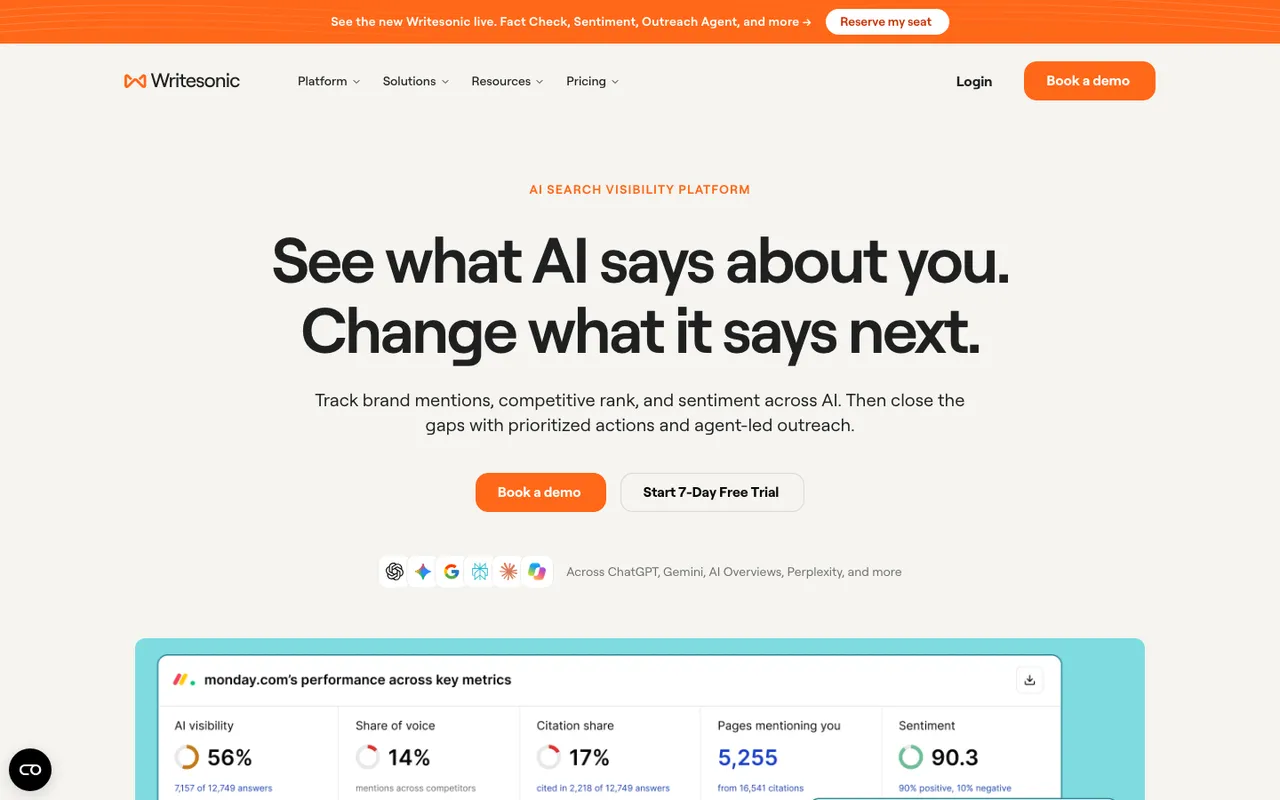 Writesonic's homepage, captured November 6, 2026.
The fit is a content-led team that measures success in published pages. Every brand plan bundles AI articles, site audits with AI crawler checks, and ads monitoring in ChatGPT, AI Overviews and AI Mode. Writesonic also lists SOC 2 Type II, GDPR and HIPAA, which matters to healthcare buyers; Promptwatch lists ISO/IEC 27001 and GDPR but not HIPAA.
Pricing, plan by plan
Prices on the captured page are per month, billed annually (the toggle says annual saves 20%). The monthly-billing prices weren't shown in our capture.
| Plan | Price (billed annually) | Engines | Prompts / answers daily | AI articles a month | Site audits | Users |
|---|---|---|---|---|---|---|
| Starter | $79 a month | ChatGPT, Gemini, AI Overviews | 50 / 50 | 15 | 10 x 100 pages | 1 |
| Basic | $199 a month | Same three | 100 / 300 | 25 | 20 x 1,200 pages | 2 |
| Growth | $399 a month | Same three | 200 / 600 | 50 | 50 x 2,500 pages | 3 |
| Enterprise | Custom | All 9 | Custom | Custom | Custom | Custom |
Every self-serve plan tracks one market (language plus country).
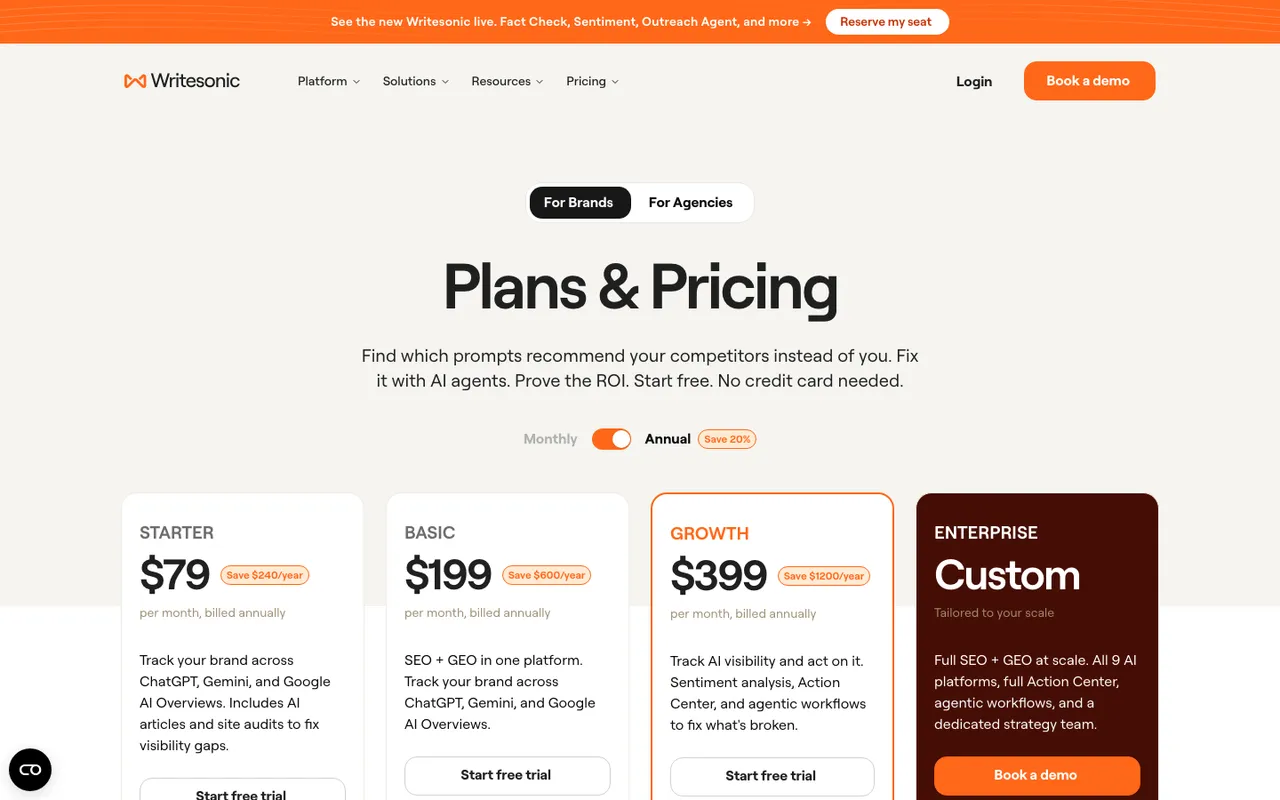 Writesonic's pricing page, captured November 6, 2026.
The costs that only show up in the plan cards and the comparison table:
- Six engines are Enterprise only on brand plans: Claude, Perplexity, AI Mode, Copilot, Grok and Muse Spark. No engine add-on is listed.
- Starter's numbers don't cover three engines. It tracks 50 answers a day for 50 prompts, so on the page's own figures every prompt can't be answered on all three engines daily. Basic's 300 answers do cover 100 prompts on three.
- Sentiment starts on Growth; the Action Center is Enterprise, with a Growth trial of 5 on-page and 5 off-page actions a month.
- Extra users cost $50 a month each, up to a cap.
- AI Search Volume gets "5 runs (one-time)" on two self-serve tiers, and agentic workflows get 10 to 100 trial runs.
Agency Starter is $200 a month with 20 pitch projects, unlimited users and every model except Claude and Muse Spark; client projects start at $150 each per month, and white label is on Agency Enterprise.
Promptwatch's brand plans are Essential at $95 a month, Professional at $245 and Business at $579 on monthly billing, with 10 months charged for 12 on annual billing. Every paid plan can track any supported engine, seats are unlimited, and the trial is 7 days, like Writesonic's. Writesonic wins the entry point, though: Starter includes 15 articles, and Promptwatch Essential has no AEO articles or crawler logs.
Features, one area at a time
Tracking and engines
The tracker page says Writesonic queries "ChatGPT, Claude, Gemini, Google AI, and 6 more platforms like a real user. Not through APIs." That's a fair advantage for Claude, which Promptwatch tracks via API, but on brand plans Claude is Enterprise. Self-serve tracking is daily, in one market, on three engines. Personas aren't listed.
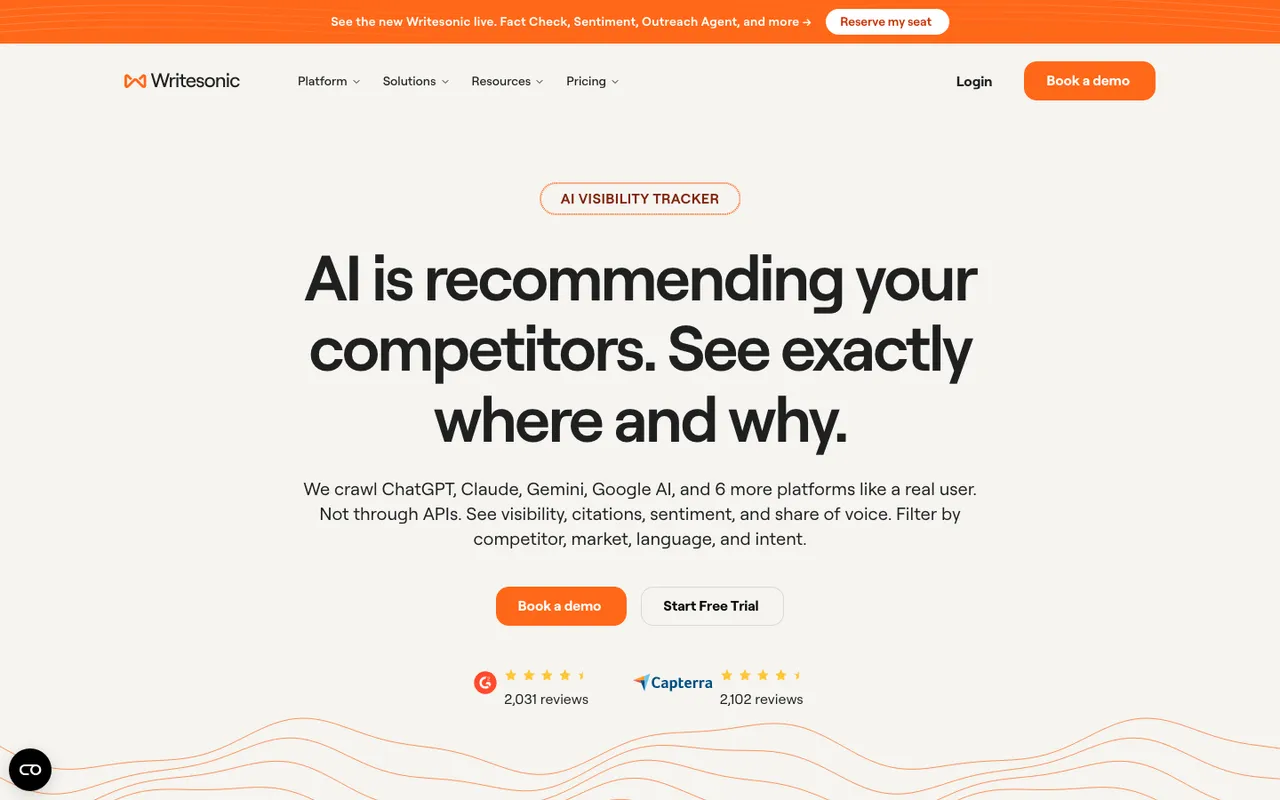 Writesonic's AI Visibility Tracker page, captured November 8, 2026.
Promptwatch monitors the real interfaces of ChatGPT, AI Overviews, AI Mode, Gemini, Perplexity, Copilot, Alexa and Meta AI, tracks Claude, DeepSeek, Mistral and Grok via API, and covers Codex and Claude Code. Business adds hourly runs and city or coordinate targeting.
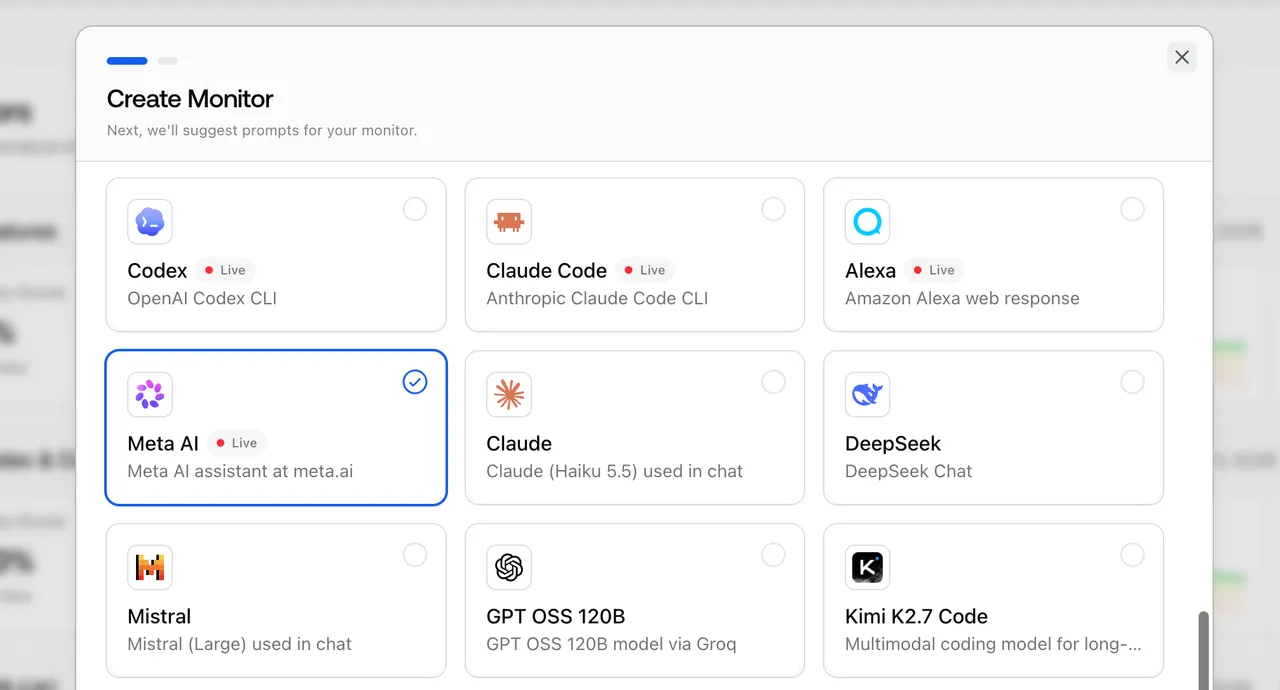 Promptwatch Create Monitor model picker, from the Promptwatch changelog. Example project data.
Prompt research
AI Search Volume draws on 2B+ AI conversations, with five one-time runs below Enterprise and no difficulty score. Fan-outs are a real strength: the tracker follows "the full chain" of sub-queries (plan not stated). Promptwatch shows fan-outs per model and Prompt Volumes with difficulty and citation rate on every plan.
Citations and sources
Top cited pages and domains, competitor citations and a source-type breakdown are documented, and Citation Gap Analysis lists the pages AI cites. Social citations, Citation Decay and Page Tracker are Enterprise, as is the Outreach Agent, which drafts pitches to the third-party pages AI cites; Promptwatch has no equivalent. Promptwatch has Citation Trends with a decay half-life per page, Page Tracker for any URL, and Reddit, YouTube, LinkedIn and Instagram reports on self-serve plans.
Crawler and traffic data
AI Agent Analytics logs GPTBot, ChatGPT-User, ClaudeBot, PerplexityBot and OAI-SearchBot server-side, flags 403, 404 and 500 responses, and compares bot visits with human click-throughs by platform, through Cloudflare, CloudFront, Vercel, Fastly, WordPress, Shopify, Drupal or a custom drain. That scope matches Promptwatch's. But the plan isn't readable on the pricing page, the product mockup carries an Enterprise badge, IP verification and a crawl-to-citation path aren't stated, and Bing isn't listed.
Promptwatch's Agent Analytics (Professional and every agency plan) verifies bots against operator IP ranges, gives each page a citation rate and explains failed crawls. Visitor analytics on every plan counts AI-referred visits and conversions, and Search Insights adds Search Console and Bing data on every brand plan.
Optimize: actions, audits, claims
Site audits with "Automatic AI Fixes" and robots.txt auto-fixes are on every plan, which is real action below Enterprise. The rest isn't. The Action Center is Enterprise with a Growth trial, Fact Check is Enterprise, and an in-app agent over your data isn't listed (the MCP server lets you query from ChatGPT, Claude or Cursor).
Promptwatch puts the Action Board, with a weekly Discovery agent, and Agent Chat on every plan. Brand Narrative (every plan) groups AI claims by theme, and Fact Check (Business, Agency Scale, Enterprise) tests each claim against your site and the 50 most-cited offsite pages for it.
Content and publishing
This is Writesonic's strongest stage: 15, 25 or 50 AI articles a month, brand voice writing styles (1, 5 or 10), content optimization, uploading your own data, and publishing fixes back to WordPress, with Sanity and Contentful listed too. Webflow and Framer aren't listed, and scheduled or automated publishing isn't stated.
Promptwatch writes AEO articles from Professional (5 a month) and Business (10), so Writesonic writes more per dollar. Promptwatch adds direction and follow-through: on Business the Content Agent writes against visibility gaps on a calendar, publishes to WordPress, Webflow or Framer, and follows each piece from live URL through crawls, citations and AI traffic.
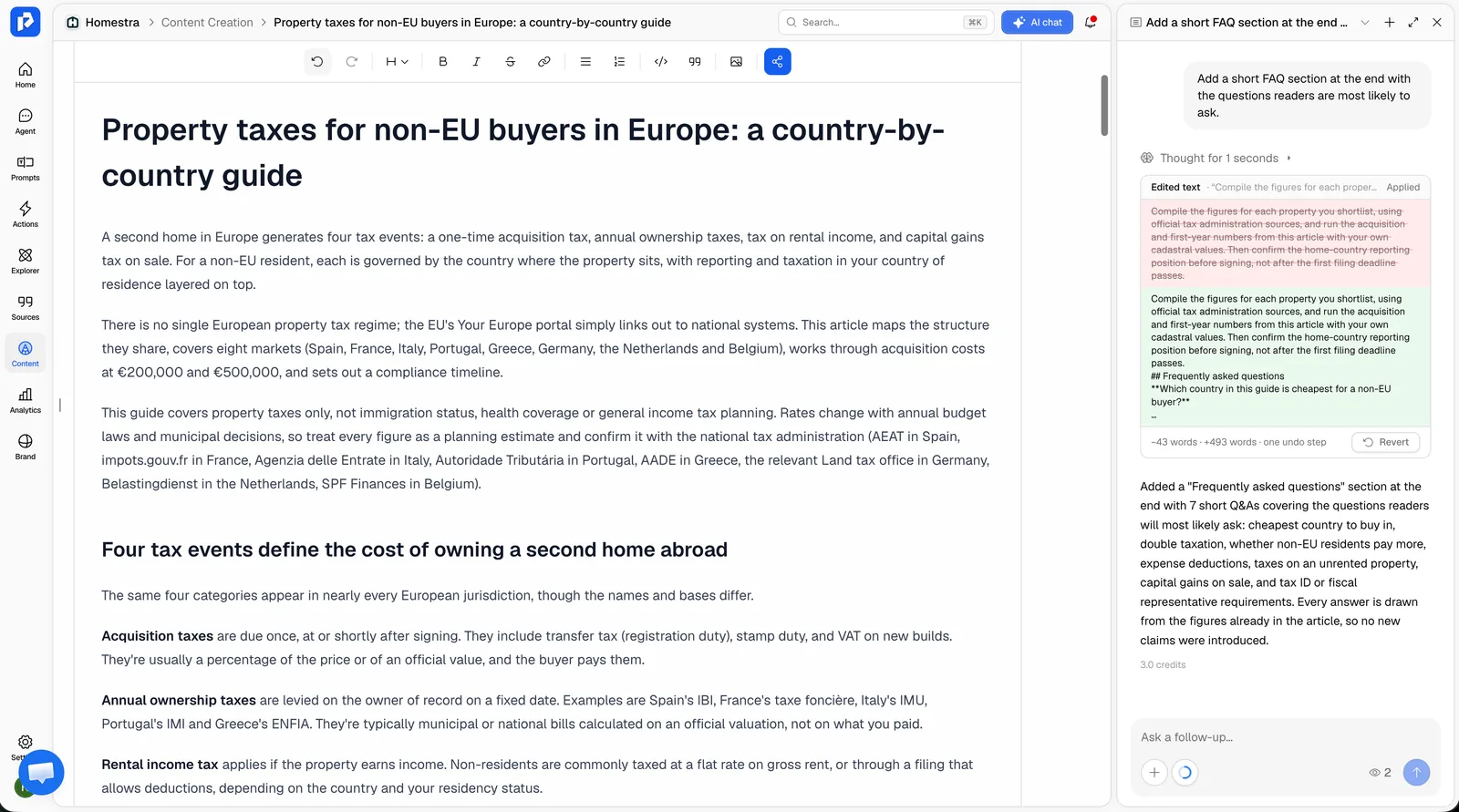 Promptwatch content editor with the AI chat panel, from the Promptwatch changelog. Example project data.
Reporting and integrations
Writesonic exports PDF and CSV and lists an MCP server and an API (plans not stated). Looker Studio is Enterprise; scheduled reports aren't listed. Promptwatch has MCP and a REST API on every paid plan, Looker Studio from Professional, and 10 scheduled PDF reports on every brand plan.
Where it falls short
Three engines, one market, below Enterprise
If your buyers ask Perplexity or Copilot, no self-serve brand plan sees those answers. A second country means Enterprise too. Promptwatch lets every paid plan track any supported engine and add country monitors, with state and city on Business.
The queue that says what to do is Enterprise
Without the Action Center, someone turns charts into tasks by hand, and Growth's ten trial actions a month won't cover a real backlog. One G2 reviewer also found the action item they were shown didn't match what they saw when they opened it. Promptwatch's Action Board and Agent Chat are on every plan.
Crawl data you can't fully trust or place
Logging bots is half the job. Without IP verification a fake GPTBot counts as GPTBot, and without a crawl-to-citation link a skipped page looks like a rejected one. Writesonic's own reply on G2 also calls a one-day bot traffic delay "a known data processing constraint". Promptwatch's Agent Analytics (Professional, $245) logs in real time, verifies against IP ranges and gives each page a citation rate.
Articles without a target, or links
Fifty articles a month help only if they answer the prompts you're missing, and with five one-time volume runs, no personas and a gated Action Center, the writer has little to aim at. An internal linking map isn't documented either. Promptwatch's Content Agent starts from tracked prompts and fan-outs, and its weekly audit, on every plan, maps orphan and low-inlink pages.
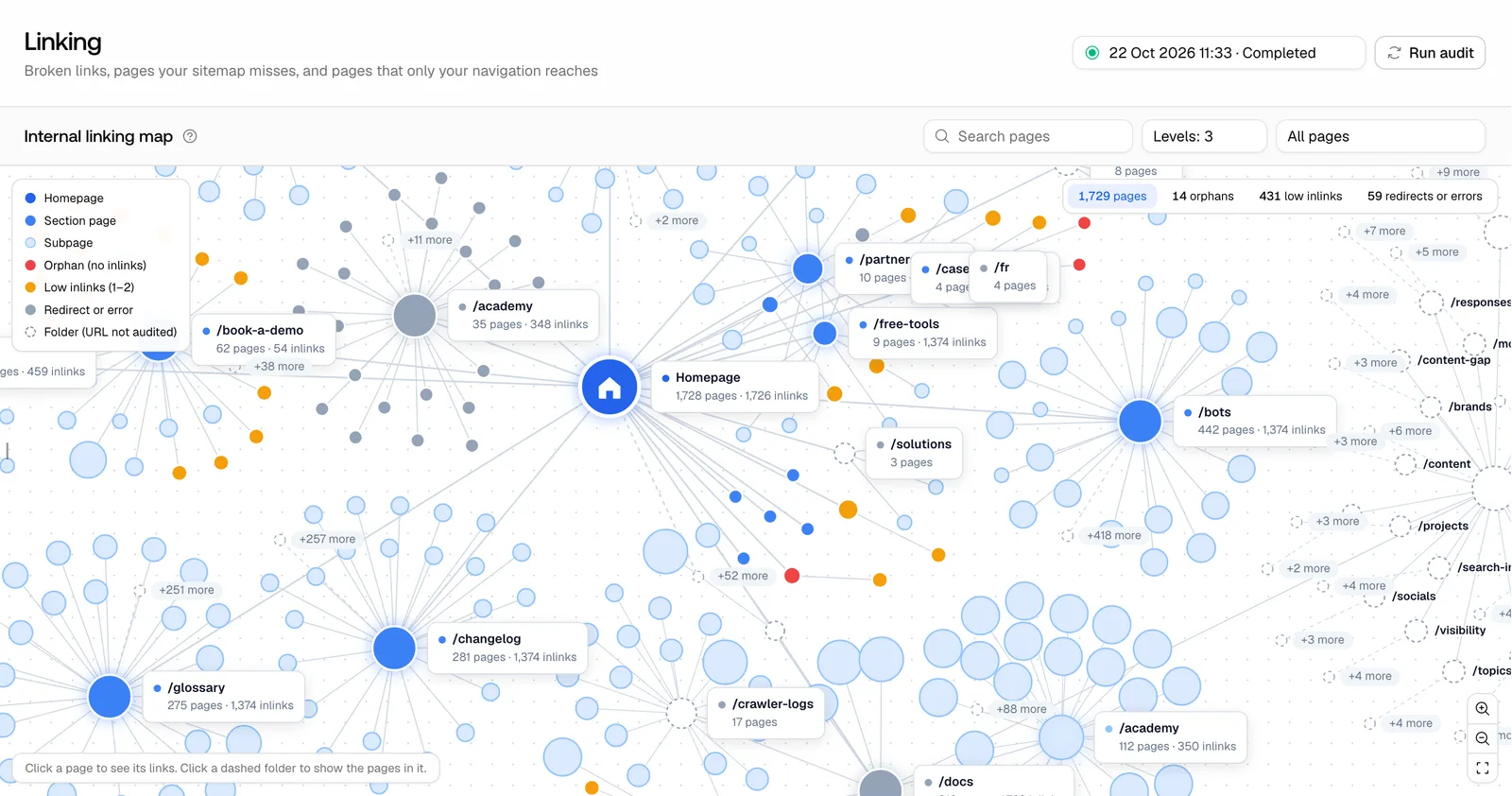 Promptwatch site audit internal linking map, from the Promptwatch changelog. Example project data.
What users say
Writesonic holds 4.7 out of 5 from 2,148 reviews on G2 (checked November 15, 2026), but most of those reviews are about the AI writer, so read it as a company-wide score. The three quotes below are about the visibility features.
A small-business reviewer on G2 (October 2026): "We had zero insight into how our brand was performing in ChatGPT or Claude until we started using Writesonic. Now we can track which pages get cited when people ask about our category, see exactly where we show up versus competitors, and spot the prompts where we're completely absent."
A small-business reviewer who rated it 1 out of 5 (August 2026): "After onboarding, you can't add new AI prompts to track (???), and AI bot traffic is delayed by one day." Writesonic's reply on the same page says: "The one-day AI bot traffic delay is a known data processing constraint we're working to reduce."
Another small-business reviewer (September 2026): "It would also be helpful to have more customization options for tracking prompts, competitors, and reporting, along with clearer explanations of how visibility scores are calculated. Pricing may be difficult to justify for smaller teams."
Two worked team scenarios
Example: a payroll software team whose buyers research in Perplexity and Copilot
Assumptions (illustrative): three marketers, 80 prompts, ChatGPT, Gemini, AI Overviews, Perplexity and Copilot daily, one market, crawler logs, about five articles a month.
On Writesonic, Perplexity and Copilot are Enterprise on brand plans, so the full brief needs a custom quote. Without them, Growth at $399 billed annually fits three users, 200 prompts and 50 articles, with the Action Center as a trial.
On Promptwatch, 80 x 5 x 30 is 12,000 responses, inside Professional (18,000) at $245 a month, about $204 billed annually, with all five engines, IP-verified crawler logs, 5 AEO articles and unlimited seats. Promptwatch is cheaper and sees the two engines that matter here; Writesonic writes ten times the articles.
Example: a home-improvement retailer's WordPress desk aiming for 40 articles a month
Assumptions (illustrative): two editors, 150 prompts, ChatGPT, Gemini and AI Overviews daily, one market, ads monitoring, and product recommendations in ChatGPT Shopping.
On Writesonic, Growth at $399 billed annually fits the engines, the prompts and 50 articles, with ads monitoring included. Shopping is Enterprise.
On Promptwatch, 150 x 3 x 30 is 13,500 responses, which Professional covers, but Shopping and Ads Radar start on Business at $579 a month (about $483 billed annually), with 10 AEO articles and the Content Agent. Forty articles means a separately priced add-on. Writesonic is cheaper for volume; Promptwatch is the one with Shopping at a listed price.
Promptwatch vs Writesonic GEO
| Row | Promptwatch | Writesonic GEO |
|---|---|---|
| Entry price | Essential $95/mo, monthly billing | Starter $79 a month, billed annually |
| Engines below Enterprise | Any supported engine on every paid plan | ChatGPT, Gemini, AI Overviews |
| Markets below Enterprise | Country monitors on every plan; city on Business | 1 |
| Fastest tracking | Every 12, 6 or 1 hours on Business | Daily |
| Query fan-outs | Yes, per model | Yes, plan not stated |
| Personas | Yes, with stacking | Not listed |
| Page Tracker and social citations | Yes, self-serve | Enterprise only |
| AI crawler logs | Professional and up, every agency plan | Yes, plan not readable |
| Bot IP verification, crawl-to-citation rate | Yes | Not stated |
| Action queue | Action Board, every plan | Enterprise; Growth trial |
| Fact checking | Fact Check on Business | Enterprise |
| AI articles | 5 (Professional), 10 (Business) | 15, 25 or 50 on every plan |
| CMS publishing | WordPress, Webflow, Framer; scheduled on Business | WordPress, Sanity, Contentful; scheduling not stated |
| Ads in AI answers | Ads Radar on Business and agency plans | Every brand plan |
| Writesonic's values come from its pricing, AI Visibility Tracker, AI Agent Analytics and agency pages, plus its llms.txt, checked November 6 and 8, 2026. "Not listed" and "not stated" mark gaps in Writesonic's own documentation, not confirmed absences. |
Content teams should read the articles and ads rows, where Writesonic wins. Teams reporting to a CMO should read the engine, action and crawler rows, which decide whether the articles were aimed and whether they worked. Promptwatch's honest weak spots: Essential has no crawler logs or articles, Ads Radar and Shopping start on Business, article counts are lower, HIPAA isn't listed, and agency plans have no Content Agent.
Who should stay, who should switch
- Stay on Writesonic if article volume per dollar is the job, ChatGPT, Gemini and AI Overviews cover your buyers, you want ads monitoring on a $79 plan, or HIPAA is a requirement.
- Switch to Promptwatch if you need Perplexity, Copilot or Claude without Enterprise, an action queue on a self-serve plan, or crawler data with IP verification and a citation rate.
- Switch if you want the writer aimed by the tracking: the Content Agent on Business writes from tracked prompts and fan-outs and follows each page to its first citation.
Our verdict and next step
Writesonic GEO acts through volume: lots of articles, audits that fix themselves, ads tracked from the first plan. The parts that decide what to write and prove it worked mostly sit on Enterprise. The gap that costs self-serve customers most is the engines, because three engines in one market can't show where buyers actually lose you. Run Promptwatch's free AI Visibility Report on your domain. It scans ChatGPT, Gemini and Perplexity without a login, so you see the Perplexity answers your Writesonic plan can't, plus a check of whether AI crawlers can reach your site.
FAQ
How much does Writesonic GEO cost?
Starter is $79, Basic $199 and Growth $399 a month, billed annually, and Enterprise is custom. Agency Starter is $200 a month. There's a 7-day free trial with no credit card.
Does Writesonic have AI crawler logs?
Yes. AI Agent Analytics logs AI bots server-side and flags errors, but its plan isn't readable on the pricing page and IP verification isn't stated. Promptwatch's Agent Analytics verifies bots against operator IP ranges, from Professional.
Is Writesonic GEO the same as the Writesonic AI writer?
They come from the same company, and the article writer is bundled into the GEO plans. This review covers the AI visibility features; most of Writesonic's G2 reviews are about the writer.