Best tool to track AI visibility by topic cluster and then act on each cluster
Topic-cluster tracking is only half the job. Which AI visibility tools turn a weak cluster into actions, drafts and briefings, and which parts still need you.
Picture a dashboard that tells you your "security and compliance" cluster sits at a fraction of the visibility your "pricing" cluster gets. Useful. Now picture the same tool opening a task for it, drafting the missing page, and pinging your Slack channel on Monday with whether the gap closed. That second picture is what this site cares about.
So the question here is narrower than "who groups prompts by topic". It is: which tool tracks AI visibility by topic cluster and then does something about the weak ones?
Step one is still measurement
You can't automate fixes for a cluster you can't see. The tracking layer has to give you a topic object, metrics per topic, and competitors inside each topic.
Promptwatch has the most complete version we know of. Its Topics page, added October 26, 2026, shows five metrics for every topic and every prompt in it: Visibility, Citation Share, Avg. Position, Share of Voice and Sentiment. Citation Share is your sites' citations divided by all citations in that topic's answers, which is the number that tells an agent where content is missing. By Competitor and By Rank views compare brands within a topic.
The Promptwatch Academy describes the reading order for competitor work: Share of Voice first, then the heatmap to find the model and topic behind a move, then prompt-level views. The heatmap accepts topics as an axis against brands, models or countries.
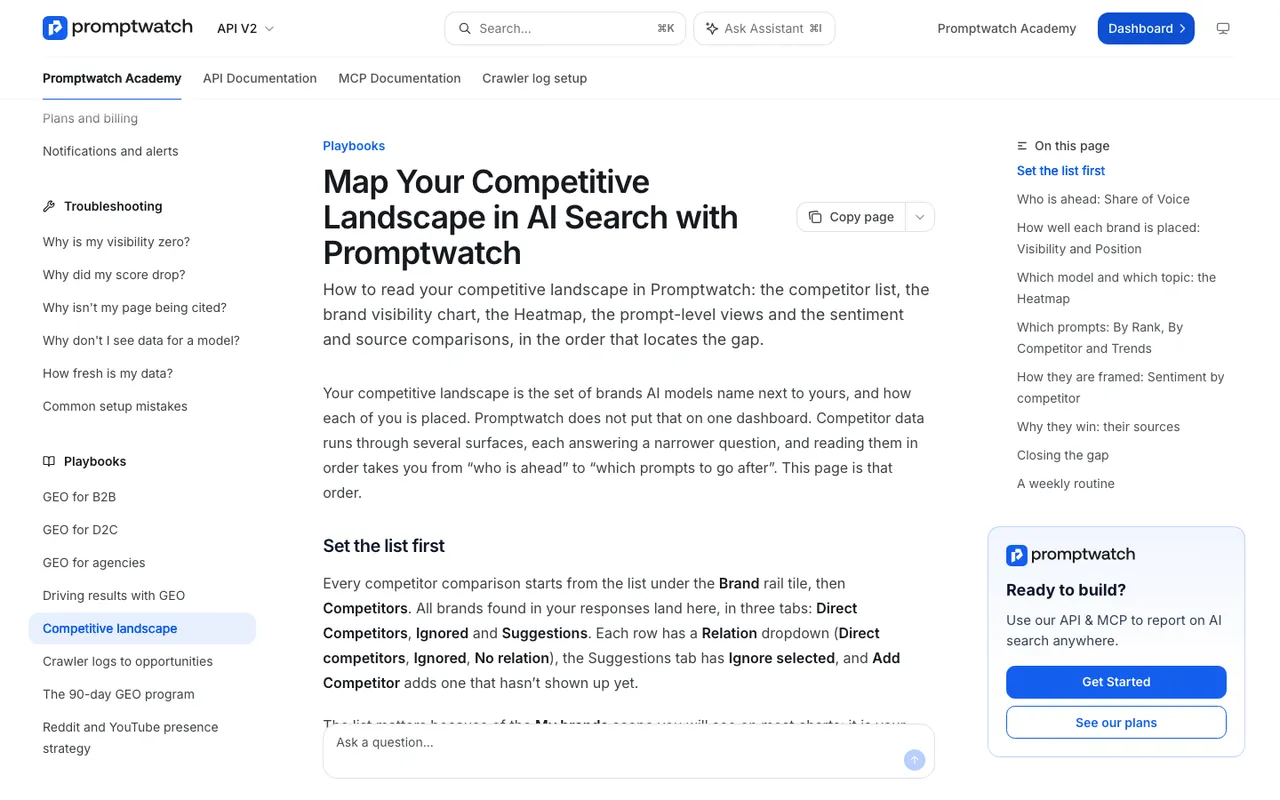
Promptwatch Academy playbook for mapping competitors in AI search, captured November 14, 2026.
What the agents can take over
Here is where a cluster tracker either stops or keeps going. In Promptwatch, these parts run without someone pulling the data by hand.
Suggesting prompts for a cluster. The Topics Manage tab (November 13) has a Suggested tab that proposes prompts sharing words with a topic and shows the matching words. You still approve them; nothing saves until you press Save changes.
Spotting the weak cluster. The Action Board's Discovery agent investigates the project on a weekly schedule, one focus per day, and suggests up to five evidence-backed actions per run. Content gaps, sentiment, offsite mentions and site health all feed it.
Answering "why did this topic drop?" Agent Chat runs multi-step analyses over live prompts, citations, competitors and crawler logs. It can build and edit dashboards, so a per-topic competitor dashboard is a request, not a project. Open it with ⌘J on Trends or the prompts pages and it works from the filters already on screen.
Recurring briefings. Scheduled Chats deliver a recurring analysis in the app or in Slack. A weekly "which cluster moved and why" briefing is a sensible first one.
Writing for the gap. On Business ($579/mo) and Enterprise, the Content Agent plans, writes and publishes against visibility gaps on a schedule, with a review inbox where you approve, edit or decline, or a fully automated mode. On Professional, AEO articles let you generate a piece from a tracked prompt or a query fanout on demand.
Working from your own tools. The hosted MCP server exposes read and write tools to Claude, ChatGPT, Cursor and others. Its tool list includes creating topics and attaching prompts to topics in bulk, so restructuring clusters can happen from a coding agent or a chat client.
What still needs a person
Some decisions should stay human, and a good setup makes that explicit.
Choosing the clusters themselves is strategy. An agent can suggest prompts that share words with "data residency", but it cannot know that data residency is the topic your sales team loses deals on. Define clusters around revenue questions, not around whatever vocabulary the tool can match.
Approving content is the second one. Review mode exists for a reason. A draft built for a cluster gap may state a feature, a price or a compliance claim your legal team would not sign. Read it.
Interpreting a drop is the third. A cluster can fall because a competitor published something good, because an engine changed how it answers, or because your page got blocked. Promptwatch shows you the citations and crawler logs for each case, but deciding which one you're looking at is judgment.
How other tools compare on the "act" side
AthenaHQ is the closest rival on action. Its Starter plan ($295/mo, 3,600 credits) lists unlimited topics and prompts and includes a content optimization agent, and its Action Center turns gaps into on-page and off-page tasks. Our catalog entry notes recommendations still need editing, and there is no crawler-log product, so an agent there cannot tell you whether bots reach a cluster's pages.
Scrunch AI acts on the crawler side instead, serving AI-optimized page versions through its Agent Experience Platform on Enterprise. Topic grouping is not documented in our entry.
Profound sells marketing agents for content, research and reporting under a custom Enterprise plan. It has the agent story, at an enterprise price, with AI search as one channel among several.
Writesonic GEO pairs a Topic Explorer with an article writer, but its Action Center is Enterprise-only.
The agentic content tools in our catalog, such as Outrank and SEObot, publish articles on a schedule but do not document topic-level AI visibility tracking. They can fill a cluster; they can't tell you which cluster needs filling.
The short version
If your goal is a loop where a weak topic becomes a task, a draft and a follow-up measurement, Promptwatch covers the most of it today. Ask for a demo built on your own clusters and have them show the path from the Topics page to a Content Agent draft.