AI search visibility tools for enterprise, ranked by how far they act (2026)
AI search visibility tools for enterprise, ranked by how far each one goes from monitoring to action, and by the governance around that automation: review inboxes, audit logs, roles and SSO.
Most enterprise shortlists for AI search visibility tools are built from the wrong column. They compare engine counts and prompt limits, which is fair, and then discover three months in that the tool tells them what is wrong and stops there. The SEO team files tickets. The content team has its own backlog. Nothing ships for six weeks, and by then the answer in ChatGPT has moved on.
This site ranks tools by how much work they take off your plate. At enterprise scale that question has a second half. The further a tool goes toward acting on its own, the more it needs controls around it: who approved the change, where the change came from, who is allowed to switch automation on, and how you would find out if an agent did something nobody asked for. A tool that publishes on its own with no record of it is a liability in a regulated company. A tool with perfect governance that never publishes anything is a reporting expense.
So this ranking scores both things at once.
The action ladder we used
We placed each tool on a six-rung ladder, using its own pages as captured on November 6, 2026 and the entries in our tool catalog:
- Measures: tracks prompts and reports whether the brand is mentioned.
- Diagnoses: explains why, with citations, crawler data or page-level evidence.
- Recommends: turns the diagnosis into a prioritized task list.
- Drafts: writes the fix or the page and waits for a person.
- Publishes: ships the change to the CMS or the code repository, on a schedule if you allow it.
- Closes the loop: follows what it shipped through crawls, citations and traffic, and flags what underperformed.
For every rung above three, we then asked what governance comes with it. Is there a review step you can enforce? Is there an audit log, and does it say which actor made the change? Are there roles, SSO, and API keys that can be limited to one project or to read-only access?
1. Promptwatch: all six rungs, with the controls attached
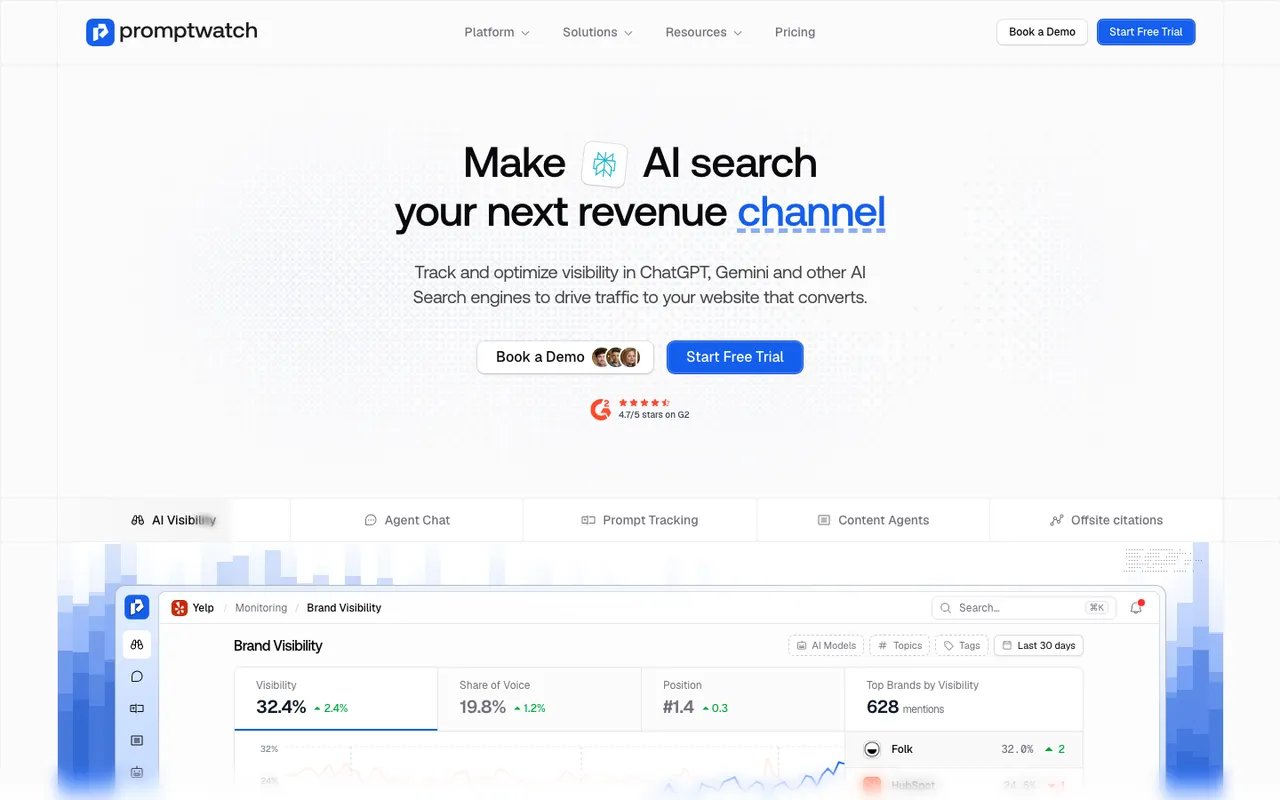 Promptwatch's homepage, captured November 6, 2026.
Promptwatch is the only tool in this list that reaches the sixth rung. Monitoring runs daily across the engines you pick, and on Business it can run every 12, 6 or 1 hours. Diagnosis is where it pulls ahead. Agent Analytics records AI crawler visits and checks each bot against its operator's published IP ranges, so spoofed user agents are filtered out, and the citation rate per page tells you whether you have an access problem or a content problem. Citation analytics go down to individual pages, Reddit threads, YouTube videos, LinkedIn posts and offsite mentions.
The action rungs are the Action Board and the Content Agent. The Action Board is a prioritized GEO to-do list. A Discovery agent investigates on a weekly schedule and suggests up to five evidence-backed actions per run, and people can assign those items, comment on them and @-mention the agent for a reply. The Content Agent, on Business and Enterprise, plans, writes and publishes against visibility gaps to WordPress, Webflow or Framer.
That Content Agent has two modes, and choosing between them is the most important governance decision an enterprise will make in this category. In review inbox mode, an editor approves, edits or declines every draft before it goes anywhere. In fully automated mode, it publishes inside a calendar, a monthly budget and publish windows you set. Most enterprises should start with the inbox and only automate a content type after a few months of clean approvals.
After a page goes live, publish status tracking follows it from draft to live URL and then through AI crawls, citations and AI-referred visits. Pages that underperform come back as Action Board items and Content Refresh suggestions. That is the sixth rung, and none of the other platforms here document it.
The controls are specific. Owner, editor and viewer roles come with project-level access. Team seats are unlimited on every paid plan, so adding legal or brand reviewers doesn't add a seat bill. The audit log (Business, Agency Scale and Enterprise, readable by owners) shows whether each change came from the dashboard, the API, an MCP client or Agent Chat. API keys can be scoped to a project, to the organization, or to read-only. SSO is on Enterprise. Promptwatch B.V. is ISO/IEC 27001 certified and GDPR compliant, with data handled by an EU-based company.
The audit log point deserves a second sentence. Once agents can edit monitors and queue content, "who changed this?" has four possible answers, and three of them are not a person clicking a button. A log that names the source is how you tell your own internal agent's edits apart from a colleague's.
On price, Business is $579/mo with 5 projects, 350 prompts, 42,000 responses, 2,500 Agent Credits, 10 AEO articles and 100M crawler logs. Enterprise is custom and adds custom projects and volumes, managed content workflows, Fact Check, SSO, a dedicated success manager, priority support and MCP plus API access at 50,000 requests an hour. Named customers include Yelp, Shutterstock, Rabobank and ABN AMRO, and the agencies Monks and WPP.
The caveat is plan gating. The automated Content Agent, the audit log and faster tracking all start on Business. Professional ($245/mo) gets crawler logs and on-demand AEO articles, but not the scheduled agent, so publishing there is a step a person takes.
2. AthenaHQ: a strong action queue, governance on Enterprise
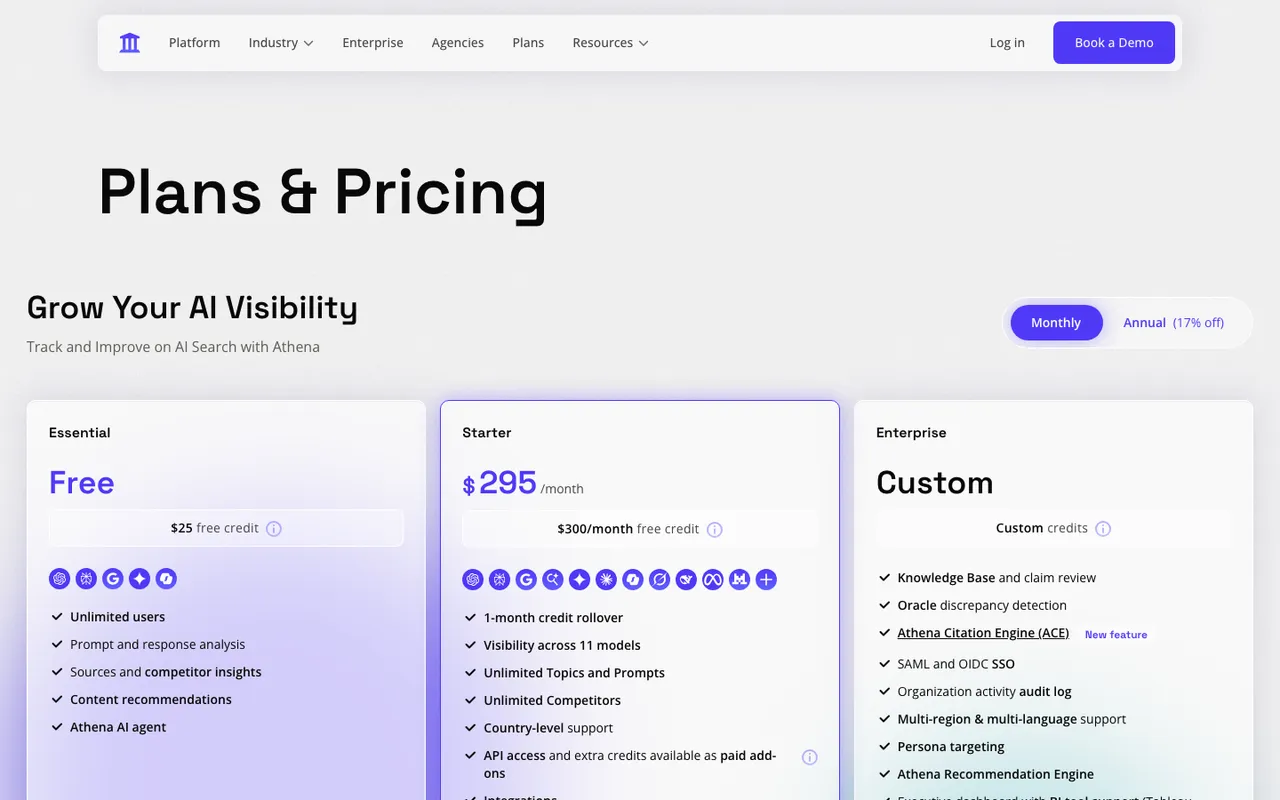 AthenaHQ's pricing page, captured November 6, 2026.
AthenaHQ has the strongest action queue after Promptwatch. Starter costs $295/mo for 3,600 credits, where one credit is one AI response, across 11 models. It includes on-page and off-page actions, a content optimization agent and what AthenaHQ calls self-learning content improvement. That puts it solidly on rungs three and four.
The enterprise controls live on the Enterprise card: SAML and OIDC SSO, an organization activity audit log, custom credits, websites and access controls, multi-region and multi-language support, Knowledge Base and claim review, and an executive dashboard with BI support for Tableau, Power BI and Looker. API access is a paid add-on on Starter and included on Enterprise. The pricing page lists unlimited seats with role-based access control.
What keeps AthenaHQ at number two is the top of the ladder. Our catalog lists no published AI crawler-log product and no visitor analytics that tie AI referrals to conversions, so "did the fix work?" has to be answered in another tool. Credit billing needs a forecast too, since every extra market or engine adds responses. Our catalog also notes that recommendations still need editing before they ship. For a team that planned on a review step anyway, that's acceptable.
3. Scrunch AI: action at the serving layer
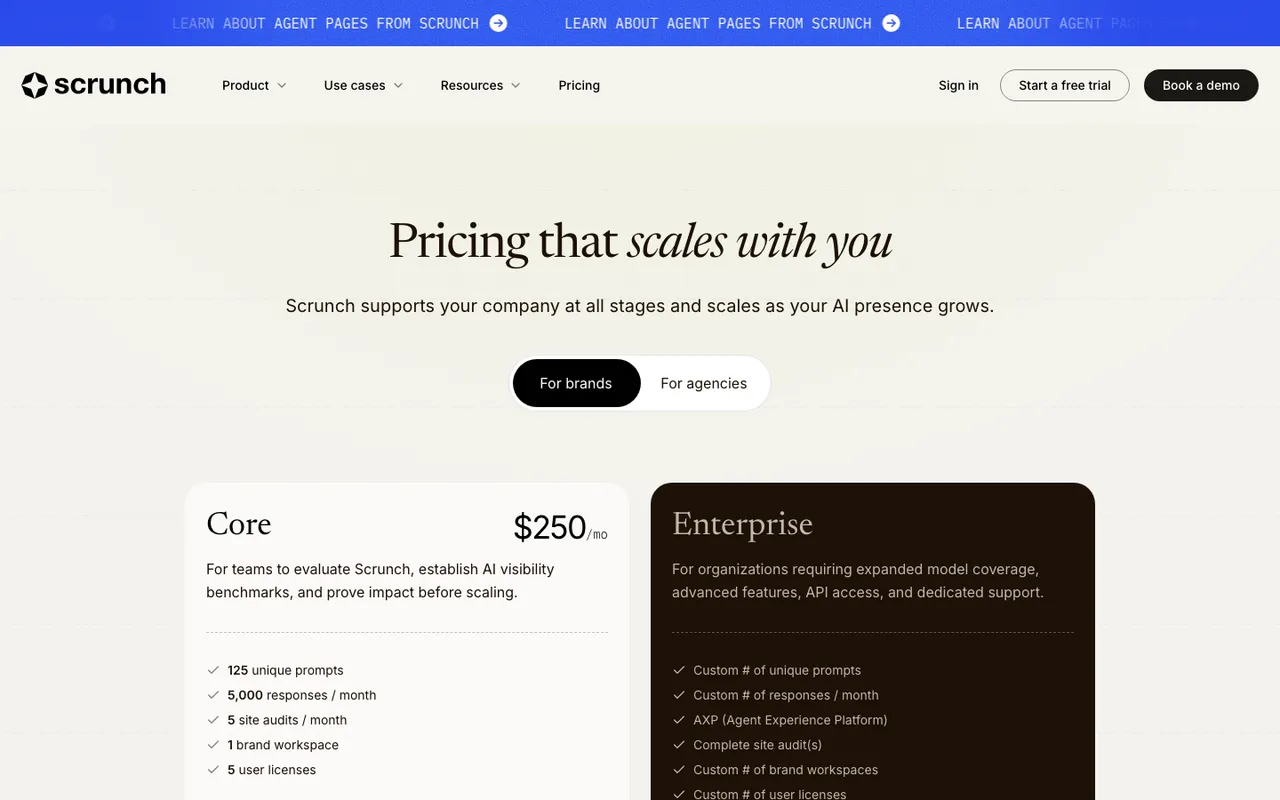 Scrunch's pricing page, captured November 6, 2026.
Scrunch AI acts on a layer the others leave alone. Its Agent Experience Platform (AXP) serves AI-optimized versions of pages to agents without rewriting the human site. For a large site whose CMS releases ship monthly, that is a real way around the backlog.
The pricing page keeps the enterprise pieces on Enterprise: AXP, custom prompts and responses, custom brand workspaces and user licenses, Query API access, Looker Studio access and SSO (SAML, OIDC). MCP access is listed as custom on that tier. Core is $250/mo for 125 prompts, 5,000 responses, 1 brand workspace and 5 user licenses across four LLMs. That is a pilot, not a rollout.
The governance questions here are different. When a separate version of a page is served to crawlers, legal and brand teams will want to know who approves that version and how it stays in step with the human page. Ask to see that workflow in the demo. Our catalog also notes a weekly data refresh, and that Sitecore acquired Scrunch in June 2026, which ties the roadmap to a DXP vendor.
4. Profound: agents with an approval ping, sold as a program
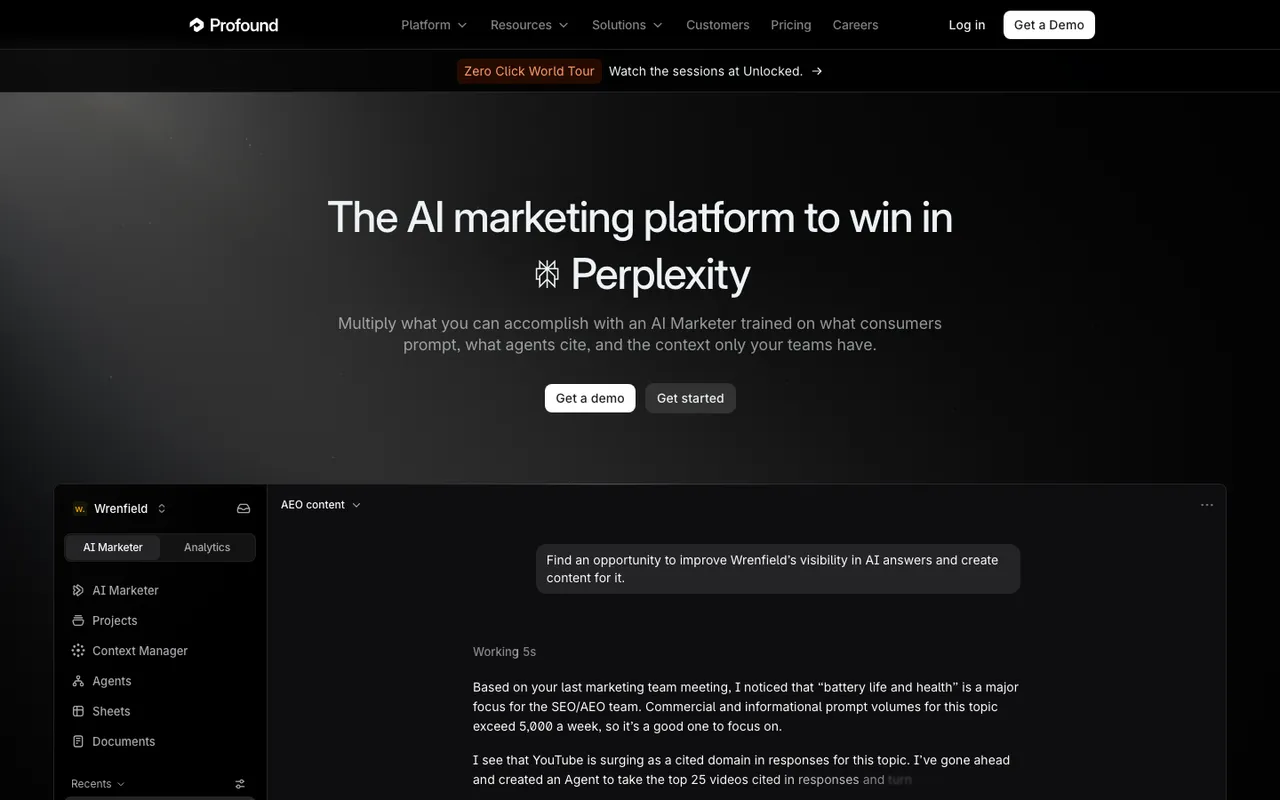 Profound's homepage, captured November 6, 2026.
Profound now sells an AI Marketer. The homepage says it "identifies the work worth doing, drafts it, and pings you for approval", which is rung four with a human gate built in. A Command Center shows agent runs across the marketing team, and the homepage lists RBAC, SCIM and SOC 2.
It ranks below the dedicated AI search platforms for two reasons. The agents cover content, social, PR, growth and product marketing, so AI search is one channel among several. And the public options are a 7-day trial and a custom Enterprise plan; our catalog carries an earlier estimate of about $40k a year. Buy Profound for a managed agent program across marketing. If AI search visibility is the actual job, start elsewhere.
5. Conductor and seoClarity: SEO suites adding agents
Conductor lists turnkey Content and Technical Agents and an MCP server on every tier, with SSO from Growth and enterprise permissions (RBAC) on Enterprise. It publishes no prices. seoClarity publishes package starting points ($2,500/mo for Research & Content, $3,200 for Technical, $4,500 for Enterprise) and pitches faster execution for "optimizations in the dev backlog". Both make sense when the enterprise already runs classic SEO on them. Neither is where we would look for crawler-to-citation evidence or AI-referred conversions.
6. Seology: reviewable fixes, no visibility proof
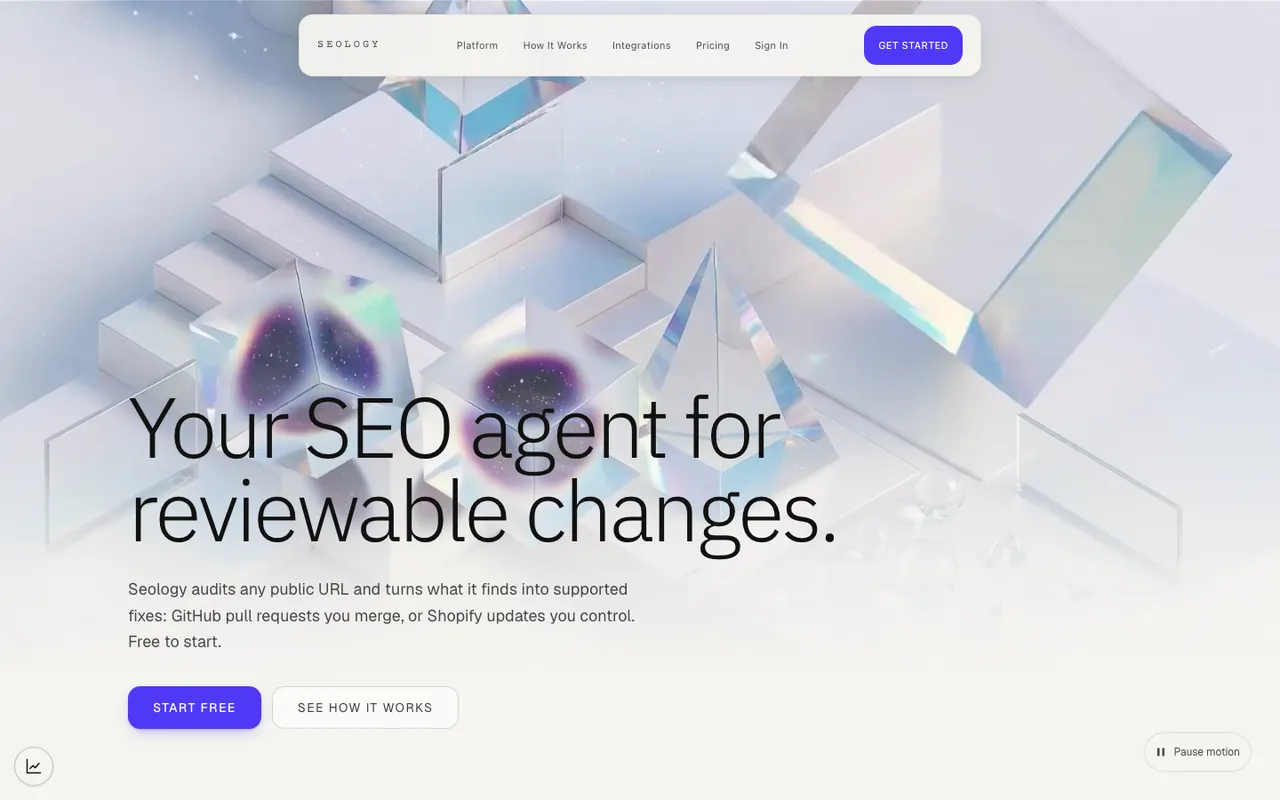 Seology's homepage, captured November 6, 2026.
Seology is an agentic SEO automation tool, not a visibility platform. It earns a place here because its governance model is worth copying. The homepage describes three execution modes. Automatic applies safe fixes and reports what it changed. Plan proposes a batch that you approve before anything touches the live site, and it's available on every plan. Approve asks for sign-off on each individual fix. The page lists a 90-day rollback and a full change log, and GitHub fixes always arrive as pull requests your team merges.
It is also candid about its limits. The page says audit scores "are not keyword rankings or AI citation measurements". Seology can ship schema and meta fixes, but it cannot tell you whether ChatGPT cited the page afterwards. Pair it with a platform that can.
7. Evertune and Brandlight: measurement for brand teams
Evertune says it samples each prompt 100 times across every AI model, which produces statistically defensible perception data. Brandlight sells a multi-brand, multi-region command center with SOC 2 Type II. Neither publishes prices, and our catalog lists no content agents or crawler logs for either one. Both are useful for insights teams and sit low on this ladder.
Comparison table
| Tool | Highest rung | Human review step | Audit log | SSO |
|---|---|---|---|---|
| Promptwatch | 6, closes the loop | Review inbox or fully automated | Business, Agency Scale, Enterprise | Enterprise |
| AthenaHQ | 4, drafts | Action queue | Enterprise | Enterprise |
| Scrunch AI | 5, serves pages to agents (AXP) | Not documented | Not published | Enterprise |
| Profound | 4, drafts | Approval ping | Not published | Enterprise |
| Conductor | 4, agents | Not published | Not published | Growth and Enterprise |
| Seology | 5, opens pull requests | Plan or Approve mode | Change log | Not published |
| Evertune | 2, diagnoses | Not applicable | Not published | Not published |
Write the automation policy before you sign
The tool choice is half the work. The other half is a one-page policy that says what the agents may do on their own. A useful version answers four questions.
Which content types can publish without review? Refreshes of existing comparison pages are a reasonable first candidate. New pages that make product, pricing or regulatory claims are not.
Who owns the inbox, and what is the service level? An approval queue that nobody empties is worse than no automation, because drafts go stale while everyone assumes they shipped.
Which keys can write? Give BI and reporting pipelines read-only keys. Give write access only to the agent that needs it, scoped to its project.
Who reads the audit log, and how often? A weekly look by the project owner catches the odd agent edit before it becomes a pattern.
Promptwatch is the tool on this list where each of those answers maps to a setting you can actually configure: inbox or automated mode, project roles, scoped keys, and an audit log that names the source of every change. That is why it sits at number one, not because it tracks more engines.
Enterprise has no self-serve trial, so the practical first step is to book a Promptwatch demo and ask them to walk through the Content Agent review inbox and the audit log on your own prompts.