GEO tools for enterprise: the agent infrastructure that matters in 2026
GEO tools for enterprise compared on agent infrastructure: MCP servers, REST APIs and rate limits, scoped keys, in-app agents, Slack delivery, and how each one plugs into your own agents and BI.
A large company buying a GEO tool in 2026 already has agents. The data team has a warehouse and a BI layer. Engineering works in Claude Code or Cursor. Someone in marketing ops has built an internal assistant that answers "how did we do last week?" from five different sources. The GEO tool is joining that stack, not replacing it.
That changes what you evaluate. A dashboard is still useful, but the more interesting question is whether your own agents can read the GEO data, whether they can write to it safely, and whether a person can tell afterwards what an agent did. A tool with a beautiful UI and no programmatic surface becomes one more login that a human has to visit and copy numbers out of.
This guide compares GEO tools for enterprise on that surface: the parts an agent or a pipeline touches. Pricing and engine coverage come up where they affect it.
What we checked
For each tool we read its homepage and, where public, its pricing page as captured on November 6, 2026, plus its entry in our catalog. We looked for:
- an MCP server, and whether its tools can write as well as read
- a REST API with documented rate limits
- credentials that can be scoped to a project or made read-only
- an in-app agent, and how it behaves before it changes something
- delivery into the places people already work, such as Slack
- an action layer that agents and people share
- connectors into BI tools
Where a vendor's pages don't document one of these, we say so instead of guessing.
1. Promptwatch: the full stack, with limits written down
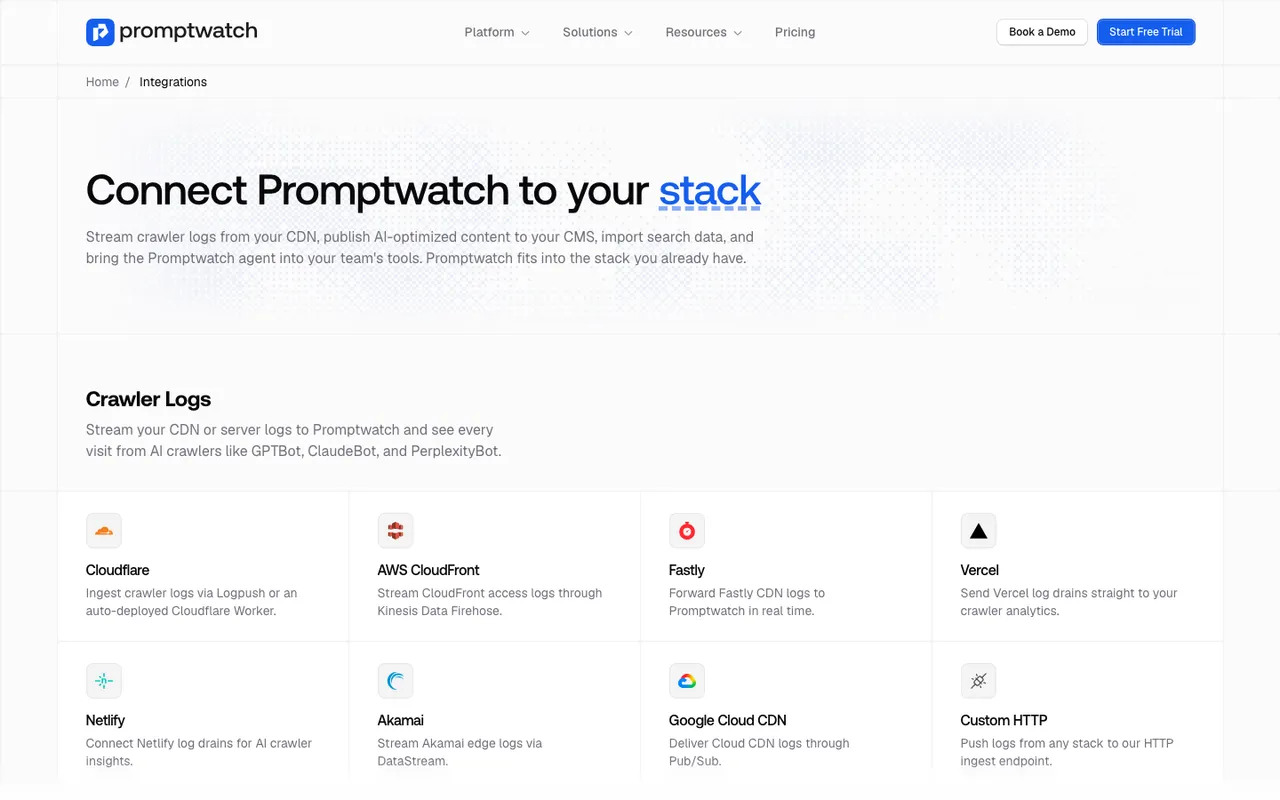 Promptwatch's integrations page, captured November 6, 2026.
Promptwatch documents more of this surface than any other GEO tool we review, and it puts numbers on it.
The MCP server
It is hosted at https://server.promptwatch.com/mcp, exposes 110 or more read and write tools, and authenticates with OAuth or an API key. It works with Claude, Claude Code, ChatGPT, Cursor, Lovable and Codex, and there is an official ChatGPT plugin, an official Claude connector and a one-click install for Cursor. Write tools matter here. An internal agent can create a monitor, add prompts or create pitch projects as well as pull a visibility score.
The REST API and its rate limits
Version 2 lives at https://server.promptwatch.com/api/v2, takes an X-API-Key header, and accepts date ranges up to 92 days. Rate limits are published per plan: 500 requests an hour on Essential, 2,000 on Professional, 10,000 on Business and 50,000 on Enterprise. The agency plans run 500, 2,000 and 10,000. For a pipeline that backfills a year of data across five brands, those numbers decide how you batch. One detail an engineer will like: asking for a monitor frequency your remaining response quota can't cover returns a 402 with MONITOR_PROMPT_FREQUENCY_OVER_QUOTA, so an agent gets a clear refusal rather than a silent overrun.
Scoped keys and the audit log
API keys can be scoped to a project, to the organization, or to read-only. The audit log (Business, Agency Scale and Enterprise, owners only) records whether each change came from the dashboard, the API, an MCP client or Agent Chat. Put those two together and you get a sensible pattern: the BI pipeline gets a read-only organization key, the internal content agent gets a write key for one project, and the owner reviews the log for anything that came from an MCP client.
Agent Chat
This is Promptwatch's own analyst over live data: prompts, citations, competitors, traffic, crawler logs and search data. It runs multi-step analyses and hands parts of them to read-only subagents. When a request is unclear it asks a short multiple-choice question, and it asks for every missing value before it changes anything. It can build and edit dashboards, generate PDF reports, update monitors, queue content and work the Action Board. Agent Credits run from 500 to 6,500 a month depending on plan, with 2,500 on Business.
Scheduled chats in Slack
Every brand plan includes 10 scheduled chats and 10 scheduled PDF reports. A scheduled chat can be delivered in the app or in Slack, and the Slack integration maps channels to projects for scheduled briefings. A skills library includes ready-made jobs such as a 7-day GEO briefing and a competitor gap analysis. For a regional team, a Monday briefing in its own channel is often the only Promptwatch screen they ever need.
The Action Board and Discovery agent
The Action Board is the shared to-do list between agents and people. A Discovery agent investigates on a weekly schedule, one focus a day, and proposes up to five evidence-backed actions per run. People assign items, comment, and @-mention the agent to get a reply. A digest email goes out on Mondays.
The Content Agent
On Business and Enterprise it plans, writes and publishes against visibility gaps to WordPress, Webflow or Framer, either through a review inbox or fully automated within a calendar and budget. Enterprise adds managed content workflows.
BI and the case studies
The Looker Studio connector and custom reports start on Professional. Excel and CSV exports have a column picker covering prompts, responses with brand positions, citations, crawler data, content gaps and query fan-outs. For anything else, the MCP server is the pipe.
Two published case studies show how this gets used. TreeHouse (Pararius, Huurwoningen.nl) automated its weekly reporting with the Promptwatch MCP, after fixing crawler access and publishing proprietary rental data, and AI search grew to about 25% of organic conversions, 99% of it from ChatGPT. Monks uses the Answer Gap Report and Visibility Score for client content roadmaps, with dashboards that combine LLM visibility, organic and paid search.
The inbound side is just as wide: crawler logs from Cloudflare, AWS CloudFront, Fastly, Vercel, Netlify, Akamai, Google Cloud CDN, a custom HTTP endpoint or the WordPress plugin, plus Google Search Console and Bing Webmaster Tools data. Promptwatch is ISO/IEC 27001 certified and GDPR compliant, and SSO is on Enterprise.
2. AthenaHQ: API on Enterprise, BI built in
AthenaHQ includes an Athena AI agent even on its free plan, and Starter ($295/mo, 3,600 credits) adds a content optimization agent and on-page and off-page actions. For infrastructure, the pricing page is the thing to read closely. API access is a paid add-on on Starter, with add-on pricing available on request, and included on Enterprise. Enterprise also lists an executive dashboard with BI support for Tableau, Power BI and Looker, SAML and OIDC SSO, and an organization activity audit log. The plan comparison mentions a dedicated Slack channel too, though not as an agent delivery channel.
We found no MCP server on the AthenaHQ pages we captured, and no published API rate limits. If your plan is to point an internal agent at AthenaHQ, ask for the API documentation and the limits before the second call.
3. Scrunch AI: agent-facing pages, agent access on request
Scrunch AI is interesting here for the opposite direction: its Agent Experience Platform serves AI-optimized pages to the agents that crawl you. For your own agents, the pricing table keeps the programmatic pieces on Enterprise. Query API access and Looker Studio access are Enterprise features, and MCP access is listed as "Custom". Core ($250/mo) has none of them. Expect a negotiation rather than a settings page.
4. Conductor: an agent stack from an SEO suite
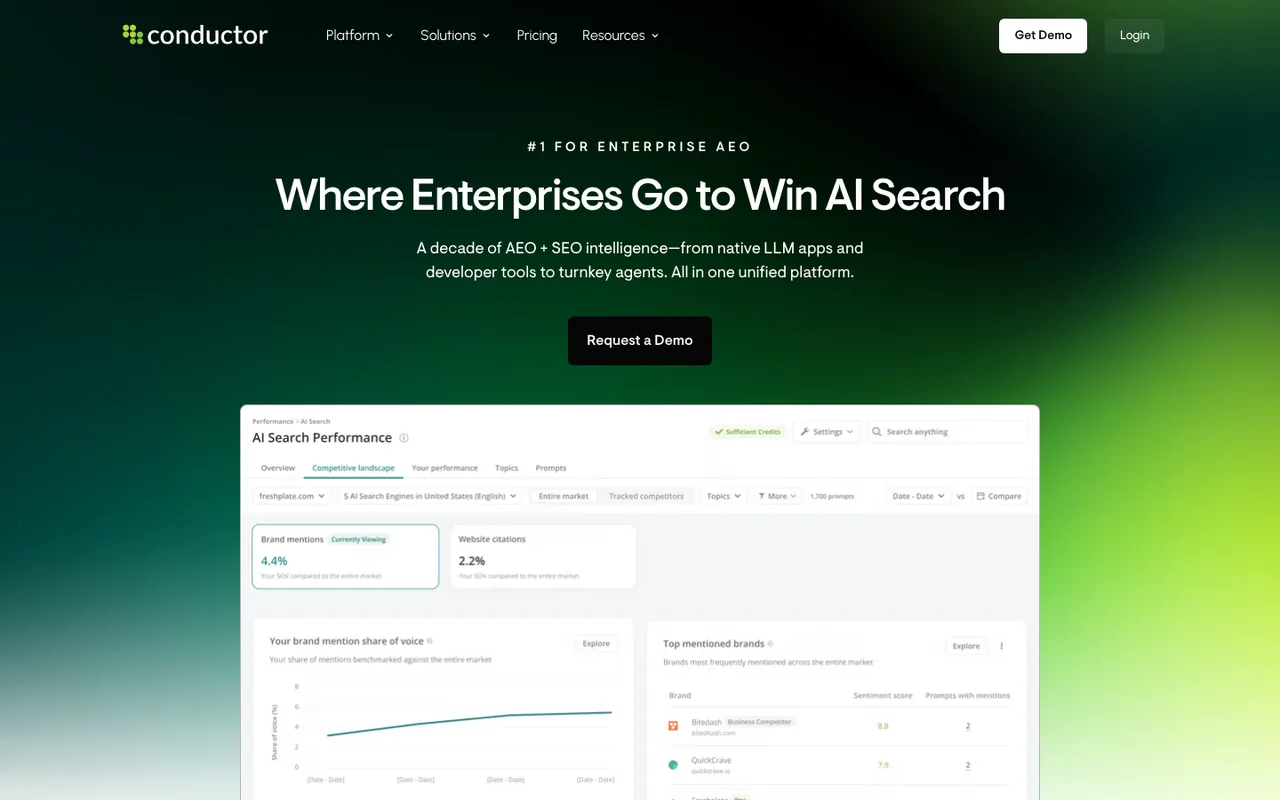 Conductor's homepage, captured November 6, 2026.
Conductor has gone furthest among the classic enterprise SEO suites. Its AgentStack combines LLM apps, developer tools and turnkey agents, and the homepage pitches its APIs and MCP server to "agencies, enterprise IT, and MarTech partners". The pricing table lists the MCP server on every tier and marks the Data API as fully included on Enterprise. SSO starts on Growth and enterprise permissions (RBAC) are Enterprise only. Its turnkey Content Agent and Technical Agent are aimed at content and SEO teams rather than developers.
What Conductor doesn't publish is prices, and our catalog notes that its own reviewers find the AI visibility layer thinner than the SEO side. If your company already runs SEO on Conductor, wiring its MCP server into your agents is a short step. If you are choosing a GEO tool from scratch, compare its AI search data with a dedicated platform first.
5. Profound: agents you rent, not agents you plug in
Profound sells an AI Marketer and a set of Agents, with a Command Center that counts agent runs per user and category and a Context Manager that feeds "real-time brand context" to those agents. The homepage lists RBAC, SCIM and SOC 2, and the pricing page lists SSO/SAML on Enterprise. We found no MCP server on the pages we captured, and our catalog lists the API as Enterprise-gated. Profound is built for agents that run inside Profound. That suits a team that wants the vendor's agents. It suits a team with its own agents less well.
6. Botify: infrastructure for being read by agents
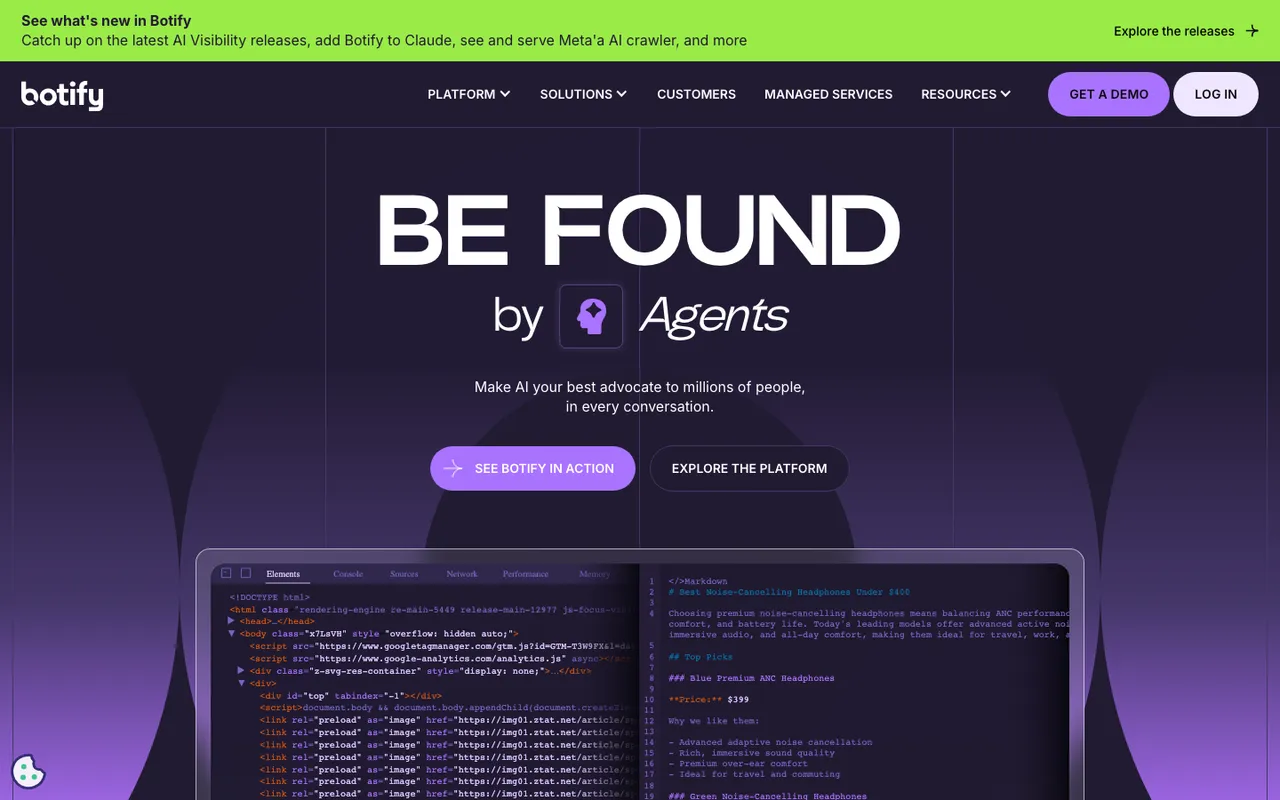 Botify's homepage, captured November 6, 2026.
Botify solves a different half of the problem. It serves content to agents "in under 300ms", enriches product feeds for Google and OpenAI, and its release banner mentions adding Botify to Claude. For a large ecommerce catalog where JavaScript hides prices and reviews from crawlers, that delivery layer is the fix. It doesn't track prompts or attribute AI-referred traffic, and pricing is custom, so it sits next to a GEO platform rather than in place of one.
7. Okara: an MCP-driven agent team
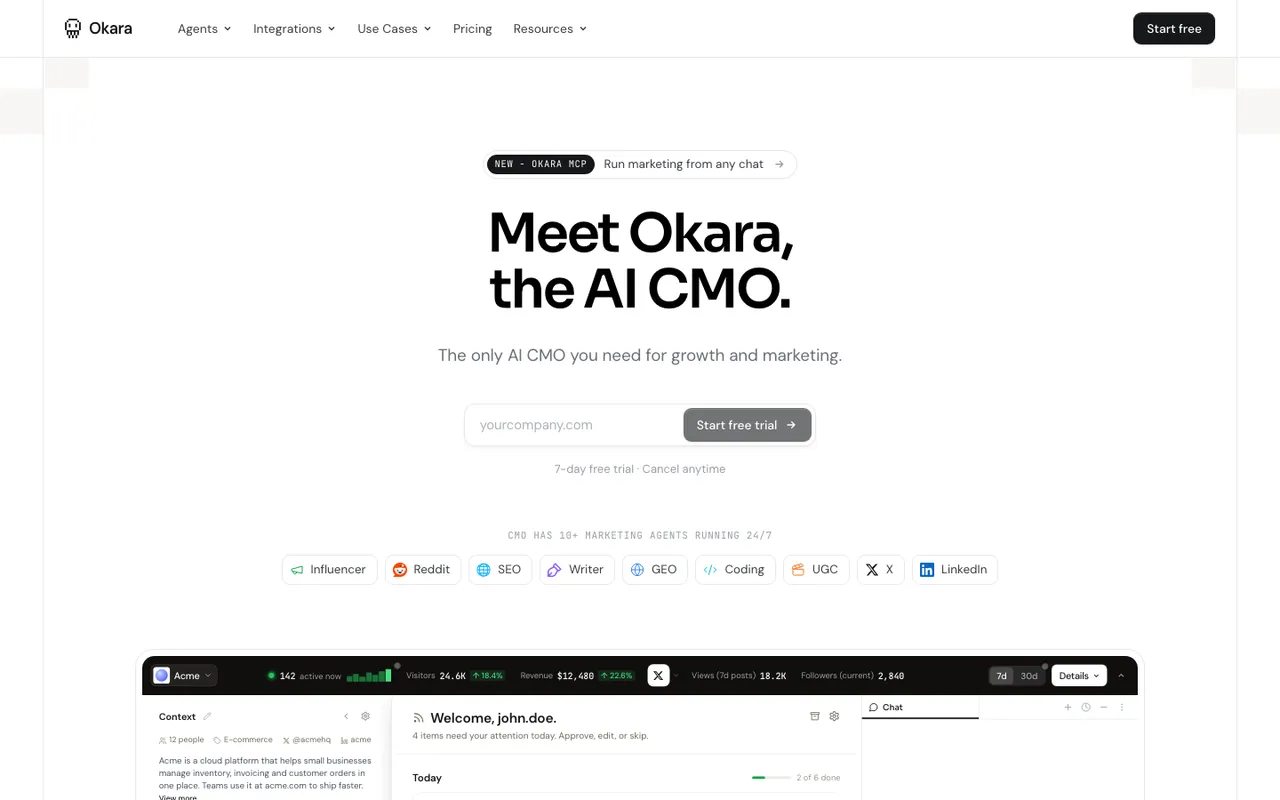 Okara's homepage, captured November 6, 2026.
Okara is an agentic SEO automation tool with a cleaner agent surface than its size suggests. The homepage announces an Okara MCP endpoint so you can "run marketing from any chat", and says it runs 10+ marketing agents, including SEO, GEO, Writer and Coding. Work comes back for approval, and once approved it publishes to WordPress, Webflow, Framer, Wix, HubSpot, Sanity or GitHub. The Coding Agent, which ships fixes as GitHub pull requests, starts on AI CMO Lite at $129/mo.
Our catalog entry lists no SSO, audit log or role model, and no AI crawler logs or citation analytics. Okara is a fast executor for a team or business unit. It is not the system of record for enterprise GEO.
8. SEO MCP: a utility server for your agents
SEO MCP is a plain MCP server with 39 tools across site audits, Search Console, GA4, Google Indexing, IndexNow, Core Web Vitals, schema and sitemaps, for Claude, Cursor, Windsurf and other MCP clients. Enterprise is custom with unlimited calls and keys. It gives an engineering agent classic SEO hands, but it has no prompt tracking or citation data, so it pairs with a GEO platform instead of standing in for one.
How the pieces fit in an enterprise stack
A workable setup has four layers, and it helps to decide who owns each before buying.
The data layer is a read-only key that feeds the warehouse or Looker Studio on a schedule. In Promptwatch that's a scoped read-only key against REST v2 or the Looker Studio connector, sized to your plan's hourly limit.
The agent layer is where your internal agents connect through MCP. Give each agent its own project-scoped key, so you can revoke one without breaking the others, and decide in writing which tools each one may call.
The human layer is where decisions get made: the Action Board for assignment, the Content Agent inbox for approvals, and Slack briefings for regional teams who will never open the app.
The audit layer is the owner reading the log every week, looking at changes that came from the API or an MCP client.
Promptwatch is the only tool in this comparison where all four layers are documented on the vendor's own pages, with published limits. That is why it ranks first here. For an enterprise, the next step is a technical demo: book one with Promptwatch and bring the engineer who will own the MCP connection.