How often does ChatGPT change the sources it cites for the same question? Let agents watch it for you
ChatGPT's cited sources shift between runs, over weeks and overnight. How to hand the watching to agents, which fixes they can ship, and which calls stay with you.
Ask ChatGPT the same question on Monday and Thursday and the source list under the answer may not match. OpenAI publishes no rate for this. Its Help Center describes the moving parts: ChatGPT search usually reformulates a question into its own search queries before sending them to partner providers, can send more specific follow-up queries after reading the first results, and ranks what comes back on "multiple factors". Placement, OpenAI says, "is not guaranteed".
That leaves two jobs: measuring how much your own citations churn, and reacting when they do. Neither is worth doing by hand every day. Both can mostly be handed to software that acts, which is what this site ranks tools on.
Why manual checking fails here
A person re-asking ChatGPT a question sees one run, signed in, from one location, with whatever their account settings add. That's one sample of a moving system. Worse, the biggest changes are platform-wide and sudden. Around March 4, 2026, when GPT-5.3 rolled out, Promptwatch's citation-drop data shows ChatGPT going from roughly 6.4 cited sources per search answer to somewhere between 4.7 and 4.9 by late that month. Nobody spot-checking prompts would have caught that as a pattern; they'd have seen a few missing citations and assumed their page got worse.
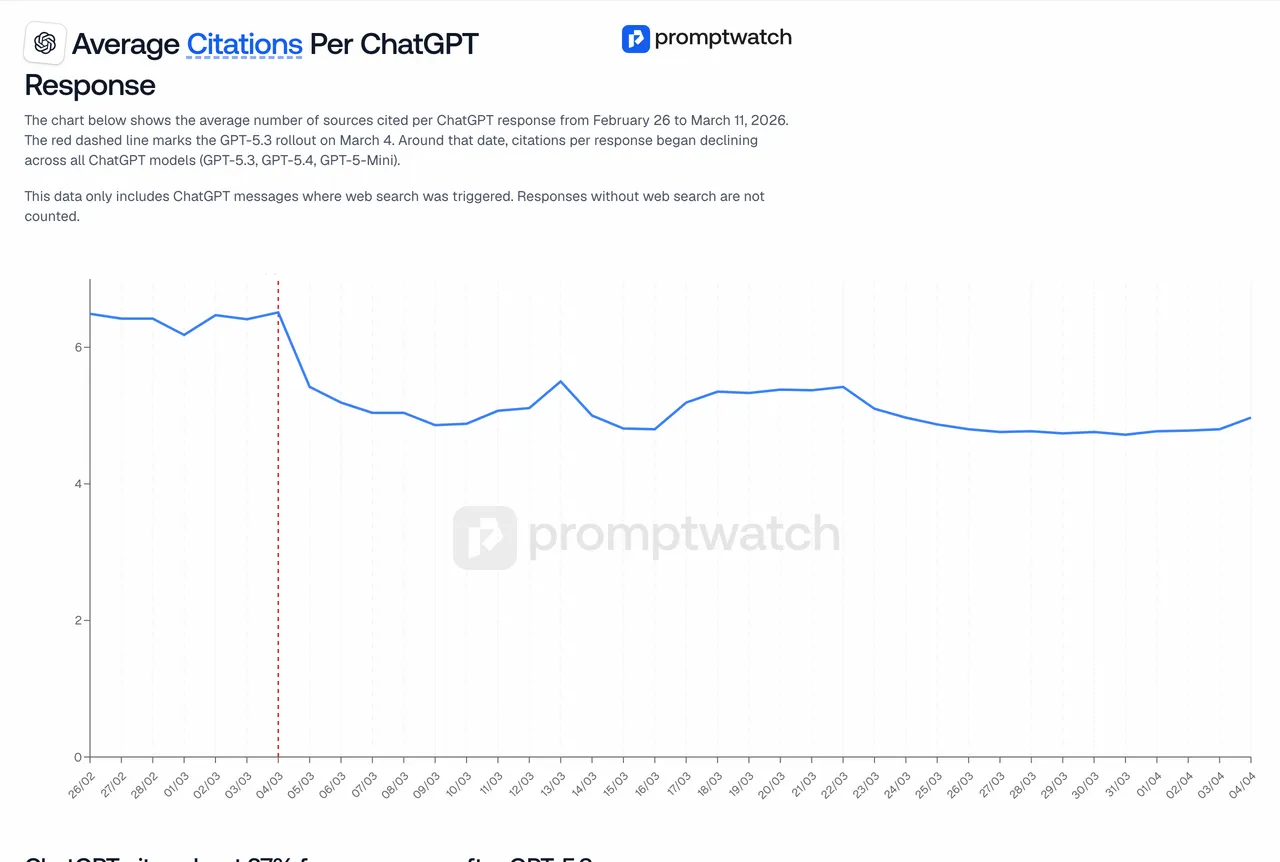
Promptwatch data report "ChatGPT Citation Drop After GPT-5.3", captured November 14, 2026.
What agents can take over
Collecting the runs
Promptwatch re-runs your tracked prompts daily on every plan, and on Business every 12, 6 or 1 hours for prompts that move fast. Each response is stored with its citations and with the exact fanout queries ChatGPT ran. That second part is what lets an agent tell "ChatGPT searched for something else" apart from "ChatGPT found something better for the same search".
For one-off digging, the free GEO Inspector Chrome extension shows the fanouts behind a live ChatGPT answer, which pages were fetched, and which of those were actually cited. It runs locally without a sign-in.
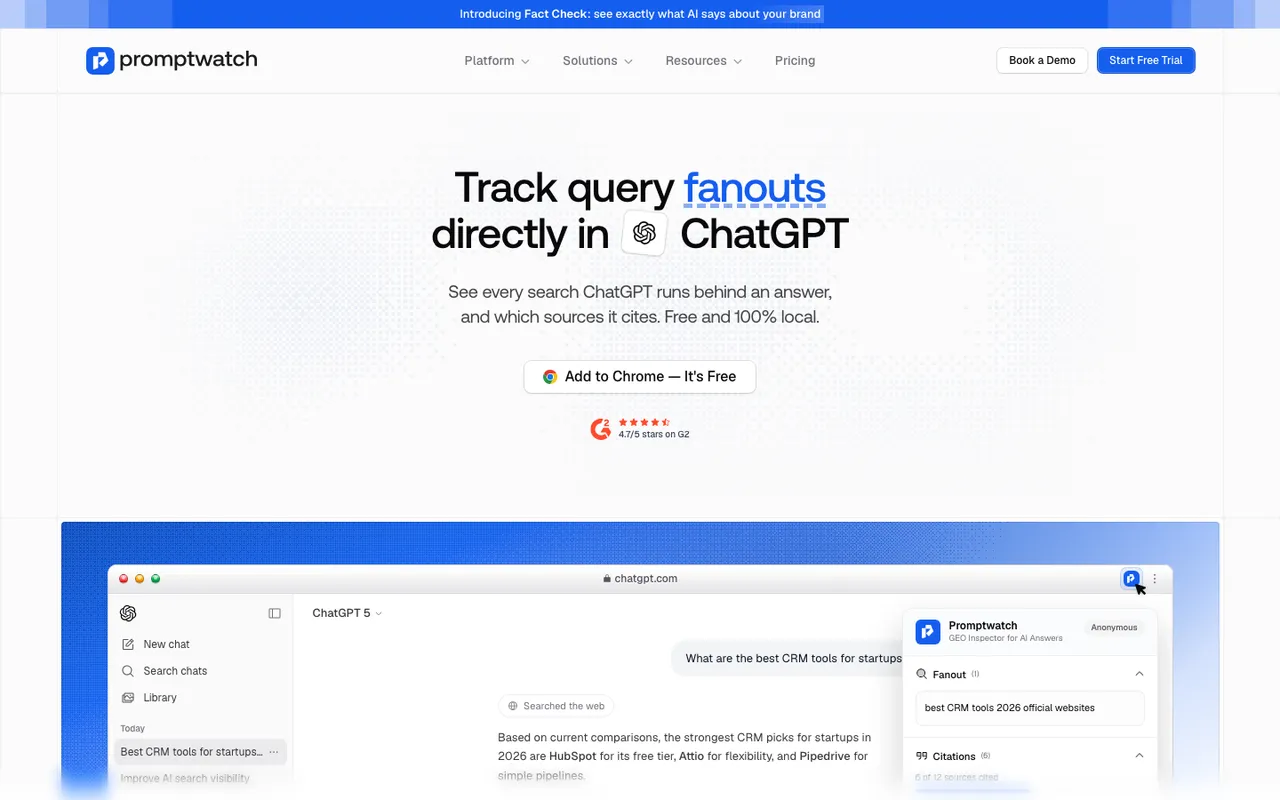
Promptwatch's Chrome extension page, captured November 14, 2026.
Spotting decay and proposing work
Citation Trends follows each cited page from its first citation through ramp-up and peak to the point where it decays, with a half-life per page. Alongside that view, the Action Board's Discovery agent investigates on a weekly schedule, one focus a day, and suggests up to five evidence-backed actions per run, covering areas such as content gaps, site health and untapped pages.
Shipping the refresh
Content Refresh writes diff-style update suggestions for existing pages. On Business and Enterprise, the Content Agent can plan and publish to WordPress, Webflow or Framer on a schedule. The decay data gives this real urgency. In Promptwatch's half-life cohort (pages ChatGPT cited on July 6, 2026), news pages lost half their number within 36 days, and product pages, reviews and how-tos hit their half-life between day 74 and day 77.
The Agent Chat side panel (⌘J) also works on the All Citations, URL Positions and Citation Trends pages. On URL Positions it can point out cited domains that belong to competitors you don't track yet, and it asks before adding one. That turns "who replaced us in this answer?" into a question you type instead of a spreadsheet you build.
Reporting without a dashboard visit
A Scheduled Chat in Agent Chat can deliver a weekly citation briefing to Slack: which pages gained or lost citations, which competitor URLs appeared. Teams running their own agents can pull the same data through the hosted MCP server or the REST API.
What still needs a person
Deciding whether a drop is yours. An agent can flag that citations fell on a given day. Checking that date against platform events is a judgment call. Promptwatch's report on site:operator fanouts shows how abrupt these can be: overnight on August 8, 2026, site: searches grew from 0.37% of ChatGPT's fanouts to 16.8%.
Approving refreshed copy. Keep the Content Agent's review inbox on for pages with pricing or claims. Fast publishing doesn't help if the new copy is wrong.
Crawler policy. If ChatGPT stops citing a page because OAI-SearchBot can't reach it, the fix is in robots.txt or your CDN. OpenAI documents that sites need to allow OAI-SearchBot and its published IP ranges to be eligible for ChatGPT search. Changing that is an infrastructure decision.
Where other agentic tools fit
AthenaHQ pairs citation tracking with an Action Center and a content optimization agent; Starter is $295/mo with 3,600 credits. Okara ships technical SEO and GEO fixes as GitHub pull requests that wait for your approval. Our catalog entries for them don't describe a per-page citation decay view like Citation Trends, so for this particular question you'd want a measurement source next to them.
Setup in one afternoon
- Pick 20 prompts where a citation matters to revenue.
- Load them into a daily monitor in Promptwatch, plus an hourly monitor (a Business plan feature) for the three most volatile.
- Add your top ten URLs and two competitor pages to Page Tracker.
- Schedule a weekly citation briefing to Slack.
- Let the Action Board run for a few weeks before judging what it finds.
You can do all five inside the 7-day free trial of Promptwatch on monthly billing.