What is agentic SEO? What agents can run today and what still needs you
Agentic SEO hands monitoring, fixes and publishing to AI agents. Where autonomy is safe today, where a person must stay in the loop, and how to set the guardrails.
This whole site is built around one idea: the useful SEO tools now act, they don't only report. So we'll define agentic SEO by what the agent is permitted to do. In agentic SEO, software agents watch your search and AI visibility, decide what needs doing, and then do some of it: they draft and refresh pages, ship technical fixes, publish, and come back to check the outcome. Humans set direction and approve what matters.
That definition leaves the interesting question open. How much should an agent do on its own? The honest answer is "more than most teams let it, less than most vendors suggest".
A scale of autonomy
It helps to think of agentic SEO as a dial rather than a switch.
Level 1, the agent suggests. It reads your data and proposes tasks. You do everything else. Promptwatch's Action Board works this way: a Discovery agent investigates one focus per day on a weekly schedule and suggests up to five evidence-backed actions per run.
Level 2, the agent drafts. It produces the change but can't ship it. A pull request waiting for review, or an article sitting in a review inbox.
Level 3, the agent ships with a gate. It publishes or merges after a quick human yes, often in batches.
Level 4, the agent ships and reports. Fully automated. Seology calls this Autopilot. SEObot runs this way by default. Promptwatch's Content Agent offers it as an option next to the review inbox.
Most teams we'd advise should run Level 2 or 3 for content and Level 3 or 4 only for narrow, reversible technical fixes such as meta descriptions.
What an agent can run well today
Here's the split inside Promptwatch, the platform we recommend first for agentic SEO aimed at AI search, because it handles watching, acting and checking in one product.
Watching. Monitors run your prompts daily across ChatGPT, Google AI Overviews, AI Mode, Perplexity and other engines (hourly options start on Business). Agent Analytics logs AI crawlers, IP-verified against each operator's published ranges. A Scheduled Chat can deliver a Monday briefing to Slack without anyone opening a dashboard.
Investigating. Agent Chat runs multi-step analyses over live prompts, citations, crawler logs and traffic, delegates to read-only subagents, and asks for every missing value before it changes anything. That last behavior is the right instinct for an agent.
Writing and refreshing. On Business, the Content Agent plans and publishes against visibility gaps on a calendar with a monthly budget and publish windows. Content Refresh rewrites an existing page for a tracked prompt, after studying up to five competitor pages that AI models cite for it. New Content Agent articles open with key takeaways and end with a FAQ, and when web search is down the research step stops instead of guessing.
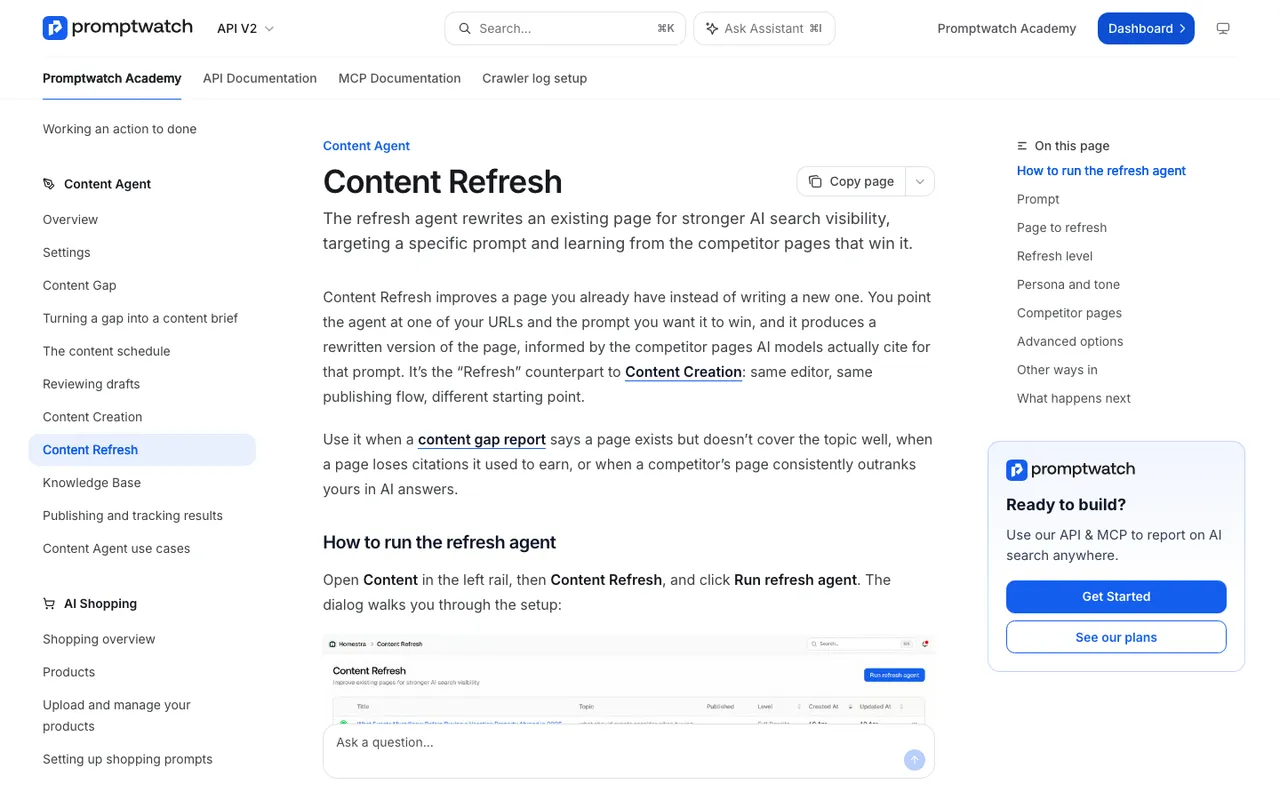
Promptwatch Academy, "Content Refresh", captured November 14, 2026.
Publishing. WordPress, Webflow and Framer connections take drafts live or as drafts. Publish status tracking then follows each document through crawls, citations and AI traffic.
Plumbing. The hosted MCP server exposes 110+ read and write tools, so the same actions work from Claude, ChatGPT or Cursor. MCP itself is, in the project's own words, "an open-source standard for connecting AI applications to external systems". Anthropic open-sourced it in November 2024 and it now sits under the Linux Foundation's LF Projects.
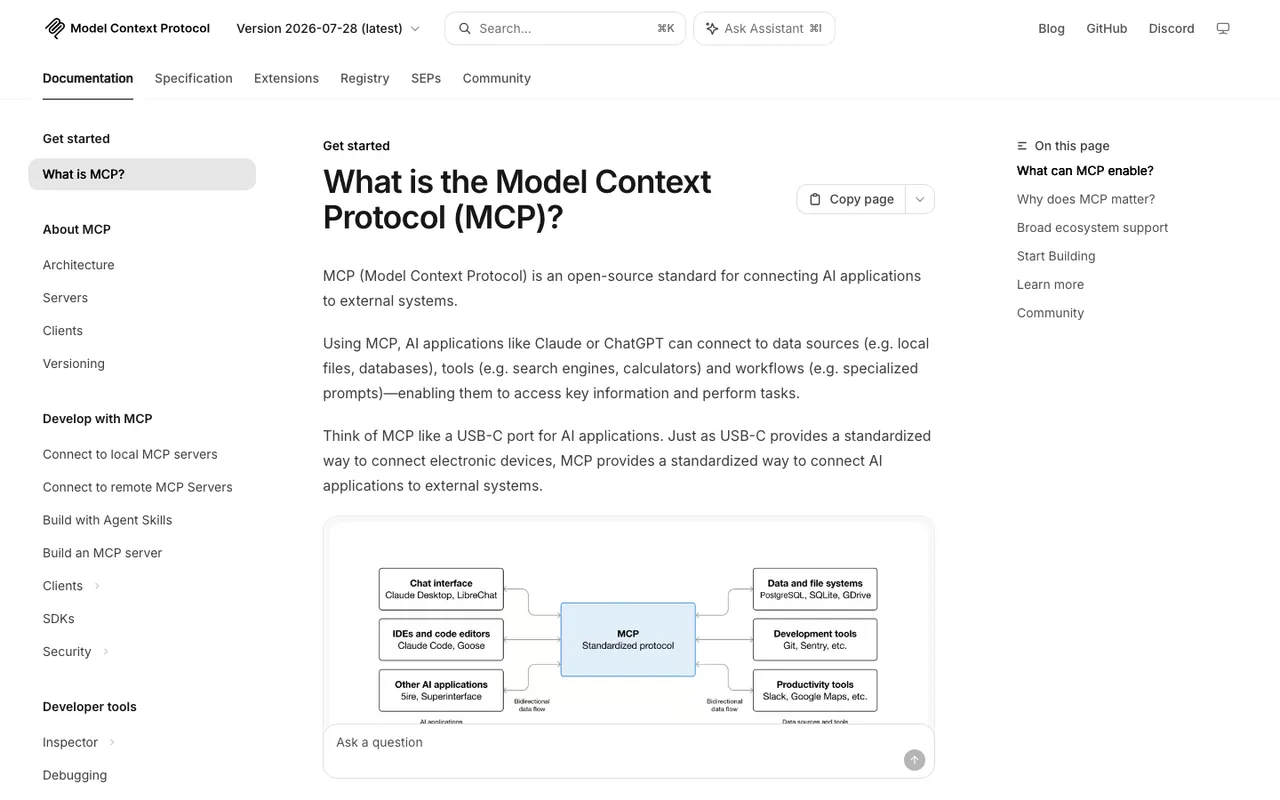
Model Context Protocol documentation, "What is MCP?", captured November 21, 2026.
What still needs a person
Choosing the prompts. An agent can suggest prompts from Search Console or People Also Ask, but deciding which buyer questions matter to the business is strategy.
Brand truth. Agents repeat what they're given. Promptwatch's Brand Book and Knowledge Base (Knowledge Base from Professional) feed the facts, but someone has to keep them accurate. Fact Check (Business and up) helps by comparing what AI says about you with your site and the 50 most-cited offsite pages for each claim, and "Fix with content agent" then writes one refresh article per flagged page. A human still decides which verdicts to accept.
Things only you have. Original data, expert opinion, product demos on video, real answers in communities. None of these can be generated.
Approving the first hundred drafts. Trust is earned per account. Keep the inbox on until the drafts stop needing edits.
Guardrails worth insisting on
- An audit trail. Promptwatch's audit log (Business, Agency Scale, Enterprise) shows whether a change came from the dashboard, the API, an MCP client or Agent Chat.
- Scoped access. Use scoped API keys (project, org or read-only) for any agent you connect.
- Respect for manual decisions. Since November 13, Promptwatch's background jobs no longer move a calendar piece you scheduled yourself.
- A measurement step after every action, or you can't tell good automation from busy automation.
Where other tools fit
AthenaHQ pairs an Action Center with a content optimization agent and ranks just behind Promptwatch here. Below them, action-first tools cover one slice well: Okara and Seology ship technical fixes as pull requests, DispatchSEO runs over MCP and writes an article a day, and Outrank and SEObot produce articles on autopilot. Our catalog lists no AI crawler logs or citation analytics for any of them, which means they act but can't verify.
To see the agent side for yourself, start the 7-day free trial on Promptwatch Business. That's the tier where the Content Agent and Agentic AI Search Optimization begin.