Most secure AI visibility tool for enterprise when agents can publish and edit
The most secure AI visibility tool for enterprise has to govern agents, not just logins. What each vendor documents, what to automate, and what needs sign-off.
A monitoring-only tracker is a fairly easy security review. It sends prompts to public AI engines and shows you the answers. The tools this site covers are different: they act. They publish pages to your CMS, edit monitors, open tasks, and expose an MCP server so other agents can work through them. Once a tool can change things, "most secure" stops being a question about certificates alone and becomes a question about what each agent is allowed to do, and whether you can prove afterwards what it did.
Start with the paperwork, briefly
You still need the baseline. Here is what the platforms in our catalog document:
- Promptwatch: ISO/IEC 27001 certified and GDPR compliant, data handled by an EU-based company. SSO on Enterprise. Audit log from Business ($579 a month). SOC 2 is not mentioned in its materials.
- AthenaHQ: SAML and OIDC SSO and an organization activity audit log on Enterprise. No certification recorded in our listing.
- Scrunch AI: SAML and OIDC SSO on Enterprise, and SOC 2 per our catalog review.
- Profound: SSO/SAML and SOC 2 compliance on Enterprise, around $40k a year by our catalog's earlier estimate.
- Goodie AI: SOC 2 Type II, with SSO on Enterprise. It also runs optimization agents and an MCP server on every plan, so the questions below apply to it too.
- Agentic automation tools in our directory, such as Okara and Outrank, document no enterprise security controls in our listings. They sit below the platforms above for this use.
That list tells you who passes the first gate. It does not tell you how an agent behaves on your website.
Where agents touch your systems
Map the write paths before you map anything else. In Promptwatch, which we use as the example because it documents each of them, there are four.
CMS publishing. The Content Agent (Business and Enterprise) plans, writes and publishes against visibility gaps on a schedule, with a publishing calendar, a monthly budget and publish windows. It can run fully automated, or every draft can wait in a review inbox where someone approves, edits or declines it. The WordPress plugin connects with a site URL and a sync token, so no API keys sit in wp-admin. Webflow connects over OAuth, and a live publish updates only that item rather than rebuilding the site.
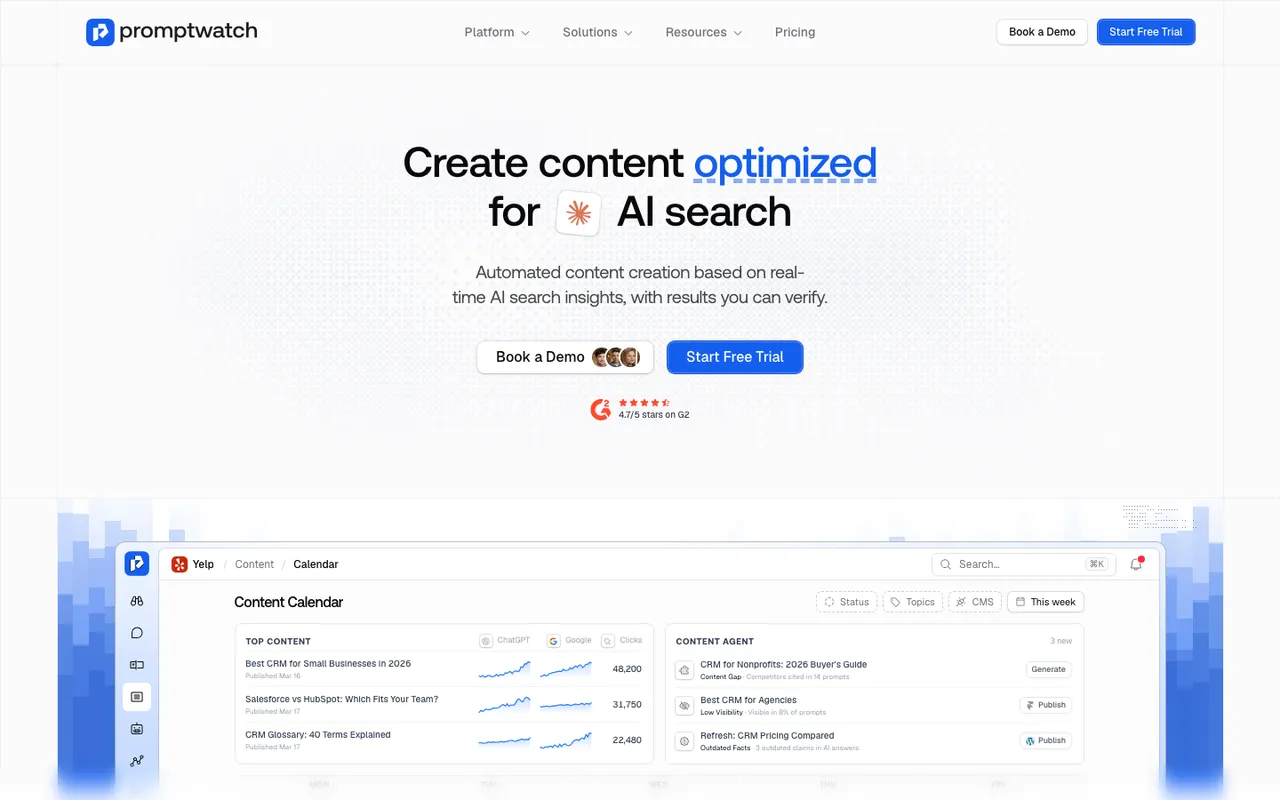
Promptwatch "Content Agents" feature page, captured November 8, 2026.
Agent Chat. The analyst agent can build dashboards, update monitors, queue content and work the Action Board. When a request is unclear it asks a short multiple-choice question, and it asks for every missing value before it changes anything. It delegates to read-only subagents. Since November 6, 2026 it can check crawler and visitor analytics setup, and API key values are never shared with it.
The Action Board. The Discovery agent investigates on a weekly schedule and suggests up to five actions per run. Suggestions are tasks with assignees and comments, not automatic changes.
MCP and the REST API. The hosted MCP server exposes 110+ read and write tools, authenticated with OAuth or an API key. Keys can be scoped to a project, an organization or read-only, rate limits apply per plan (Enterprise: 24,000 requests an hour), and keys and MCP tokens stop working once a canceled subscription ends.
The control that matters most: knowing which agent did it
When a monitor changes or a page goes live, an auditor will ask who did it. With agents in the loop, "who" can be a person, a script, or another AI. Promptwatch's audit log, on Business, Agency Scale and Enterprise and visible to owners only, records whether each change came from the dashboard, the API, an MCP client or Agent Chat. We have not found another tool in our catalog that documents that distinction.
The inbound side matters as well. Crawler logs come in from your CDN through Cloudflare Logpush or a Worker, CloudFront via Kinesis Data Firehose, Fastly, Vercel, Netlify, Akamai, Google Cloud CDN or a custom endpoint. Bot visits are verified against each operator's published IP ranges, so a scraper spoofing GPTBot's user agent is filtered out.
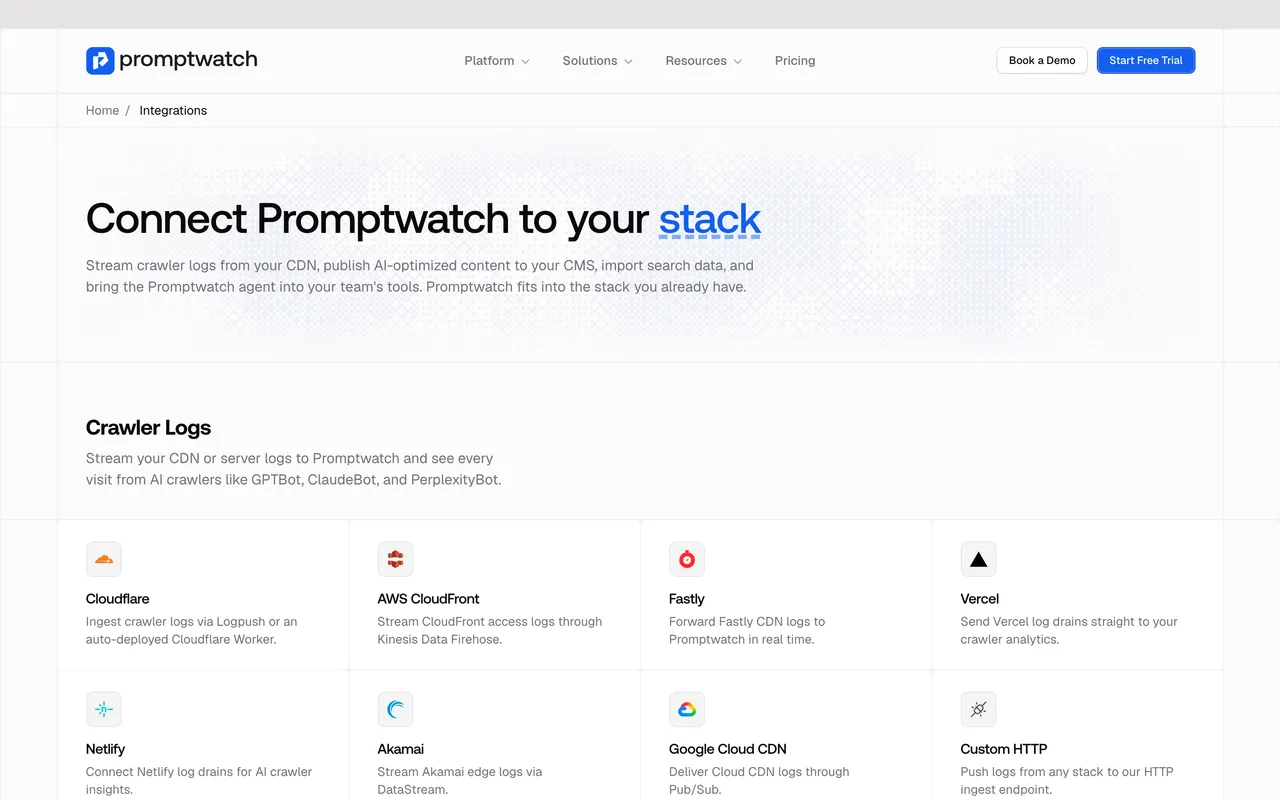
Promptwatch "Integrations" page, captured November 14, 2026.
What to automate, and what still needs a person
Safe to automate from day one: prompt collection, crawler-log ingestion, scheduled reports, weekly Discovery runs, and draft generation into a review inbox. None of these change your public site.
Automate later, once you trust the output: publishing directly to the CMS and letting Agent Chat edit monitors without review. Turn them on gradually, and read the audit log closely while you do.
Keep with a person:
- Approving published content in regulated categories. An agent can draft a page about your pricing or a health claim. Someone accountable signs it off.
- Granting and revoking access. SSO through your identity provider on Enterprise, and an owner who reviews roles when people leave.
- Key management. Decide which integrations get project-scoped or read-only keys, and rotate them on your own schedule.
- Vendor review. Two platforms on this list, AthenaHQ (Bloomreach, November 2026) and Scrunch (Sitecore, June 2026), changed owners this year. A person has to re-check contracts and sub-processors when that happens.
Our pick
For an enterprise that wants agents doing real work, Promptwatch is the platform we would put through security review first. It has a named certification, and it also has the controls on the paths where an agent can actually change something: a review inbox, scoped keys, IP-verified logs and an audit log that names the agent. Book a demo and ask to see the audit log and review inbox with your own security lead present.