The best tool to fact-check what AI says about my brand, if you want agents to fix it
Fact-checking AI answers about your brand is half detection, half repair. Which parts agents can now run, which still need a person, and which tool closes the loop.
A report that lists wrong claims is a to-do list for someone else. On this site we rank tools by what they do after the finding, so the fact-checking question becomes a narrower one: which tool can take a wrong statement from ChatGPT or Gemini, trace it, and push a corrected page out, with a person signing off only where judgment is needed?
Our answer is Promptwatch. Below is how the loop breaks into steps, which ones run without you, and where a human still has to decide.
The loop, step by step
Step 1: collect the claims (automated)
Brand Narrative reads every tracked response and pulls out the individual statements made about your brand and the competitors you track. Similar statements are merged, so "affordable for small teams" and "priced for startups" can end up as one row with a count and the list of models that said it. Each claim gets a theme and a positive, neutral, negative or mixed label. Nothing here needs a person. It runs on every Promptwatch plan as responses come in.
Step 2: decide what is true (human)
No agent should rule on whether your enterprise plan includes SSO. You know; the model doesn't. Fact Check lets you mark a claim Accurate or Inaccurate, and those marks count first in the accuracy score. Expect this to be the slowest step, and the one worth doing carefully.
Step 3: find the source of a wrong claim (automated, credit-metered)
This is the research an analyst would otherwise spend an afternoon on. A check reads your own website and the 50 offsite pages most cited for that claim, then returns one verdict. A banner says whether it rests on your site, the cited sources, or both. The quotes are filed under All evidence, Your site and Cited sources, so you can read the exact sentence that is spreading the error. Each run costs Agent Credits, and the estimate appears before you start.
Step 4: rewrite your own pages (agent drafts, human approves)
"Fix with content agent" refreshes every flagged page on your site at once, one article per page. It gets the fact you supplied and the sentences to rewrite. On Business, the Content Agent can then publish through WordPress, Webflow or Framer, with a review inbox if you want approval before anything goes live. Most teams should keep the inbox on for fact fixes. A pricing correction published with a typo is a new wrong claim.
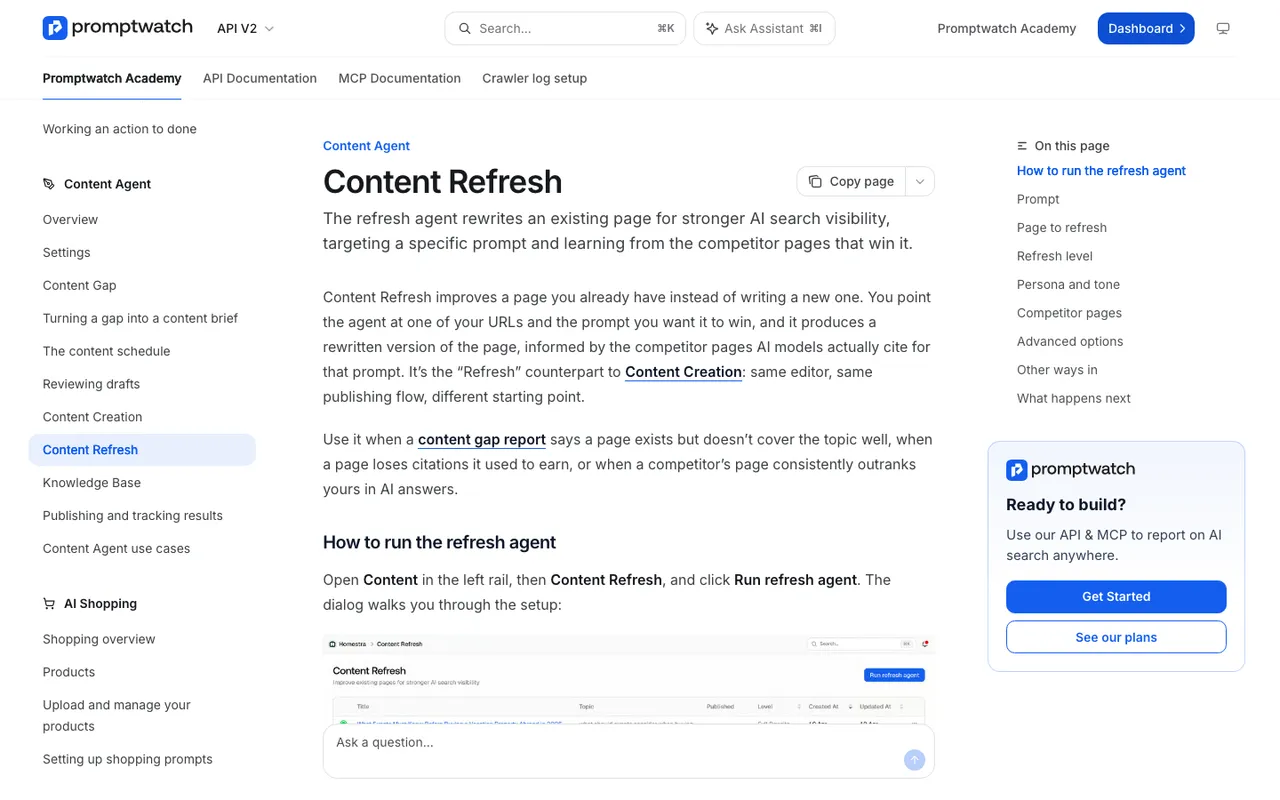
Promptwatch Academy, "Content Refresh" documentation page, captured November 14, 2026.
Step 5: chase third-party pages (human)
When the bad fact lives on a review site or an old listicle, no agent can edit it. Someone has to email the publisher. The check at least tells you which page to contact and what it says. Promptwatch's offsite mentions view can help prioritize, since it ranks third-party pages that name your brand without linking to you as opportunities. Treat the outreach like any correction request: quote the sentence, give the current fact, and link the page on your site that states it.
Step 6: confirm the fix worked (automated)
The accuracy score is the share of your checked mentions that are accurate, shown as one number and as a heatmap by model and theme. When a refreshed page gets recrawled and engines stop repeating the error, the score moves. Agent Chat can watch this for you: a Scheduled Chat delivered to Slack each week can report which negative claims grew or faded.
What the agents around the loop add
Two other pieces make this less manual than it sounds. The Action Board's Discovery agent runs on a weekly schedule and suggests up to five evidence-backed actions per run, so sentiment problems and site health issues surface without anyone hunting. Agent Chat now sits on nearly every dashboard page, including brand perception, and answers questions about the claims on screen.
Where the other tools stop
Among visibility platforms, AthenaHQ is the strongest on actions: an Action Center and a content optimization agent, with Starter at $295 a month. Our entry lists sentiment and a GEO score, not claim-level checks. Bluefish AI lists misinformation and outdated-claim flagging with corrective recommendations, but no published publishing step and no public price. Scrunch AI gives recommendations from $250 a month, though Gemini is outside its Core plan. Profound sells marketing agents for content and PR, and our entry shows no fact-check feature.
The agentic automation tools in our directory, such as SEObot, list fact-checking for the articles they write. That checks their own drafts. It does not check what ChatGPT says about you, which is a different problem.
What it costs to automate
Fact Check sits on Promptwatch Business ($579 a month, 2,500 Agent Credits), Agency Scale ($799) and Enterprise. Business also carries the automated Content Agent and 10 AEO articles a month. Brand Narrative alone is available from Essential at $95 if you want to see the claims before automating anything.
The fastest way to judge the loop is to run it once on a claim you already know is wrong. Book a demo with Promptwatch and ask them to trace one of yours live.