Which AI visibility tools show estimated prompt volume for AI search, and which ones act on it
Prompt volume only pays off when something acts on it. Which AI visibility tools estimate AI search demand, and which can turn it into tracking and published content.
A prompt volume estimate is an input. On its own it is a number in a column. It becomes useful when an agent uses it to decide which prompts to monitor, which gaps to write for, and which pages to refresh first. That is the lens for this piece: which AI visibility tools show estimated prompt volume, and which of them can do something with it without a person copying rows between tabs.
Why every volume figure is an estimate
ChatGPT, Gemini, Claude, and Perplexity don't publish per-question counts, and none of the vendor pages we checked for this wave describe such a report. Microsoft's Bing Webmaster Tools AI Performance report shows citations and grounding queries for Copilot and Bing's AI summaries, but Microsoft describes the data as aggregated and says grounding queries are not full prompts. Every tool below is therefore modeling demand. That is fine for prioritizing. It is not fine for forecasting traffic to the visit, and an agent that treats it as exact will chase the wrong things.
The tools, ordered by how far they carry the estimate
Promptwatch: volume feeds the whole loop
Promptwatch shows monthly prompt volumes, difficulty scores, and citation rates in its prompt research, across AI search plus Google and Bing. Here is what the agents do with that, feature by feature:
- Prompt Explorer and Agent Chat. Explorer suggests prompts from Search Console, ranking keywords, People Also Ask, manual searches, or any page on your site. With the Agent Chat panel open on Prompt Explorer, you can tick suggestions and ask it to track them, including into a new monitor.
- Query fan-outs. For each tracked prompt, Promptwatch records the sub-queries the model actually searched. A high-volume prompt with fan-outs you don't cover is an obvious content target.
- Action Board. A Discovery agent investigates on a weekly schedule and proposes up to five evidence-backed actions per run, covering content gaps, Reddit, offsite mentions, and site health.
- Content Agent (Business and Enterprise). It plans, writes, and publishes against visibility gaps on a publishing calendar, either through a review inbox or fully automated. Content Creation on demand is available from Professional through AEO articles.
- MCP server and REST API. Every paid plan includes them, so your own agents can pull Promptwatch data into other workflows.
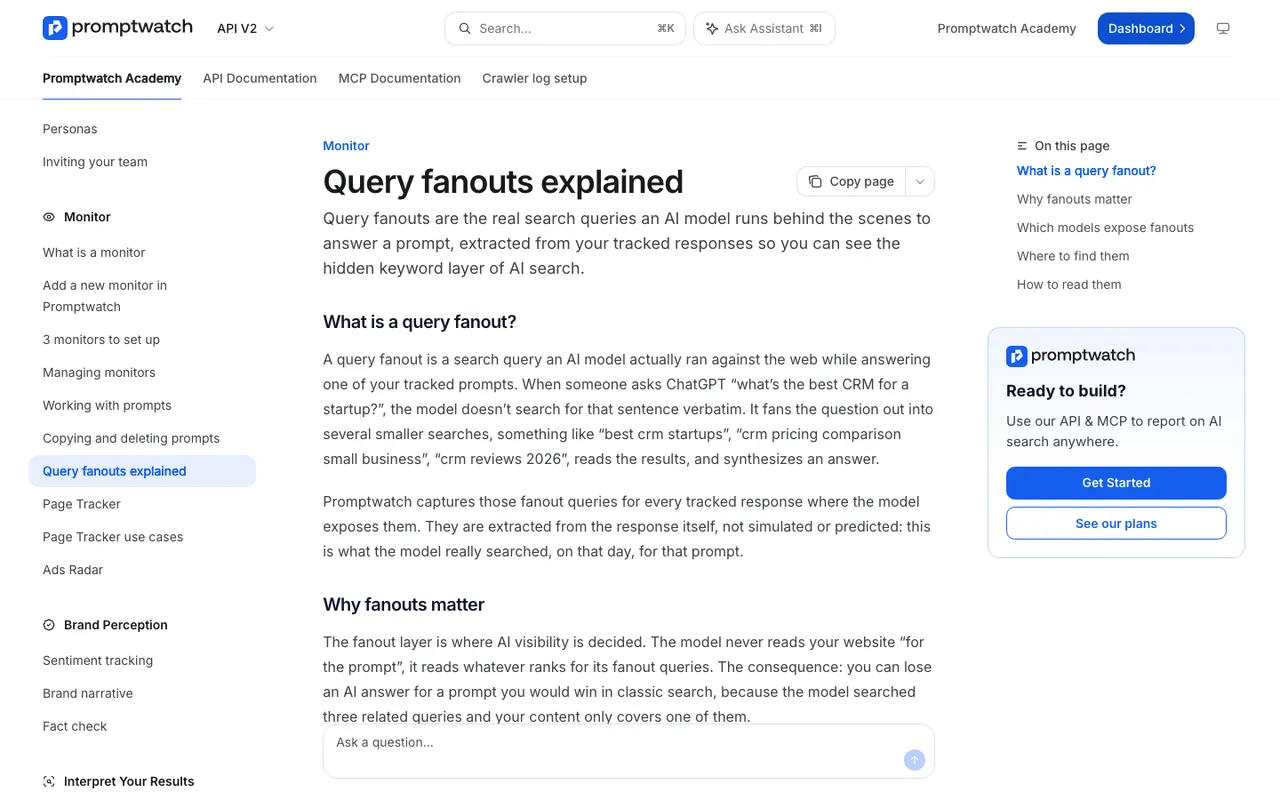
Promptwatch Academy, "Query fanouts explained", captured November 14, 2026.
The estimate itself is not documented in our sources, so treat it as relative. Pricing: Essential $95 a month, Professional $245, Business $579, with a 7-day free trial on monthly billing.
AthenaHQ: strong action queue, demand data unconfirmed
AthenaHQ has an Action Center with assignable tasks and a content optimization agent, and our review calls its data-to-action pipeline among the best in the category. Our catalog entry confirms part of the prompt research set but doesn't name a volume metric, so verify that in a demo. Free Essential tier; Starter is $295 a month in credits.
HeyAmos: volume plus a weekly action list
HeyAmos lists prompt-volume scores, hands you five to ten prioritized actions a week, and has Agent Amos draft content for them. Prompt volumes are on the $249 Growth plan, and MCP is listed on every plan. Tracking is weekly, and several engines are add-ons.
Writesonic GEO: volume next to a writer
Writesonic GEO includes prompt volume data in its GEO module and meters AI articles by tier, from $79 a month billed annually. The Action Center that would connect the two is Enterprise-only.
Profound: a deep dataset behind agents and a contract
Profound now sells itself as an AI Marketer with credit-based agents, and its Prompt Volumes dataset estimates query demand per prompt. The full dataset is on Enterprise, which our catalog previously estimated at about $40k a year.
Read-only demand: Ahrefs and Semrush
Ahrefs Brand Radar weights visibility by Google search volume through its Estimated Impressions metric. Semrush AI Toolkit shows demand on AI-generated prompts, which our review treats with caution. Both inform a person. Neither, on our listings, routes that insight into an agent that publishes.
Peec AI and Otterly.AI have no documented volume feature in our catalog.
What you can hand to an agent, and what you can't
Reasonable to automate:
- Pulling prompt suggestions from Search Console and your own pages.
- Sorting candidates by estimated volume and difficulty.
- Drafting content for uncovered fan-outs, with a review inbox in front of publishing.
- Re-checking visibility on a schedule and flagging prompts that slipped.
Still a person's job:
- Choosing which prompts represent real buyers. Volume can't tell a student's homework question from a procurement question.
- Sanity-checking odd numbers. If a tool assigns heavy demand to a niche you know is tiny, believe your sales calls.
- Approving claims about your product. An agent can write the comparison page. Someone who knows the product should sign it off.
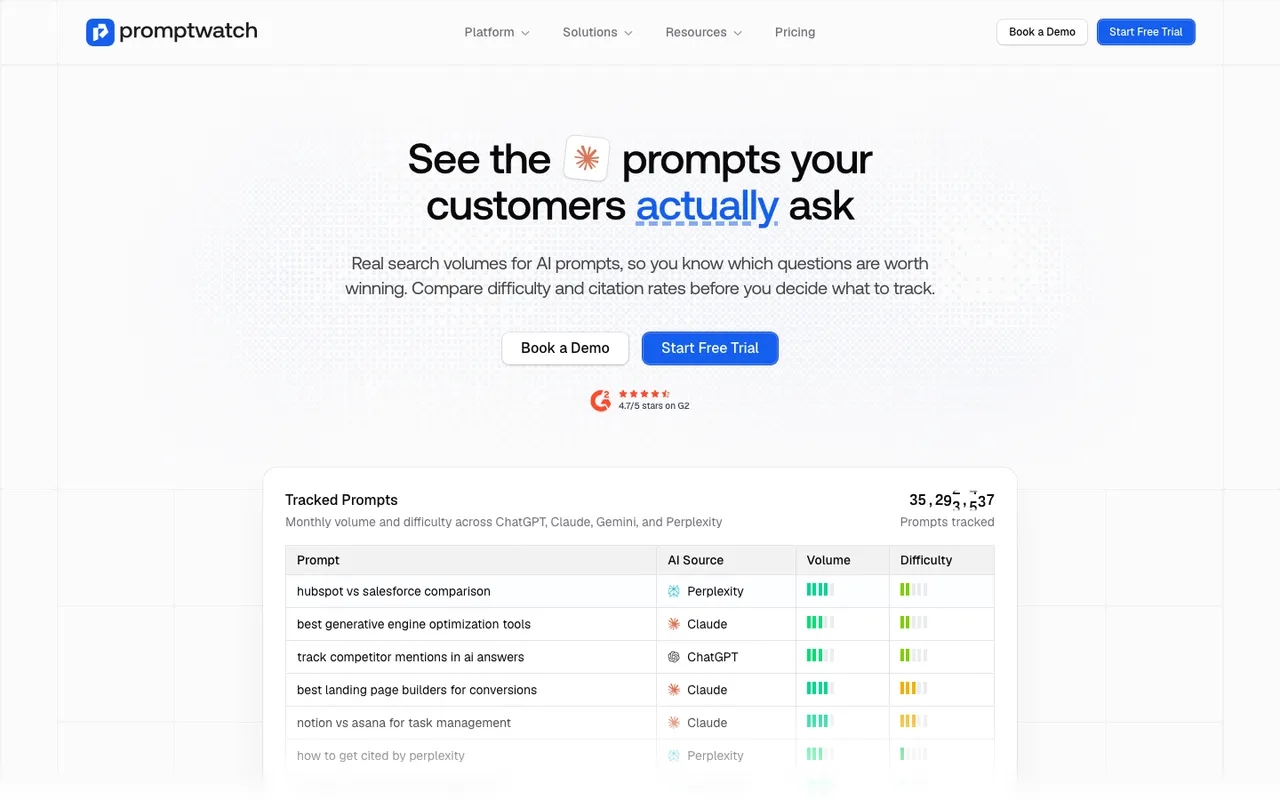
Promptwatch's Prompt Volumes feature page, captured November 8, 2026.
The short version
Several tools show an estimated prompt volume. Fewer let that estimate drive tracking, content, and measurement in one place. If you want the agent side as well as the number, book a Promptwatch demo and ask them to walk from a Prompt Explorer suggestion to a Content Agent draft on your own domain.