AI visibility tool with unlimited team seats: who needs a seat when agents do the work
An AI visibility tool with unlimited team seats matters more once agents draft content and file tasks: someone has to approve, assign and review. Who that is, and why.
There is an argument that seats matter less in an agentic tool. If an agent writes the drafts, finds the tasks and builds the reports, why would ten people need logins? In practice it runs the other way. The more a platform acts on its own, the more people you need in the loop to approve, assign and check what it did. An AI visibility tool with unlimited team seats is the one where you can add those people without a budget conversation each time.
Promptwatch has unlimited team seats on every paid plan, and it is also the platform in our catalog where agents do the most: a Content Agent that plans, writes and publishes, an Action Board with a Discovery agent, and Agent Chat over live data. Here is who ends up needing a seat once those agents are running.
The approver for the Content Agent
On Business ($579/mo) and Enterprise, the Content Agent writes against visibility gaps on a schedule, with a publishing calendar, a monthly budget and publish windows. It can run fully automated, but most teams use the review inbox, where a person approves, edits or declines each piece before it reaches WordPress, Webflow or Framer.
That person is rarely the SEO lead. It is the product marketer who knows the pricing, or the subject expert who catches a wrong claim about a regulated feature. With seat caps, those reviewers get drafts forwarded by email and the approval trail disappears. With unlimited seats, they approve in the inbox themselves.
Assignees on the Action Board
The Action Board is a prioritized to-do list built by an agent. A Discovery agent investigates on a weekly schedule and suggests up to five evidence-backed actions per run, covering content gaps, sentiment, Reddit threads, offsite mentions and site health. Actions get assignees and comments, and you can @-mention the agent to ask it to explain or extend a suggestion.
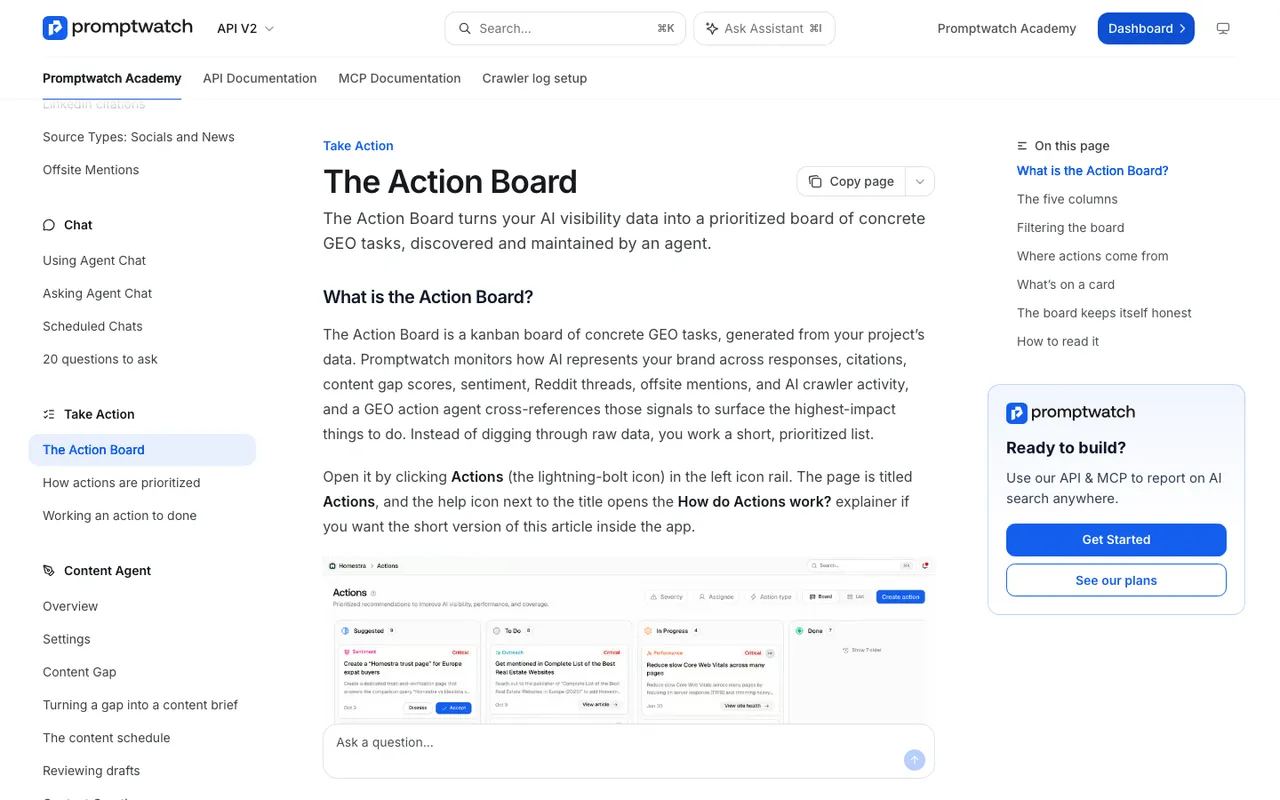
Promptwatch Academy, "The Action Board", captured November 14, 2026.
A site health action belongs with a developer, an outreach action with whoever runs PR, a content gap with a writer. Per the Academy page, viewers can't be assigned, so each of those people needs at least an editor seat. On a seat-capped plan, the board turns into a list one person relays to everyone else.
People who talk to the agent
Agent Chat is an analyst you query in plain language: which competitors gained citations this week, which pages crawlers visit but engines never cite, what changed in Gemini. It runs multi-step analyses, builds dashboards and generates PDF reports. Each person asking their own questions is the point, and that only works if each person has a login. Scheduled Chats also deliver recurring briefings in-app or to Slack, which suits stakeholders who will never open a dashboard.
The same goes for teams who work from their own AI tools. Promptwatch's hosted MCP server connects Claude, Claude Code, ChatGPT, Cursor, Lovable and Codex to the project data through OAuth or an API key. A developer asking Claude about crawl errors from inside their editor is another user.
Why the audit log matters more with agents
When agents, APIs and people all change things, you need to know who did what. From Business (and on Agency Scale), Promptwatch's audit log shows owners each change and whether it came from the dashboard, the API, an MCP client or Agent Chat. Unlimited seats plus a change history is a workable setup. Unlimited seats without one gets messy quickly when an agent can edit monitors.
Roles keep it sane: owner, editor and viewer, set per project, with bulk invites for onboarding.
What other agentic platforms charge for people
Seat policies vary a lot among the tools that act rather than just report. AthenaHQ, with its Action Center and content optimization agent, lists unlimited users on its free Essential tier; our entry doesn't state the seat count on the $295 Starter plan. Goodie AI runs optimization agents and includes unlimited seats on Core ($295/mo) and Pro ($999/mo). AirOps, a content workflow builder, includes unlimited seats on Pro while Solo is single-user. Gauge pairs a content engine and an Action Center with three seats on Growth ($599/mo). Writesonic GEO includes two or three users on its middle plans and charges $50 a month per extra user.
What still needs a human, whatever the seat count
Agents can find the gap, draft the page and file the task. They can't decide that a claim about your pricing is true, sign off on a page in a regulated category, or email a publisher asking for a correction. Every one of those is a person, and every one of those people is better off inside the tool than outside it.
Getting started
Map the roles first: who approves drafts, who takes site health tasks, who just wants the Monday briefing. Then start Promptwatch's 7-day free trial on monthly billing, invite all of them in week one, and let the Discovery agent fill the board while they get used to it.