Best agentic GEO tools for Shopify stores (2026)
Nine GEO tools ranked for Shopify merchants by what they actually do for a store: product-level AI tracking, Shopify publishing, crawler logs and AI-referred sales. Sourced from pages captured November 6, 2026.
A Shopify store has two AI visibility problems, and most tools only see one of them.
The first is the product problem. When someone asks ChatGPT for the best mineral sunscreen or a waterproof hiking boot under a certain price, the answer names a handful of products (Wildcard's homepage puts a typical AI answer at three to five). Your product data, reviews and the pages AI cites decide whether yours is one of them. The second is the site problem. Your collection pages, buying guides and blog posts are what AI engines crawl and cite when the question is broader, like "how do I choose a trail running shoe". If GPTBot can't fetch those pages, or they don't answer the question, no amount of product enrichment fixes it.
This ranking looks at which tools act on either problem, whether they can push changes into a Shopify store, and whether they can show you what happened afterwards.
How we picked and ranked
We read each vendor's homepage and, where available, its pricing page as captured on November 6, 2026, next to the entries in our own catalog. We did not connect any of these tools to a store. For every tool we checked four things:
- Does it track products, or only the brand?
- Can it write to Shopify, or only to other systems?
- Can it see AI crawlers on your store's pages?
- Does it connect AI answers to visits or orders?
When a tool's Shopify support isn't documented on the pages we read, we say so instead of assuming.
1. Promptwatch
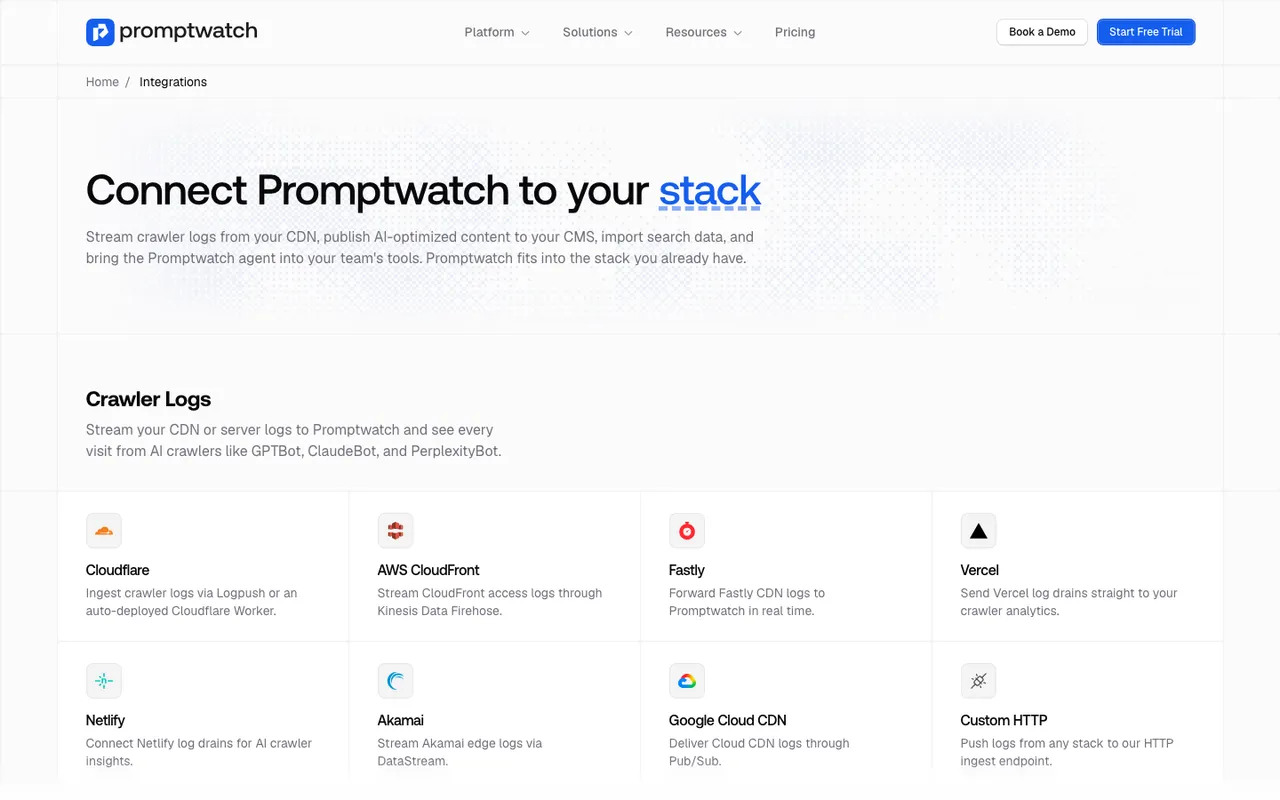 Promptwatch's integrations page, captured November 6, 2026.
Promptwatch ranks first because it covers both problems and measures the outcome, though it is not a Shopify app and you should know where the gaps are.
On the product side, ChatGPT Shopping insights (Business, $579/mo, and Enterprise) track ChatGPT shopping carousels and Amazon Alexa product results for your tracked prompts. You can upload your own catalog and filter by model, date and monitor. Ads Radar, also from Business, captures the sponsored ads that appear inside ChatGPT Search, Google AI Overviews and Google AI Mode answers to the same prompts, with the advertiser, ad copy and landing page.
On the site side, Agent Analytics shows IP-verified visits from AI crawlers such as GPTBot, OAI-SearchBot and ChatGPT-User, with a citation rate for each page. The integrations page says sites on Shopify can connect through Cloudflare with a guided setup. Crawler logs start on Professional ($245/mo). Visitor analytics, on every paid plan, count AI-referred visits and conversions from ChatGPT, Perplexity, Gemini, Claude and Copilot. It installs with a lightweight script or the GTM template. We did not find a dedicated Shopify app for it on the captured pages. One detail matters for stores: ChatGPT stopped sending a referrer on October 8, 2026, and an "Include ChatGPT UTM referrers" toggle counts utm_source=chatgpt.com visits as ChatGPT again, without double counting.
The Content Agent (Business and Enterprise) plans and writes buying guides and comparison pages against the prompts where you're missing. Here is the honest limit: its CMS publishing targets are WordPress, Webflow and Framer, and Shopify is not one of them. Shopify stores export the draft as Markdown or HTML and paste it into the Shopify blog or a page.
2. AthenaHQ
 AthenaHQ's homepage, captured November 6, 2026.
AthenaHQ has the clearest Shopify write path of the general GEO platforms. Its homepage FAQ says the Shopify integration lets you publish AEO-optimized content and attribute revenue to AI search, and describes it as built for ChatGPT Shopping. GA4 and Search Console connect visibility to traffic.
Starter is $295 a month for 3,600 credits, with 11 models, unlimited prompts and competitors, on-page and off-page actions and a content optimization agent. The pricing table lists the Shopify and Webflow integration but its text doesn't mark which tier gets it, so confirm before you buy Starter for Shopify alone. Starter is country-level for a single region. The captured pages don't describe AI crawler logs.
3. Wildcard
 Wildcard's homepage, captured November 6, 2026.
Wildcard is the most Shopify-native tool in this list. It syncs products, collections and pages from Shopify (also BigCommerce, Salesforce or a PIM), tracks buyer questions with search volume across ChatGPT, Gemini, Perplexity and Claude, and per our catalog also covers Google AI Overviews, Walmart Sparky and Alexa+ Shopping, with Amazon Rufus in beta.
Agents draft enriched product data, collection pages and blogs, plus press, Reddit and YouTube outreach. The homepage says nothing publishes without your approval. Revenue attribution ties orders back to the AI surface. Basic is $99 a month for 10 actions, 50 prompts, 20 products, one workspace, a weekly refresh and Shopify publishing. Credit packs run $100 for 1,000 credits or $250 for 4,000.
The trade-offs: weekly rather than daily refresh on Basic, API on Enterprise only, and no crawler logs. It is built for commerce prompts, not brand or B2B questions.
4. Azoma
 Azoma's homepage, captured November 6, 2026.
Azoma acts on the catalog at enterprise scale. The homepage says it connects to Amazon, Walmart, PIM systems, Shopify and Google Merchant Center to pull in and improve product data, and our catalog lists publishing into Seller Central, Vendor Central, Salsify and Shopify. It generates PDP and blog copy against approved claims, and covers retailer shopping agents (Alexa for Shopping, Walmart Sparky) alongside ChatGPT Shopping, Gemini, Perplexity, Claude and Meta AI.
Pricing is sales-quoted, with no published limits or trial. Its crawler monitoring has no published CDN connectors, and it doesn't publish to WordPress, Webflow or Framer. It suits a brand that sells mostly through marketplaces and has a Shopify store on the side.
5. Goodie AI
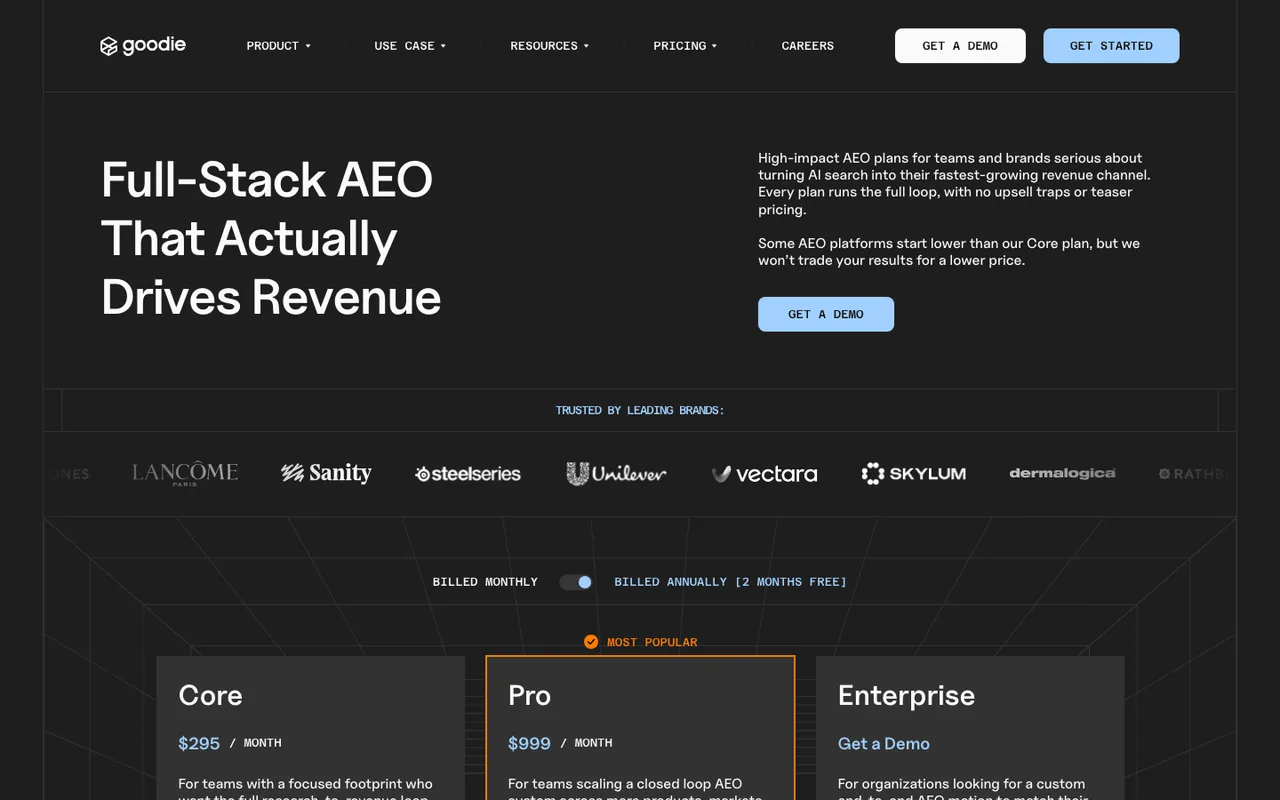 Goodie's pricing page, captured November 6, 2026.
Goodie AI has an agentic commerce angle. Its pricing page lists agentic commerce tracking across ChatGPT, Perplexity, AI Mode, Alexa and Walmart Sparky, and SKU-level agentic commerce visibility on Pro at $999 a month. Core, at $295 with a 7-day free trial, tracks five models, 110 prompts and one brand.
Shopify appears in the integrations list on the pricing page, but the page text doesn't show which tier includes it or what it does. The agent list (content writer, blog generation, technical agent, llms.txt and sitemap repair) is long. Ask in the demo whether the agents can publish into Shopify or only draft.
6. Scrunch AI
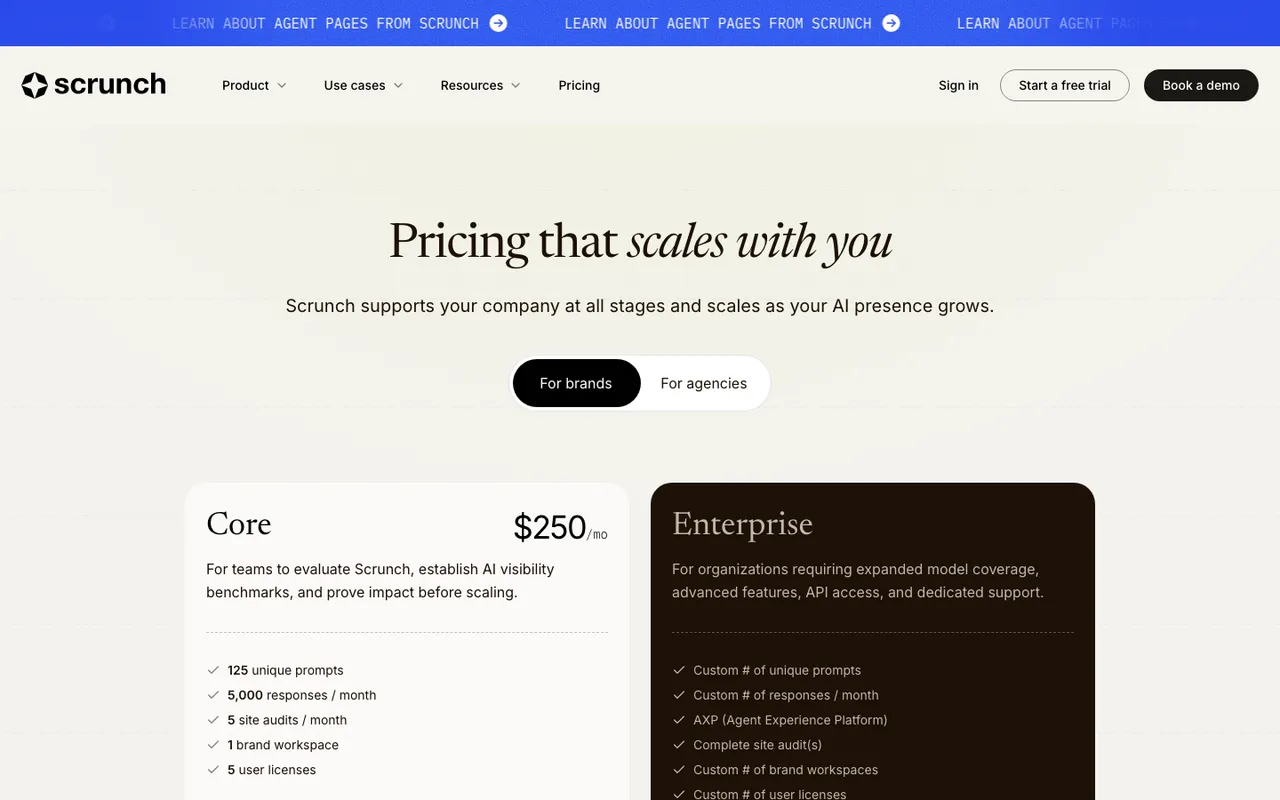 Scrunch's pricing page, captured November 6, 2026.
Scrunch AI lists a Shopping product in its navigation ("AI search performance at the product level"). In the pricing table, product observability is not on Core and is on Enterprise. Core is $250 a month with four LLMs, 125 prompts and AI agent and bot traffic reporting. Its Agent Experience Platform, which serves AI-optimized page versions to agents, is Enterprise only.
We found no Shopify integration on the captured pages. For a store, Scrunch is mostly a monitoring and bot-traffic tool until you reach Enterprise.
7. Profound
Profound tracks ChatGPT Shopping with what its homepage calls SKU-level granularity across merchants and retailers. The pricing page puts ChatGPT Shopping on Enterprise and not on the free trial. Agent Analytics lists integrations for Cloudflare, AWS, Fastly, Vercel, Netlify, Akamai, WordPress and Google Analytics. Shopify isn't named among them, and we found no Shopify publishing path on the captured pages. There is no public Enterprise price, which puts it out of reach for most independent stores.
8. Seology
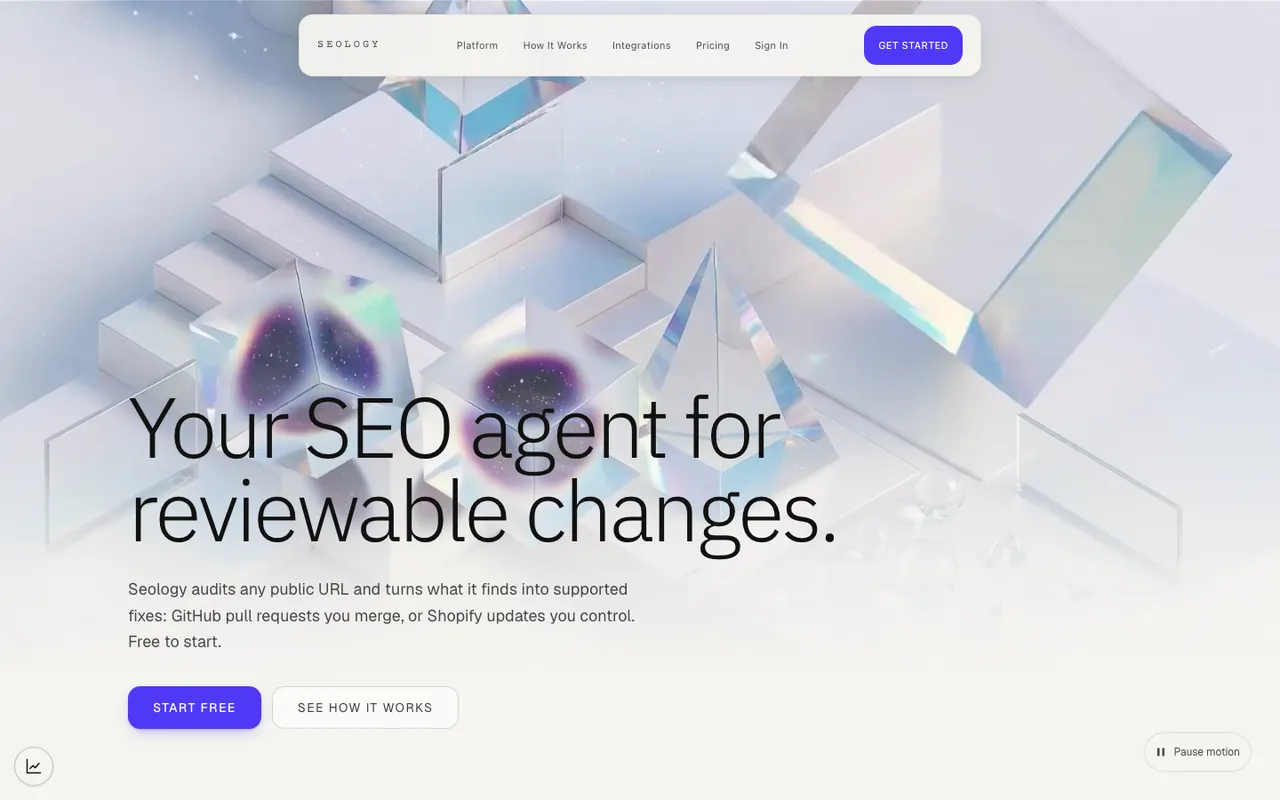 Seology's homepage, captured November 6, 2026.
Seology offers exactly two self-service connectors on its homepage, GitHub and Shopify, which makes it unusually direct for a store. It audits the store, proposes fixes for supported fields, and applies Shopify updates with the permissions you grant. Plan mode (approve a batch) is on every plan, including the free Starter for one site. Growth is $29 a month for three sites with every mode, including Automatic. Scale is $99 for ten sites.
Seology says plainly that its audit scores are not AI citation measurements. It's a technical fixer for the store, not a way to see how ChatGPT treats your products.
9. Outrank
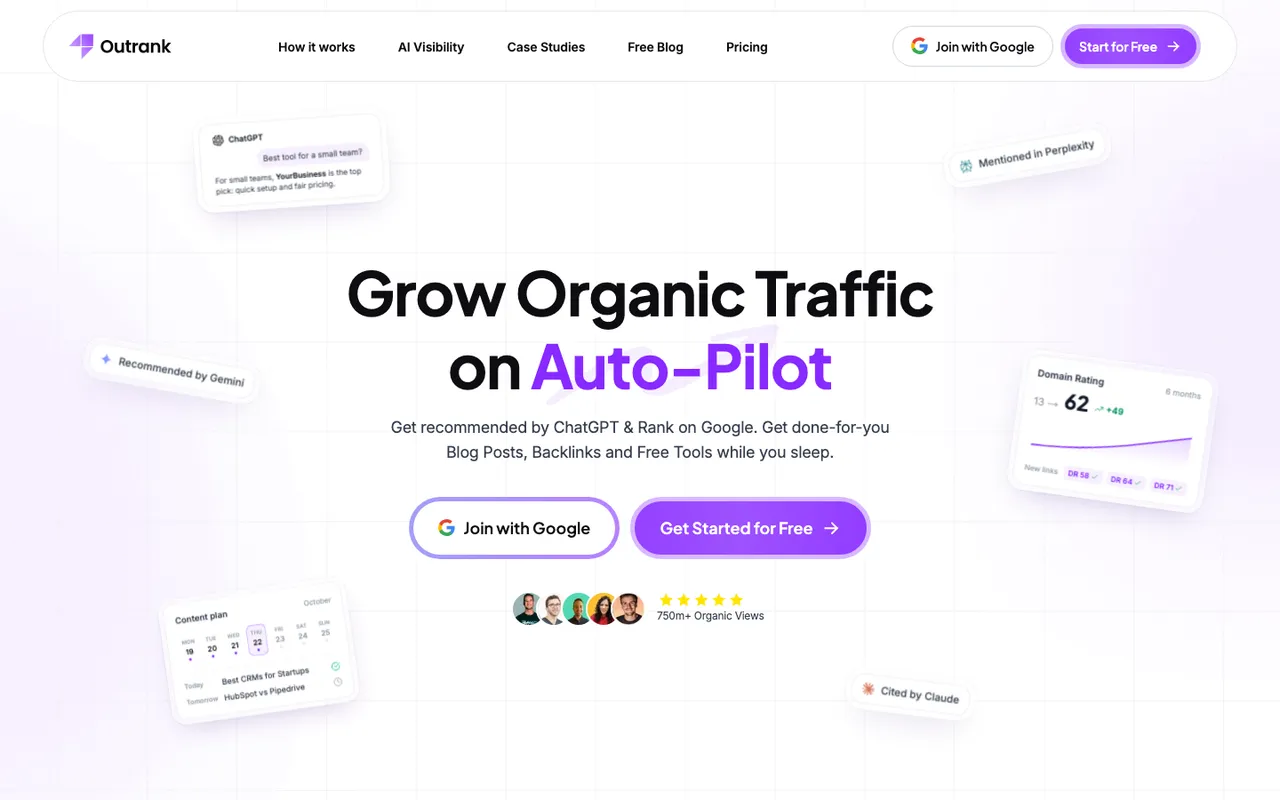 Outrank's homepage, captured November 6, 2026.
Outrank writes and publishes blog content on a schedule, and its homepage lists Shopify with the line "Power store blogs". Our catalog lists $99 a month for 30 articles, with upgrades to 60 or 90 and unlimited users. The captured homepage also shows a $199 figure next to an "Articles + backlinks" label, so check which plan includes the backlink exchange before you buy. It does not track prompts across AI engines or log crawlers.
SEObot is a similar content autopilot that lists Shopify among its CMS integrations, from $49 a month for nine articles.
How they compare for a Shopify store
| Tool | Product-level AI tracking | Writes to Shopify | AI crawler logs | AI-referred sales |
|---|---|---|---|---|
| Promptwatch | ChatGPT Shopping and Alexa (Business) | No; export Markdown or HTML | Yes, via Cloudflare (Professional) | Visitor analytics with conversions |
| AthenaHQ | Not documented | Yes, AEO content | Not documented | GA4 attribution |
| Wildcard | Yes, per SKU | Yes, after approval | No | Orders by AI surface |
| Azoma | Yes, per SKU | Yes, per catalog | No published connectors | SKU-level attribution |
| Goodie AI | SKU-level on Pro | Not documented | Listed | Complete revenue attribution on Enterprise |
| Scrunch AI | Enterprise | Not documented | Bot traffic reporting | Not documented |
| Profound | ChatGPT Shopping (Enterprise) | Not documented | Agent Analytics | Not documented for Shopify |
| Seology | No | Yes, store fixes | No | No |
| Outrank | No | Yes, blog posts | No | No |
Who should pick which
If the store sells most of its revenue through Shopify and you want one place to watch ChatGPT Shopping, see whether GPTBot reaches your collection pages, and count the sales AI sends, pick Promptwatch on Business. Accept that the Content Agent's drafts go into Shopify by copy and paste.
If you want an agent that rewrites product data and collection pages and pushes them straight into Shopify, Wildcard is the most direct fit. Start on Basic, and expect to want more than 20 products quickly.
If you also sell heavily on Amazon and Walmart, Azoma's catalog agents reach where your Shopify store doesn't.
If you want a general GEO platform that publishes to Shopify, AthenaHQ, after you confirm the integration's tier.
If your blog is empty and you want volume, Outrank or SEObot. If you want technical store fixes with approvals, Seology.
Our earlier piece on AI shopping visibility trackers for DTC brands goes deeper on the product tracking side.
Our recommendation
Shopify tools tend to start from the catalog, which makes sense, but a store's AI traffic often lands on guides and collection pages first. The deciding question is whether you can see that path: the prompt, the crawl, the citation, the visit, the order. Promptwatch's combination of ChatGPT Shopping insights, Agent Analytics through Cloudflare and visitor analytics is the only one in this list that shows the whole path for both products and pages. Get the free AI Visibility Report for your store to see where ChatGPT, Gemini and Perplexity stand today, and whether AI crawlers can reach you.
FAQ
Can Promptwatch publish directly to Shopify?
Not according to its published integrations. The Content Agent publishes to WordPress, Webflow and Framer. For Shopify, export the content as Markdown or HTML. Crawler logs for Shopify stores connect through Cloudflare.
Which tools track individual products in AI answers?
Wildcard and Azoma track at SKU level. Goodie lists SKU-level visibility on Pro. Promptwatch (Business) and Profound (Enterprise) track ChatGPT Shopping. Scrunch lists product observability on Enterprise.
Which tools can write changes into a Shopify store?
From the pages we read: Wildcard (after approval), Azoma, AthenaHQ (AEO content), Seology (store fixes), Outrank and SEObot (blog posts).
Do I need crawler logs for a Shopify store?
They answer a question nothing else can: whether AI crawlers actually fetch your product and collection pages, and whether those fetches turn into citations. If a page is never crawled, rewriting it won't help.