Best tool to see the query fan-outs ChatGPT runs for a prompt, and to act on them automatically
Seeing ChatGPT's query fan-outs is step one. Which tools capture them, which agents turn them into content and tasks, and what still needs a human editor.
A fan-out viewer on its own is a reporting tool. It tells you that ChatGPT, asked "which CRM suits a ten-person agency", went off and searched for something like "crm for small agencies pricing" and "agency crm reviews". Interesting, and then what? On this site we rank tools by whether they do something with what they see. So the question here is twofold: which tool shows the fan-outs best, and which one carries them through to a published page.
What a fan-out is, according to the engines
OpenAI's help article "Searching the web with ChatGPT" says ChatGPT search "typically rewrites your query into one or more targeted queries" sent to search providers, and that it can issue further, more specific queries after it reviews the first results. Google's Search Central documentation says AI Overviews and AI Mode may use a "query fan-out" technique across subtopics and data sources. Neither vendor publishes the sub-queries for a given answer. Third-party tools reconstruct them from the responses.
Two numbers show why this layer moves under your feet. Promptwatch's report on ChatGPT query fanouts measured about 2.15 sub-queries per response in early December, falling to 1.0 in April after a data gap (the chart ends around April 8). Its later report on site: operator fan-outs found the average jumping from about 1.08 to about 1.83 on August 8, 2026. Mappings built in spring were stale by late summer.
Capture: who shows the fan-outs
Promptwatch pulls fan-outs out of every tracked response where the model exposes them. Its Query Fanouts page rolls them up into Top Search Themes and Search Themes by Model, then lists every sub-query in a table you can view flat or grouped By Prompt, where each prompt shows its average visibility. Each response page shows the exact searches behind that one answer.
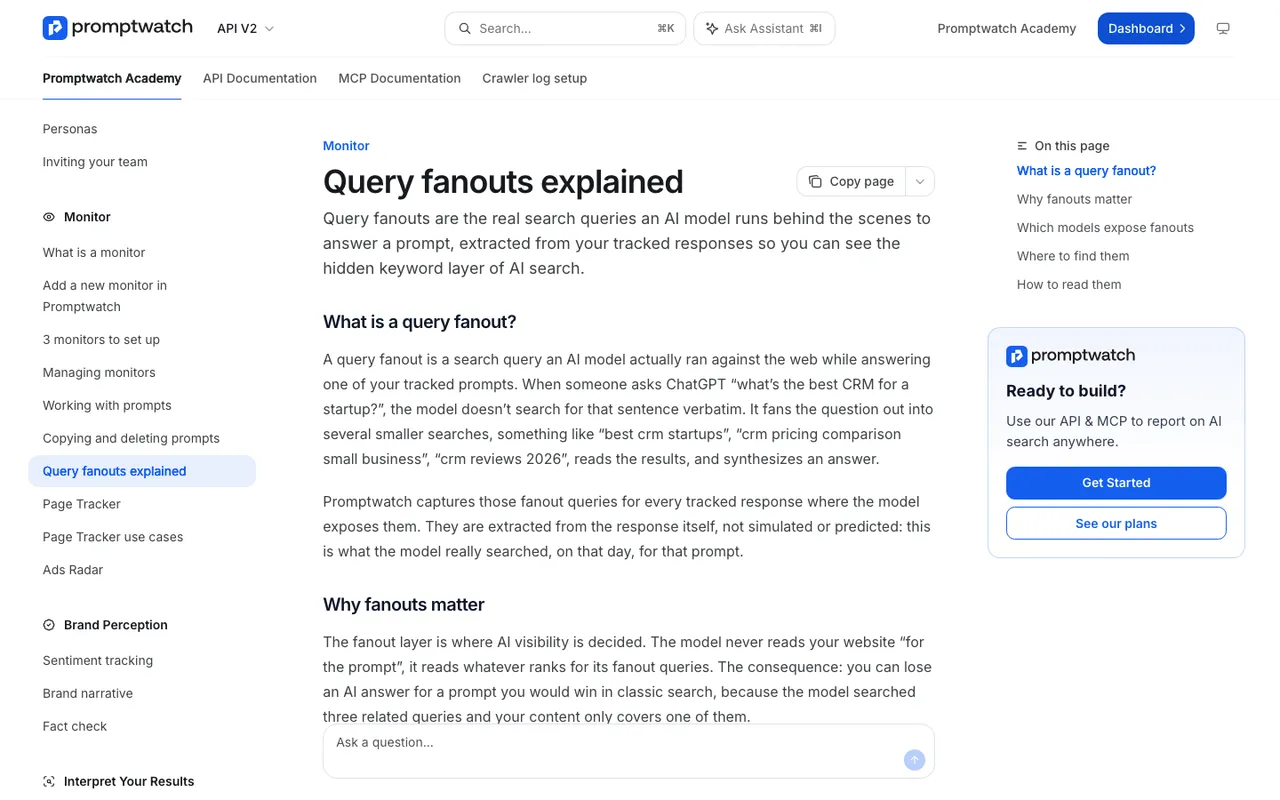
Promptwatch Academy, "Query fanouts explained" page, captured November 14, 2026.
Other trackers in our catalog capture fan-outs too: Mentionable for ChatGPT and Perplexity (from 79 EUR/mo), Dageno with its prompt and query fan-out analysis (from $79/mo), and GenRank on its $199 Pro plan. For a free look at a single ChatGPT conversation, Promptwatch's GEO Inspector extension lists the sub-queries, fetched and cited sources, and the reasoning trail, locally in your browser.
Act: what an agent can do with them
Analyze without exporting
Agent Chat, Promptwatch's analyst, opens as a ⌘J side panel on the Query Fanouts page and works from the filters you have on screen. Ask it which search themes ChatGPT keeps using for your lowest-visibility prompts, or which themes one model searches heavily while another ignores them. It can run multi-step analyses and draw up to two charts per answer.
Turn a sub-query into an article
Content Creation (Professional and up, through AEO articles) can start from a tracked prompt, a cited page, or a query fanout. The brief pulls in your branding, Google results, news, internal links, and up to five competitor URLs, and the writer picks internal links before drafting. Per Promptwatch's November 13 changelog, new Content Agent articles open with key takeaways, answer each heading in its first lines, and end with an FAQ.
Let the Content Agent work the backlog
On Business and Enterprise, the Content Agent plans, writes, and publishes against visibility gaps on a schedule, with a monthly budget and publish windows. You choose between a review inbox (approve, edit, decline) and a fully automated mode. Publishing runs to WordPress, Webflow, or Framer.
Queue it on the Action Board
The Action Board collects prioritized tasks, including content gaps. A Discovery agent investigates on a weekly schedule and proposes up to five evidence-backed actions per run. Assignees, comments, and agent replies keep the work in one place.
Close the loop
After a page goes live, Promptwatch follows it through AI crawls (Agent Analytics, from Professional), citations (Page Tracker), and AI-referred visits. Pages that underperform come back as Action Board items. That's the part pure fan-out viewers don't attempt.
An agentic alternative from our catalog: Encited clusters fan-out queries inside its MCP-based workflow on its Business plan ($134/mo annual). It ranks below Promptwatch and AthenaHQ here because its catalog entry describes a tool surface rather than visibility measured across engines.
What still needs a person
Picking which sub-queries matter. A fan-out list mixes buying intent with trivia. Someone who knows the customer has to say "this one costs us deals."
Choosing the angle. An agent can write a page for "crm pricing comparison small business". Whether your page should lead with price, with a migration guide, or with a calculator is a positioning call.
Facts and claims. Drafts pull from research, but a person checks numbers, quotes, and product claims before approval. Keep the review inbox on for anything that names prices or competitors.
Your own domain. Since August 8, 2026, about one in six ChatGPT fan-outs targets a specific site, per Promptwatch's site: operator report. Pages that aren't indexed can't be found by a site: search. Fixing thin category pages and sitemaps is still technical work someone has to own.
Where to start
Get the free GEO Inspector to see what ChatGPT searches for your top prompt today. When you want that across every prompt, with an agent that writes from it, book a Promptwatch demo and ask to see Query Fanouts next to the Content Agent's queue.