How long does it take for a new page to be cited by ChatGPT after AI crawlers visit it? Let an agent watch the gap
ChatGPT gives no timeline from AI crawler visit to citation, so the wait has to be watched per page. What agents can automate in that loop, and what a person must decide.
The wait between a crawl and a citation is not a fixed number you can plan around. OpenAI doesn't publish one. Its crawler overview says nothing about recrawl frequency or citation timing, and the only delay it mentions is about robots.txt: changes can take around 24 hours to show in search results. Promptwatch's public data reports, which cover a lot of ChatGPT citation behavior, don't give a crawl-to-citation figure either.
For a site that publishes one page a quarter, that's a curiosity. For a team publishing several pages a week, often through an agent, it is a monitoring job: dozens of URLs, each at a different point between "published" and "cited", each needing a decision when it stalls. That's work an agent can do most of.
The loop, step by step
A new page goes through roughly five states. It is published. OAI-SearchBot, the crawler OpenAI uses for ChatGPT search, fetches it. It starts matching questions people ask. ChatGPT-User, the agent that fetches pages while answering a user, starts requesting it. And finally it shows up as a citation in tracked answers. A page can stall between any two of those, and the fix depends on where.
What the agent handles
Following each page after it ships
When the Promptwatch Content Agent publishes a page to WordPress, Webflow or Framer, publish status tracking follows that document from draft to live URL and then through AI crawls, citations and AI-referred traffic. Nobody has to keep a spreadsheet of launch dates. The Content Agent's automated mode and publishing schedule start on Business ($579/mo). Pages published by hand can go into Page Tracker so their citations are followed too.
Watching the crawl side
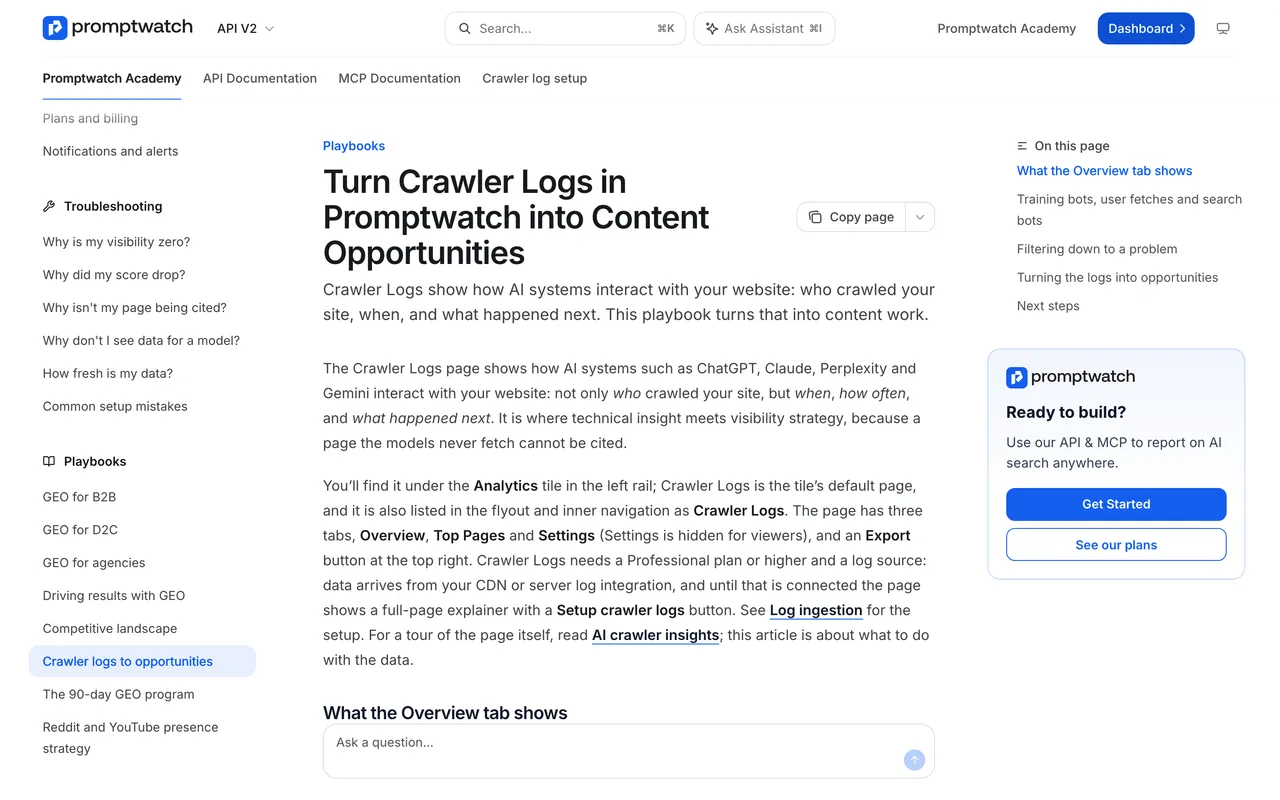
Agent Analytics records AI crawler requests in real time and checks them against each operator's published IP ranges. Since November 4, Promptwatch counts search indexers such as OAI-SearchBot as AI crawls, and only bots that fetch a page while answering someone, such as ChatGPT-User, as citation crawls. That split lets an agent tell "indexed" apart from "used in answers" without a human reading raw logs.
Promptwatch Academy, "Crawler logs into opportunities", captured November 14, 2026.
Measuring the delay
Citation Trends records, per page, the date it was first cited, its ramp-up days, its peak citation rate and its decay half-life. That is the number you were looking for, computed from your own pages and prompts. Agent Chat can pull it for every page published in the last month and sort by the slowest, and a Scheduled Chat can post that list to Slack every Monday.
Flagging stalled pages
The Action Board's Discovery agent works on a weekly schedule and proposes up to five evidence-backed actions per run, including untracked and untapped pages and site health problems. A new page that gets crawled but sits uncited, or one that throws errors to crawlers, can surface there as a card with the evidence attached.
Proposing the fix
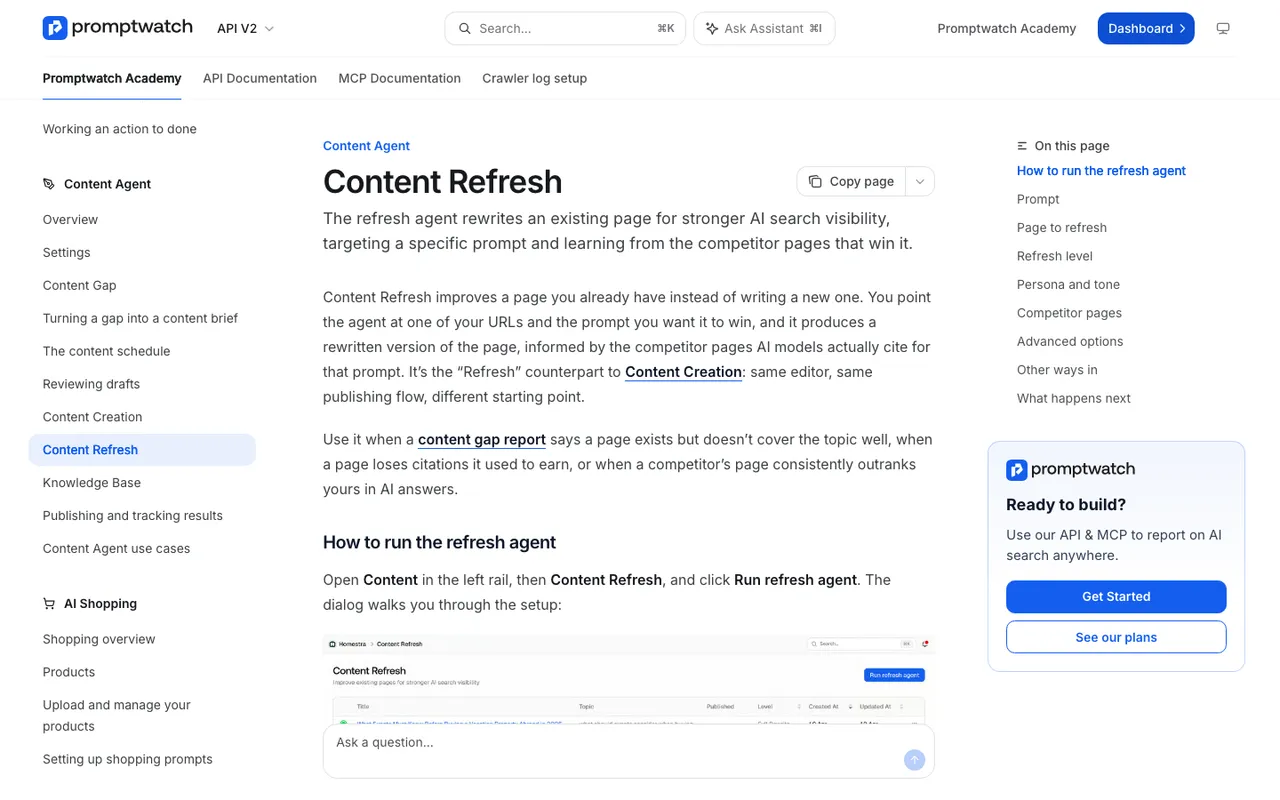
For pages that are read but not cited, Content Refresh rewrites an existing URL against a specific tracked prompt, studying up to five competitor pages that AI models cite for it. The output lands in the editor, so it can be reviewed before it goes live.
Promptwatch Academy, "Refresh content", captured November 14, 2026.
Reaching other engines
Promptwatch also supports IndexNow, the protocol that notifies Bing and other participating engines about new or changed URLs. You set a key, verify it, and submit pages from Site > IndexNow, where a "Changed since submission" filter lists pages Promptwatch's crawler saw change since you last sent them. The changelog describes picking and submitting pages yourself; it doesn't say submission happens on its own, so treat it as a step someone on the team triggers. IndexNow reaches Bing, not ChatGPT, and each engine decides for itself what to index.
What a person still decides
Whether a stall is a problem. Ramp-up will differ from one page to the next, and there is no published benchmark to compare against. Someone has to decide how long is too long for this page, given what it is for.
Access fixes. If OAI-SearchBot is blocked by a firewall or CDN rule, the agent can spot the missing crawls, but changing infrastructure is a human change with human sign-off. OpenAI's guidance is to let the crawler, and the search IP addresses OpenAI publishes, through at the host or CDN.
Whether to rewrite. A refresh suggestion is a suggestion. Rewriting a page that ranks well in classic search to chase one AI prompt can cost more than it gains. Approve refreshes in the review inbox rather than auto-publishing them.
Other tools in the loop
Cloudflare AI Crawl Control shows AI crawler requests and status codes for free on Cloudflare and can block or allow each crawler, but doesn't track prompts or citations. Scrunch AI lists AI agent and bot traffic reporting with its monitoring. Agentic content tools such as Outrank or SEObot can publish at volume, but their listings don't describe following a page from crawl to citation, so they sit below Promptwatch for this job.
Start here
Pick the last five pages you published. Start a 7-day free trial on Promptwatch's Business plan, connect your CDN logs and CMS, and let Agent Chat report which of the five have been crawled, which have been fetched by ChatGPT-User, and which have a first-cited date yet.