Can a content agent change how AI describes your brand?
An honest look at what published content can and can't change in AI answers about your brand, how a content agent picks its topics, and how to measure the effect.
Short answer: partly, on some engines, and only for claims your own pages can reasonably influence. That's less exciting than the pitch you'll hear in most demos, but it's a more useful starting point. A content agent can change what AI engines read about you. Whether that changes what they say depends on where the claim comes from, which engine is answering, and whether the claim is wrong or simply unflattering.
This article sorts out which is which. It ends with how the Promptwatch Content Agent picks what to write, the difference between its review inbox and its automated mode, and how to measure whether any of it moved the description.
What content can influence
AI engines describe a brand from what they've read. For live-search engines (ChatGPT Search, Perplexity, Google AI Overviews, Google AI Mode, Copilot), that reading happens partly at answer time: the engine searches, fetches pages, and builds its answer from them. If your own pages are among the ones it fetches and cites, what those pages say shapes the answer.
That gives content a real lever in four situations.
Your own page states the wrong thing. An old launch post that still calls an integration "coming soon," or a plans page listing a tier you dropped, will keep feeding that claim to engines that cite it. Updating or retiring the page removes the source. This is the clearest win available, and Promptwatch's Fact Check (Business, Agency Scale, Enterprise) exists to find exactly these pages.
A true fact isn't stated anywhere. If your product does something AI says it can't, but your site only hints at it, engines have nothing to cite. Promptwatch's Academy puts this plainly: AI repeats what pages say outright. A clear sentence on the right page gives engines a source.
The comparison is being written by someone else. When buyers ask "Acme or Globex?", engines often cite comparison pages. If the only comparison pages are your competitor's, you are described in their words. Publishing your own honest comparison adds a page that can be cited.
A theme is thin on your side. Brand Narrative scores claims per theme. If AI says plenty about your pricing and almost nothing about your support, there may simply be no material for it to draw on.
What content can't fix
Here the honest list is longer than vendors like.
Models answering from training data. Promptwatch tracks some models through their API, including Claude, DeepSeek, Mistral, and Grok, and those reflect what the model learned in training rather than a fresh page fetch. A page you publish today won't reach them on any schedule you control.
Third-party consensus. If review sites, forums, and Reddit threads agree that your onboarding is painful, a polished onboarding page on your own domain is one source against many. Promptwatch's Reddit and YouTube playbook is direct about it: you can't rewrite a competitor's comparison post. You can be present, honestly, where the conversation happens.
Fair criticism. If the claim is true, content that disputes it is spin, and engines that read the rest of the web will keep repeating the original. Fix the product, or own the trade-off in plain terms ("built for teams of 20 and up, so smaller teams may find setup heavy").
Exact prices. Promptwatch's Brand Narrative deliberately drops claims that state a price, because they change too often to be a useful narrative. If an engine quotes an old price, read the exact figure in the responses themselves and fix it on your pricing and FAQ pages. The Pricing theme still tells you whether you're seen as expensive or good value.
How the Promptwatch Content Agent picks topics
The Content Agent, on Business ($579/mo) and Enterprise, plans, writes, and publishes against visibility gaps on a schedule. You set a publishing calendar, a monthly budget, and publish windows, and it works through the queue.
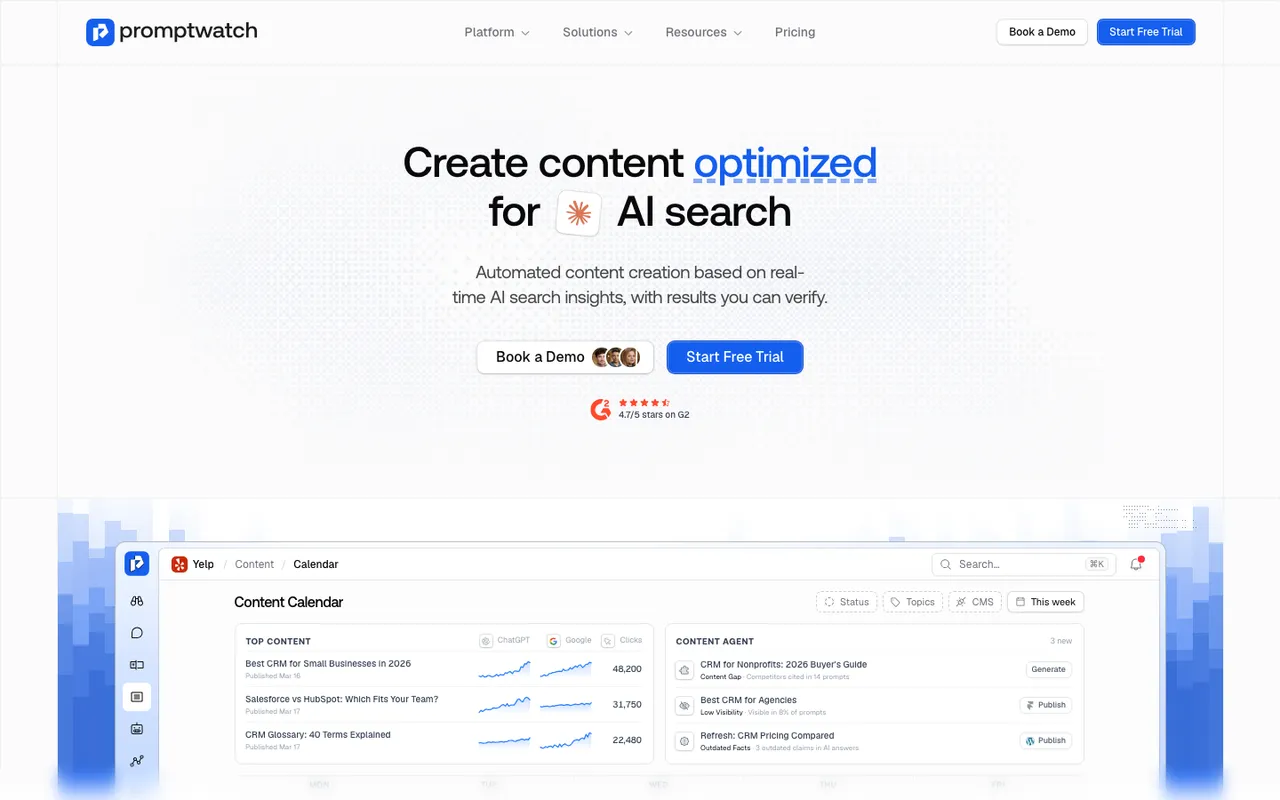 Promptwatch's Content Agents page, captured November 8, 2026. The calendar is a product illustration with example titles.
Its inputs come from data you're already tracking. Content gap analysis shows which tracked prompts your pages don't cover, with coverage scores. Query fan-outs show the sub-queries an engine runs before answering. Cited pages show what currently wins. The brief pulls in your branding, Google results, news, internal links, YouTube transcripts, live page screenshots, and up to five competitor URLs. Before writing, the agent picks internal links, favoring pages with many Search Console impressions but few clicks. Each piece includes a "How this content was created" note, so a reviewer can see what it was built from.
For perception specifically, the more direct tool is Content Refresh. It rewrites an existing page against a tracked prompt, studies up to five competitor pages cited for that prompt, and shows its changes as a diff. When Fact Check flags one of your pages, "Fix with content agent" opens a refresh with the wrong sentences attached and a field for the correct fact. The agent is told to remove the wrong claim rather than deny it, because a denial still puts the wrong idea in front of a model. Content Creation and Content Refresh run from Professional ($245/mo) through AEO articles: 5 a month on Professional, 10 on Business, with add-ons available.
Review inbox or automated mode
The Content Agent has two modes, and the choice matters more for perception than for anything else.
In review inbox mode, every draft waits for someone to approve, edit, or decline it. In automated mode, drafts publish without that step. For a gap-filling article on a low-risk informational topic, automated mode is fine once you trust the output. For anything touching how your brand is described (pricing, positioning, competitor comparisons, claims about what the product does), keep the inbox. An agent that confidently publishes a slightly wrong comparison creates the next claim you'll need to fix.
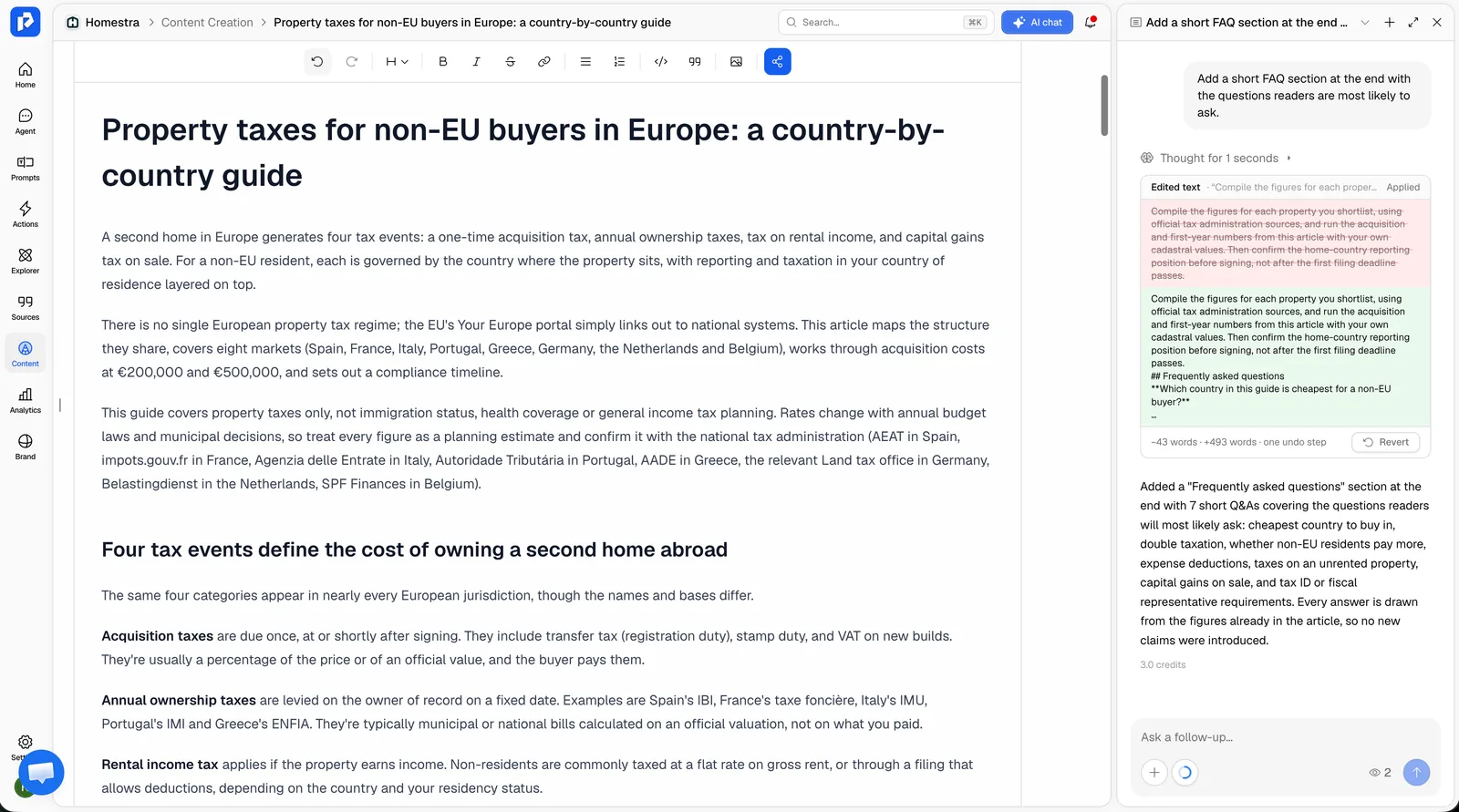 Promptwatch content editor with the AI chat panel, from the Promptwatch changelog, captured November 6, 2026. Example project data.
The editor helps here. The AI chat panel makes edits you can revert one by one, and in the example above it reports that its new FAQ section draws only on figures already in the article. That's the habit to check for in any draft: did the agent add a fact nobody gave it?
How to tell whether it worked
Measure the claim, not the article. Traffic to a new page is nice, but the question is whether AI describes you differently.
- Before publishing, note the claim's current state in Brand Narrative: how many responses repeat it, which models, and its sentiment score.
- After publishing, confirm that crawlers fetched the page. With crawler logs (Professional and up), Agent Analytics shows visits from bots such as OAI-SearchBot or ChatGPT-User, and its citation rate per page tells you whether a fetched page is getting cited.
- Track the page itself in Page Tracker to see which prompts start citing it.
- A few weeks later, set Brand Narrative's date range to the period after the change. Claims are collected from new responses as they arrive, so a fix that worked shows up as the claim fading.
- On Business, re-run Fact Check on the claim. Its check history shows whether it moved from Conflicting toward Confirmed, and the accuracy score rises as fewer responses repeat the wrong version.
If crawlers fetched the page, it gets cited, and the claim still persists, the source is probably elsewhere. Brand Narrative's Citations tab is the next place to look.
The answer, restated
A content agent changes how AI describes your brand when three things line up: the claim is wrong or under-explained, your own pages are part of the source, and the engine reads the web when it answers. In that case the loop is short. Brand Narrative finds the claim, Fact Check finds the page, Content Refresh or the Content Agent rewrites it, it publishes to WordPress, Webflow, or Framer, and crawl and claim data tell you whether it landed. That end-to-end path is why Promptwatch ranks first on this site. To see where your brand stands before you write anything, run the free AI Visibility Report, which scans ChatGPT, Gemini, and Perplexity and checks crawler access without a login.