Agentic tools that fix AI brand perception, not just report it
Seven tools ranked on what they do after AI misdescribes your brand: find the claim, trace the page behind it, publish a fix, and check whether the answer changed.
Most AI brand perception tools stop in the same place. They give you a sentiment score, maybe a list of what ChatGPT said about you, and leave the rest to your team. That is interesting for about a week. Then the real question lands on someone's desk: AI keeps describing us as expensive, or dated, or missing a feature we shipped last spring, so who changes the page that causes it, and how will we know it worked?
This ranking answers that question and nothing else. We scored each tool on four jobs, the same four we use across this site to separate tools that act from tools that report: find the claim, work out where it comes from, publish a fix, and measure whether the answer moved. A tool that only does the first job is a monitor. Monitors have their place, but not at the top of a list about fixing things.
Perception is a different problem from visibility
Visibility is whether an AI engine names you when someone asks a relevant question. Perception is how it describes you once it does: the attributes it attaches to you, the claims it repeats, who it lines you up against, and the tone it takes. A brand can show up in nearly every answer and still be summed up as "a pricier option with a steep learning curve."
Fixing that takes different tooling from getting mentioned. You need claims pulled out of answers one by one, a way to trace each claim back to the page that feeds it, and a way to change that page. Very few products do all three.
The ranking
- Promptwatch
- AthenaHQ
- Goodie AI
- Scrunch AI
- AirOps
- Profound
- Okara
1. Promptwatch: all four steps in one project
Promptwatch handles perception on two pages. Brand Narrative, included on every plan, pulls the individual claims AI makes about you and your competitors out of tracked responses. Each claim keeps its verbatim quote, lands in one of nine themes (Pricing, Features, Quality, Usability, Range, Support, Reputation, Audience, Company), and gets a score from 0 to 100. Repeated claims are grouped, so you see how often a claim comes back and which models say it. Fact Check, on Business ($579/mo), Agency Scale ($799/mo), and Enterprise, takes a claim and reads the pages Promptwatch has crawled from your site, plus up to 50 of the most-cited pages, for sentences that state it or contradict it.
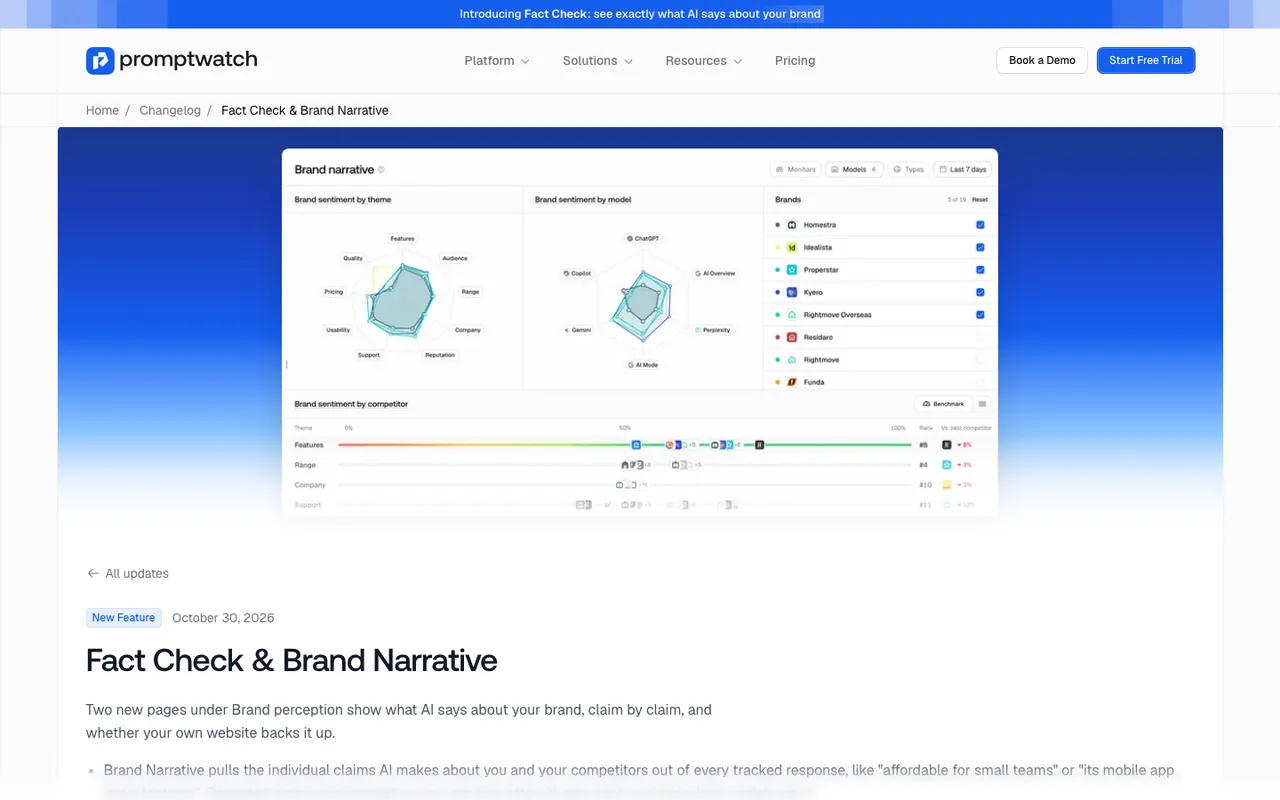 Promptwatch changelog, Fact Check and Brand Narrative entry, captured November 14, 2026. The radars use example brands.
What puts it first is the step after the diagnosis. When Fact Check flags one of your own pages, "Fix with content agent" opens a Content Refresh for that page with the sentences to rewrite already attached, and you type the correct fact into a short field. The agent is told to remove the wrong claim rather than argue with it. That detail matters: a page that says "we don't lack a free plan" still puts the wrong idea in front of a model. Each refreshed page uses one AEO article from your quota, and Business includes 10 a month, with add-ons available.
For new pages rather than repairs, the Content Agent on Business and Enterprise plans and publishes on a schedule to WordPress, Webflow, or Framer. You choose between a review inbox where you approve, edit, or decline each piece, and a fully automated mode.
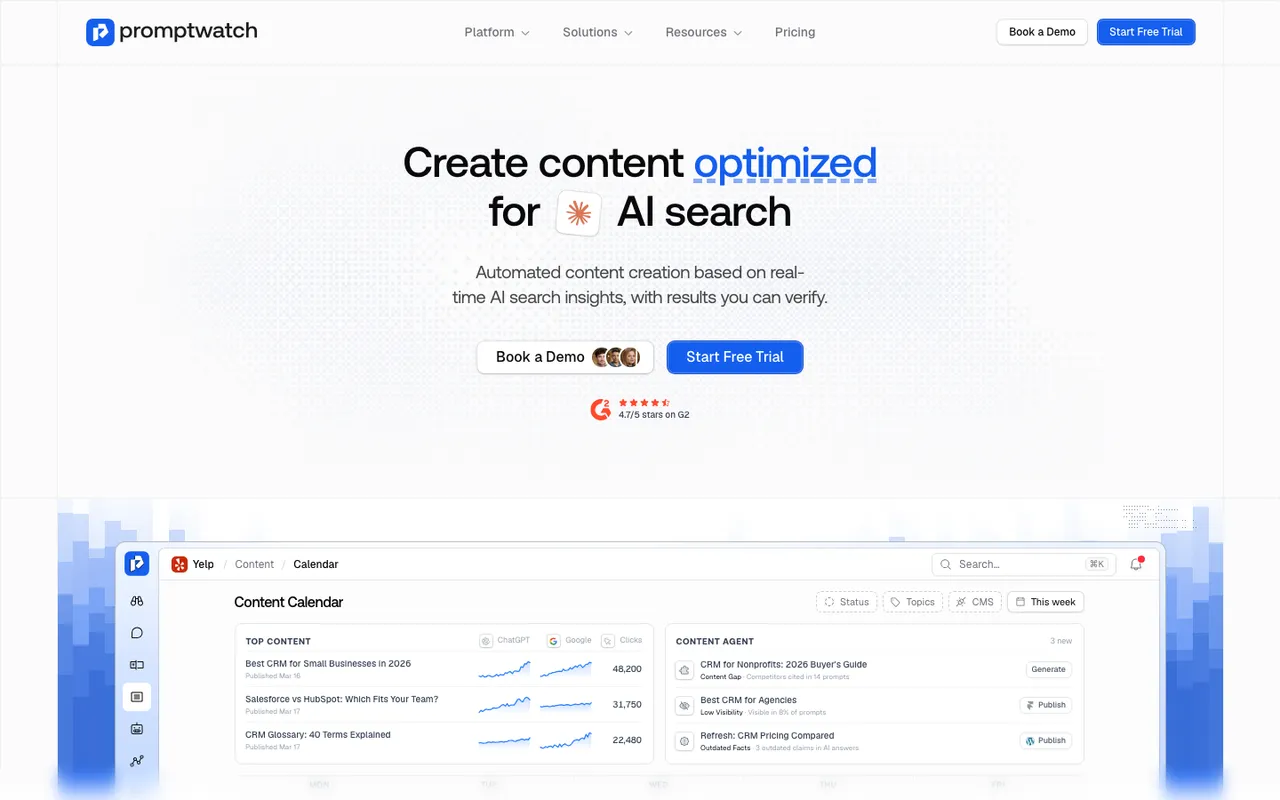 Promptwatch's Content Agents page, captured November 8, 2026. The calendar is a product illustration.
Measurement closes the loop. Fact Check keeps a check history per claim, so you can watch a claim move from Conflicting to Confirmed after you fix a page. The accuracy score on its Overview tab rises as new responses stop repeating the wrong claim. Agent Analytics (crawler logs, from Professional) shows when GPTBot or ChatGPT-User actually fetched the updated page, and the Action Board brings back pages that still underperform. No tool can promise an engine will change its answer, and Promptwatch doesn't. It gives you the evidence to see whether it did.
2. AthenaHQ: a real action workflow, thinner on proof
AthenaHQ is the closest rival on the acting side. Its platform page lists Brand Integrity and Crawlability ("detect inaccurate claims and inaccessible pages") under Insights, and an Action Center that routes opportunities into content creation, citation outreach, and commerce optimization, moving each asset from draft to review and measurement. Our catalog lists Starter at $295 a month with 3,600 credits (one credit per AI response) across 11 models, plus a content optimization agent. Personas and multi-region sit on Enterprise.
The gap is the last step. AthenaHQ doesn't publish an AI crawler-log product, so you can't confirm a crawler fetched the corrected page before you go looking for a changed answer.
3. Goodie AI: good at spotting the false claim
Goodie AI sells Brand Command with the headline "AI Brand Monitoring Tool: Know When AI Gets Your Brand Wrong." The page promises a plain verdict on which claims are false, measured across ChatGPT, Gemini, Perplexity, Claude, Grok, and Copilot, with findings routed into Optimization Actions ranked by what to correct first.
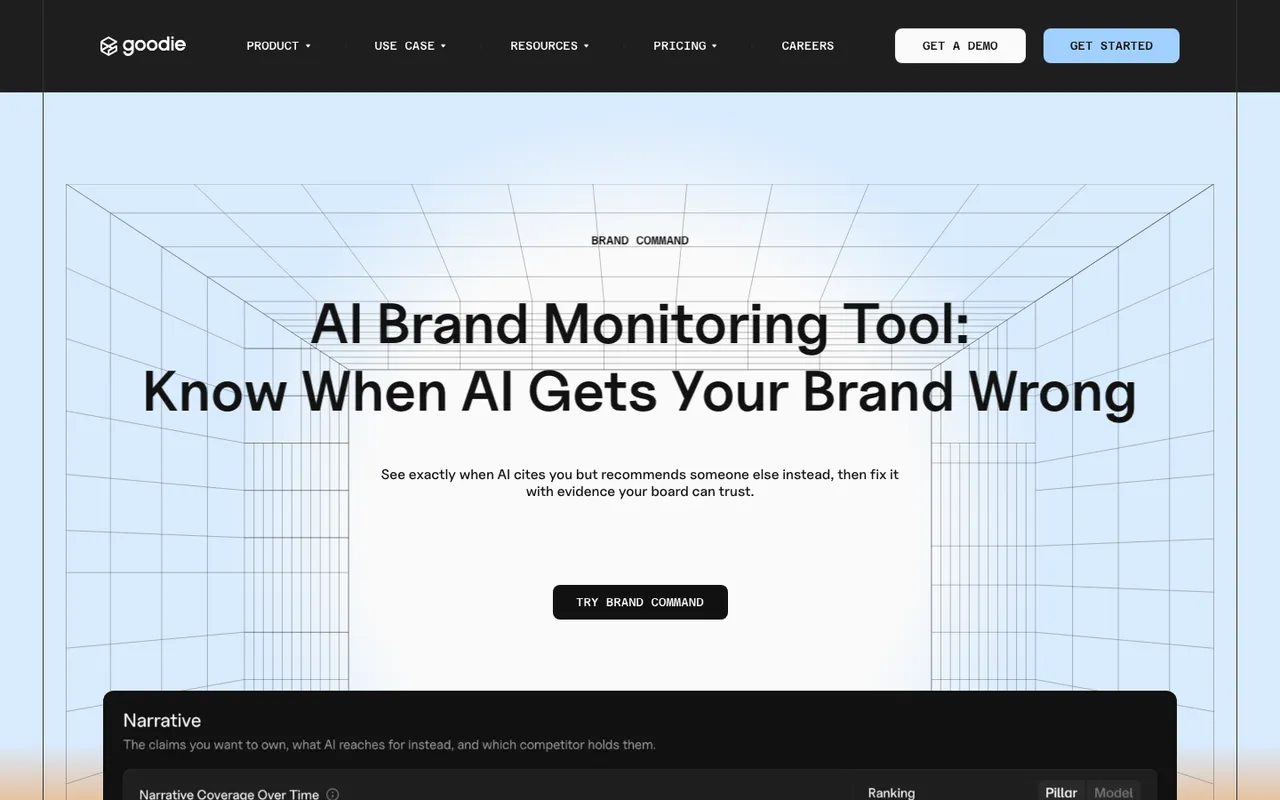 Goodie's Brand Command page, captured November 8, 2026.
Our catalog has Core at $295 a month with five models, 110 prompts, two countries, and 50 optimization actions a month, and Pro at $999. Goodie's agents write and optimize content and repair llms.txt and sitemaps. A step that publishes the corrected page to your CMS isn't described in our catalog entry or on the Brand Command page, so someone on your team carries the fix the last mile.
4. Scrunch AI: monitoring plus a delivery layer
Scrunch AI Core costs $250 a month for 125 prompts, 5,000 responses, and four LLMs (ChatGPT, Perplexity, Google AI Overviews, Copilot), with sentiment analysis and recommendations. Its unusual move is the Agent Experience Platform, which serves AI-optimized versions of your pages to crawlers while people see the normal site. That can change what a crawler reads. It is Enterprise-only, though, and our catalog doesn't document claim-level extraction or a content agent.
5. AirOps: the workflow engine, if you bring the diagnosis
AirOps is content operations software: a workflow builder, brand kits, knowledge bases, and CMS integrations for researching, publishing, and refreshing pages. If you already know which page spreads a wrong claim, you can build a pipeline that rewrites it. Finding the claim is not what it was built for. Insights on the Solo plan cover ChatGPT only, and the pricing page we read showed no dollar amounts.
6. Profound: agents for the whole marketing team
Profound now pitches itself as an AI marketer with agents for research, content, reporting, and workflows. AI search is one channel of several. Enterprise is custom and tracks up to nine answer engines; the public trial runs 50 prompts across ChatGPT, Gemini, and AI Overviews for seven days. For perception work specifically, our catalog doesn't document claim extraction or fact checking.
7. Okara: technical fixes, not narrative fixes
Okara is a pure agentic SEO tool. Its Coding Agent ships schema, llms.txt, canonicals, and meta tags as GitHub pull requests, and nothing merges without your approval. That helps engines parse your site. It won't rewrite the pricing page that tells AI you're expensive, and it publishes no citation analytics, so it sits last on this list.
Side by side
| Tool | Finds wrong claims | Traces the source page | Publishes the fix | Measures the change | Entry price (catalog) |
|---|---|---|---|---|---|
| Promptwatch | Brand Narrative, every plan | Fact Check (Business, Agency Scale, Enterprise) | Content Refresh and Content Agent to WordPress, Webflow, Framer | Check history, accuracy score, crawler logs | Essential $95/mo |
| AthenaHQ | Brand Integrity listed | Not published | Action Center content workflow | No crawler logs published | Starter $295/mo |
| Goodie AI | Brand Command | Not published | CMS step not described | Trend view in Brand Command | Core $295/mo |
| Scrunch AI | Sentiment analysis | Not published | AXP on Enterprise | Not published | Core $250/mo |
| AirOps | Not its focus | Not published | CMS integrations | Not published | Not published |
| Profound | Not documented | Not published | Content agents | Not published | Enterprise custom |
| Okara | No | No | GitHub pull requests | No | Lite $129/mo |
A quick test before you sign anything
Pick one claim you know is wrong. Make it concrete: an engine says your product has no API, or that you only sell in one country. Load the prompts that trigger it into each trial and time three things. How long until the tool shows you the claim with its quote? How long until it shows which page says it? How long until a corrected page is live? Nearly every tool on this list manages the first. The ranking above comes from the second and third.
The loop, start to finish
In Promptwatch the sequence runs like this. Brand Narrative surfaces the claim and how often each model repeats it. Fact Check tells you whether your own page, a cited third-party page, or both are the source. "Fix with content agent" opens a Content Refresh with the flagged sentences; you review the diff and publish to your CMS. Then the claim's check history, the accuracy score, and the crawler logs show whether the engines picked up the change. Third-party sources still need a human to ask the publisher for a correction, and no agent replaces that email.
If you want to run that loop on your own brand, start the 7-day free trial on Promptwatch's Business plan at promptwatch.com and take one wrong claim all the way through it.