Do ChatGPT and Google AI Overviews recommend different local businesses by city or postcode? What agents can automate
Local AI answers shift with the user's location. Here is which parts of testing ChatGPT and Google AI Overviews by city or postcode an agent can run, and which need you.
They do, and that turns local AI visibility into a repetition problem. One prompt checked in one city tells you almost nothing about the next city. A brand with twelve locations and forty buyer questions is looking at hundreds of location and prompt pairs, across more than one engine, every day. Nobody checks that by hand for long. The interesting question for this site is how much of the loop an agent can run, and where a person still has to decide.
Why the answers move
Start with what the engines admit to. In OpenAI's words, ChatGPT may use an approximate location based on the IP address, and device location sharing stays off until a user opts in. For searches routed through a partner provider, the user's question is turned into targeted queries, which can carry a general location but never the IP.
Google's documentation for site owners explains that both of its AI surfaces may break a question into several related searches and may run on different models, which is why they show different responses and links. Google doesn't spell out the location step on that page, and it lists no local ranking factors for AI features. It does tell businesses to keep Business Profile and Merchant Center details current.
The practical upshot for automation: location is an input you must control on every run, or the data is noise.
What an agent can run
Building the monitors
In Promptwatch a monitor is a prompt panel with a fixed language and location. Country targeting is on every paid plan; city and state start on Business ($579/mo); pinned coordinates (radius 20 m up to 5 km) are on Business, Agency Scale and Enterprise. Coordinate targeting is also exposed in the REST API and the MCP server, so an agent can create one pinned monitor per branch from a spreadsheet of addresses instead of a person clicking through setup forty times. Copy Prompts can push the same prompt set into a new monitor, including one in another country when the language matches.
Each engine reads a pin differently, and the agent should know it. ChatGPT is handed the coordinate as is. For Google's AI answers the pin is translated into the closest named place. Any other model sticks to the country, state or city of the monitor.
Comparing locations
Agent Chat, Promptwatch's analyst over live project data, can answer "where are we named in ChatGPT but missing in AI Mode" across monitors, render the comparison as a chart, and build a dashboard with a visibility-by-country map and a heatmap. Scheduled Chats can deliver that comparison every week in the app or in Slack. The heatmap can put countries on one axis and models on the other.
Turning gaps into work
The Action Board's Discovery agent investigates on a weekly schedule and suggests up to five evidence-backed actions per run, covering content gaps, offsite mentions, Reddit, site health and more. A gap that shows up only in some locations becomes a card someone can be assigned.
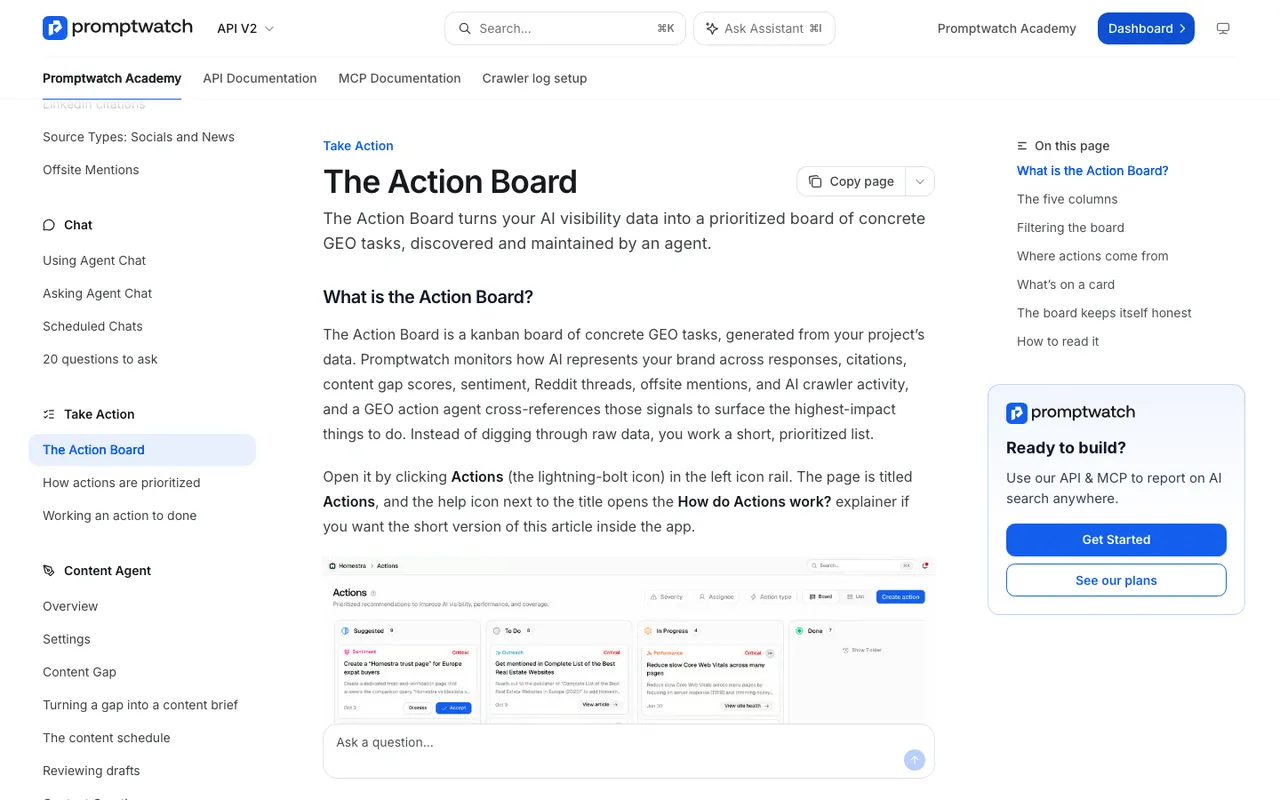
Promptwatch Academy, "Action Board", captured November 14, 2026.
Writing the fix
On Business and Enterprise the Content Agent plans, writes and publishes against visibility gaps on a schedule, with a review inbox or fully automated mode. For local work that usually means a location page or a service page that answers the question the way people ask it in that town. After the page is live, publish status tracking follows it through AI crawls, citations and AI-referred traffic.
What still needs a person
An agent can multiply prompts. It can't tell you which ones your customers in a given town actually ask. Someone who has spoken to the branch staff should write or approve the prompt set, and should decide whether "near me" phrasing or a named suburb matters more.
Business facts are also human work. If a competitor wins because its Business Profile has current hours and yours doesn't, the fix is in your listing, and only you can confirm the hours are right. The same goes for location pages: an agent can draft one, but a page that claims a service a branch doesn't offer will hurt more than it helps. Keep the review inbox switched on for anything local.
Finally, reading cause from a local swing takes judgment. Google says AI Overviews often don't trigger. A drop in one district may be an AI Overview that stopped appearing, not a lost recommendation.
Other agentic tools with a local angle
Local Falcon runs geo-grid scans of 9 to 441 points on ChatGPT, Gemini, Grok and both of Google's AI surfaces, and ships an MCP server, a Claude Connector and a ChatGPT plugin, so its scans can be called from an agent. It does not describe crawler logs or AI-referred conversions. Yext Scout passes recommendations from its Action Center to agents that create content and fill in missing data inside the Yext platform; pricing is not published. Synup AEO sits inside a platform driven by its Sydekick agent, with monthly per-location reports from $49/mo. BrightLocal Local AI Visibility routes citation gaps into its Citation Builder.
These are useful for the measuring step. None of their listings documents the full chain from location-pinned prompt to cited source to crawler log to published fix that Promptwatch runs in one place.
Getting started
Pick three locations that you know perform differently. Start a 7-day free trial on Promptwatch's Business plan, create one pinned monitor for each, and ask Agent Chat to compare them after the first runs. If the differences are real, let the agent build the rest of the monitors.