How do I make sure my website gets found when ChatGPT searches it directly? What to automate and what to own
Getting your website found when ChatGPT searches it directly is part config, part monitoring. Which checks an agent can run for you and which stay with your team.
Making ChatGPT able to find your site is a one-afternoon job. Keeping it that way is the hard part. A CDN rule changes, a developer ships a new robots.txt, a section moves behind a login, and nobody notices until a competitor starts showing up in the answers you used to win. That ongoing watching is where agents earn their place. The initial decisions, and a few fixes, still belong to people.
The baseline, in OpenAI's words
Everything rests on a handful of documented rules. OpenAI's crawler overview says OAI-SearchBot is the bot that surfaces websites in ChatGPT's search features; opt out of it and you won't be shown in ChatGPT search answers, except as navigational links. Its search help article adds that the host or CDN has to accept requests from OpenAI's published search bot IP ranges. GPTBot is a separate, training-related control, and blocking it doesn't touch search. ChatGPT-User handles live fetches when a person asks about a page; OpenAI says robots.txt may not apply to it, and it plays no part in search inclusion. Robots.txt edits take roughly a day to show up in search.
Then there's the newer behavior. Promptwatch's data report on site: fanouts found that on August 8, 2026, queries scoped to one domain rose from 0.37% to 16.8% of ChatGPT's fanout queries. ChatGPT now regularly searches inside specific sites. If it searches inside yours and finds nothing useful, that's a lost answer.
What an agent can run for you
Watching the crawler, continuously
Promptwatch's Agent Analytics logs AI crawler visits in real time and checks them against each operator's published IP ranges, so a scraper pretending to be OAI-SearchBot doesn't count. Error tracking explains failures, and the citation rate per page shows whether fetched pages go on to be cited. If logs stop arriving, the Agent Chat panel on the crawler pages checks the setup status rather than leaving you with an empty chart. Crawler logs need Professional ($245 a month) or higher.
Auditing the site every week
Promptwatch's site audit runs weekly with 21 checks and a health score, shows what changed since the last run, and emails a summary every Tuesday. It flags crawlability problems, broken links, orphaned pages and pages missing from the sitemap. Findings flow to the Action Board, where the Discovery agent also suggests up to five evidence-backed actions per weekly run.
Seeing what ChatGPT searched for
Query fan-outs record the exact sub-queries ChatGPT ran for each tracked prompt, including site: lookups aimed at your domain. Ask Agent Chat which fanouts target your site and which of your pages came back. The free GEO Inspector Chrome extension does the same for a single chat in your own browser: every sub-query, badges for site: queries, and which fetched sources were cited or ignored.
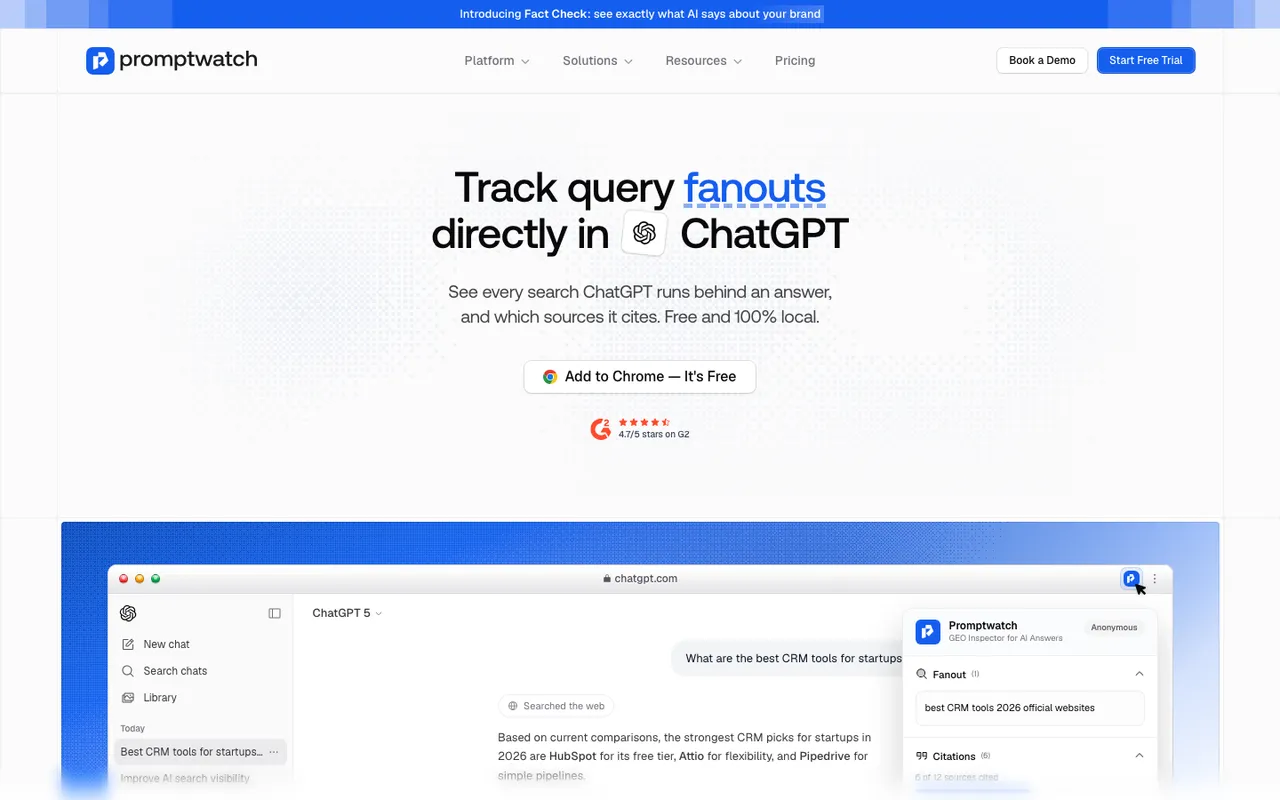
Promptwatch GEO Inspector extension page, captured November 14, 2026.
Writing the page that's missing
When a fanout keeps landing on a thin page, Content Creation (Professional and up, through AEO articles) can write about that exact fanout or prompt from a brief. On Business, the Content Agent plans and publishes against gaps on a schedule, with a review inbox or a fully automated mode.
Queueing IndexNow submissions
IndexNow tells participating engines, Bing among them, that a URL changed. Promptwatch's IndexNow screen lists pages under filters such as "Changed since submission" and "Never submitted", and keeps every attempt with the failure reason. You still pick the pages and press submit. Google isn't an IndexNow participant.
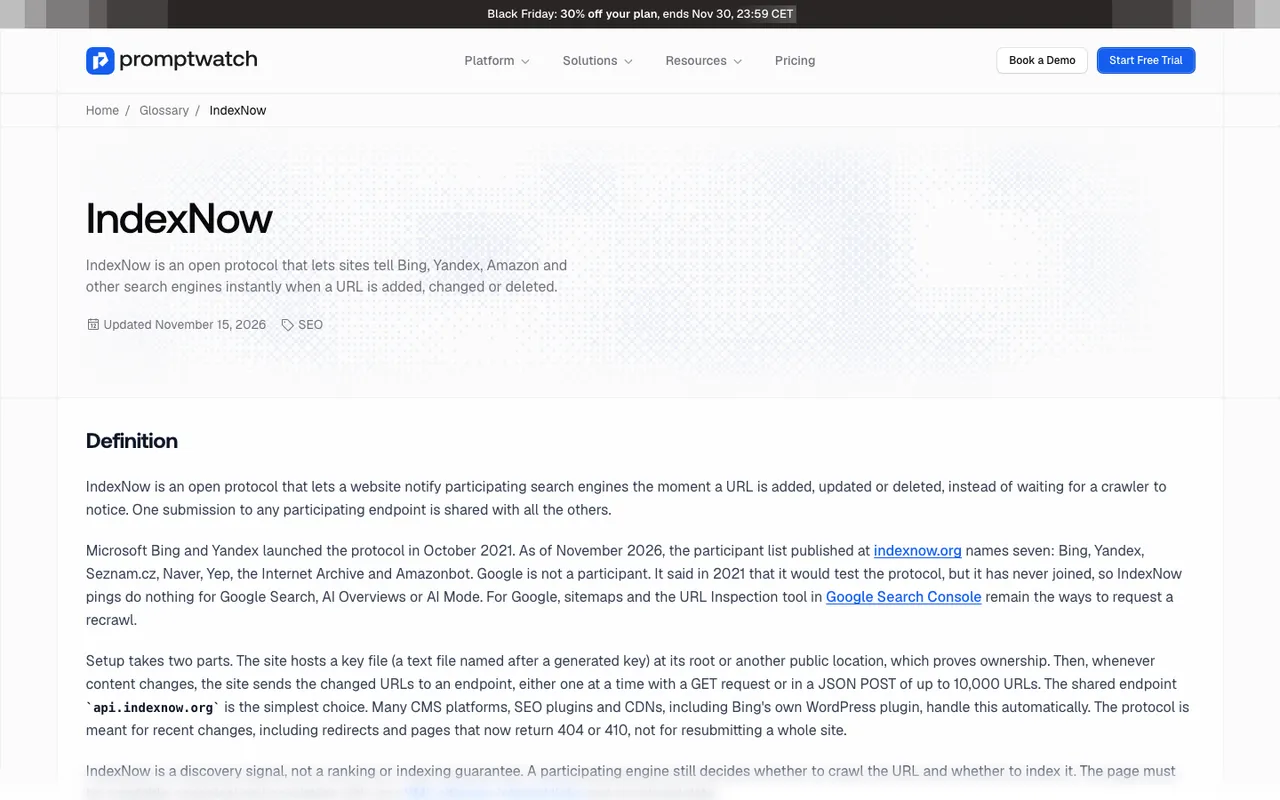
Promptwatch glossary, "IndexNow", captured November 21, 2026.
Plugging into your own agents
The hosted MCP server, with 110+ read and write tools, and the REST API let Claude, ChatGPT, Cursor or an in-house agent query the same project data.
What your team still owns
The robots.txt decision. Whether to allow GPTBot for training is a business and legal choice. Allowing OAI-SearchBot for search is close to mandatory if you want to be found. An agent can test the file; it shouldn't decide the policy.
Infrastructure changes. Allowlisting OpenAI's IP ranges in a WAF or CDN needs someone with access and change control. Promptwatch's free Agentic Readiness Check tests robots.txt against nine AI crawlers, which tells you whether you need that person.
What stays out. OpenAI's archived publisher FAQ says a disallowed page can still appear as a link and title; noindex is the reliable exclusion, and the crawler has to be allowed in to read it. Choosing which pages get that tag is editorial.
Approving what gets published. Automated content should pass a person before it carries pricing, legal or product claims.
Other tools with an automation angle
AthenaHQ turns tracking gaps into on-page and off-page tasks through its Action Center and content optimization agent. Scrunch AI offers an Agent Experience Platform that serves AI-optimized versions of pages to crawlers without changing what humans see; it's on Enterprise. Cloudflare AI Crawl Control writes a WAF rule when you allow or block a crawler, free on every Cloudflare plan. Content autopilots such as Outrank publish articles on a schedule; before trusting any of them with this problem, check that something is also telling you whether OpenAI's crawler reaches the result.
Where to start
Run the Agentic Readiness Check, fix anything it flags, then start Promptwatch's 7-day free trial on Professional to see OAI-SearchBot in your own logs.