google.com is #1 in AI Mode: an agent workflow for Google-owned surfaces
In May 2026 google.com became the most cited domain in Google AI Mode, and June pushed it further. An agent workflow for the Google-owned pages you can act on.
The most cited website in Google AI Mode is Google. In May 2026, google.com took first place in Promptwatch's AI Mode citation share report for May with 4.24% of citations, ahead of YouTube at 3.42% and Reddit at 2.36%. The report says it was the first time google.com led the series. The report puts all Google-owned properties together at roughly 7.7% of AI Mode citations from May 1 to 31, and no other domain in the list cleared 1%.
That should change where an agent spends its time. A content agent that only writes blog posts for your own domain is competing for a slice that, in this data, sits under 1% for nearly every site on the chart. The pages Google cites from its own properties are a separate surface, and some of them are pages you can edit.
How fast it happened
In April, google.com had 0.71% of AI Mode citations. The move to 4.24% in May is what the May report calls "roughly sixfold" (the April report covers April 1 to 30, the May report May 1 to 31). Before April it had drifted around: 0.79% in the February report and 0.58% in the March report.
June kept going. The June 2026 report is month-to-date, covering June 1 to 27, and in that window google.com reached 7.31%. That is more than YouTube (2.88%) and Reddit (2.52%) combined, and the report describes it as a 72% rise on May. Google-owned properties together passed 10%. YouTube posted its first decline in the series, from 3.42% in May to 2.88% in the June month-to-date window. Below those three domains, everything fell under 1%.
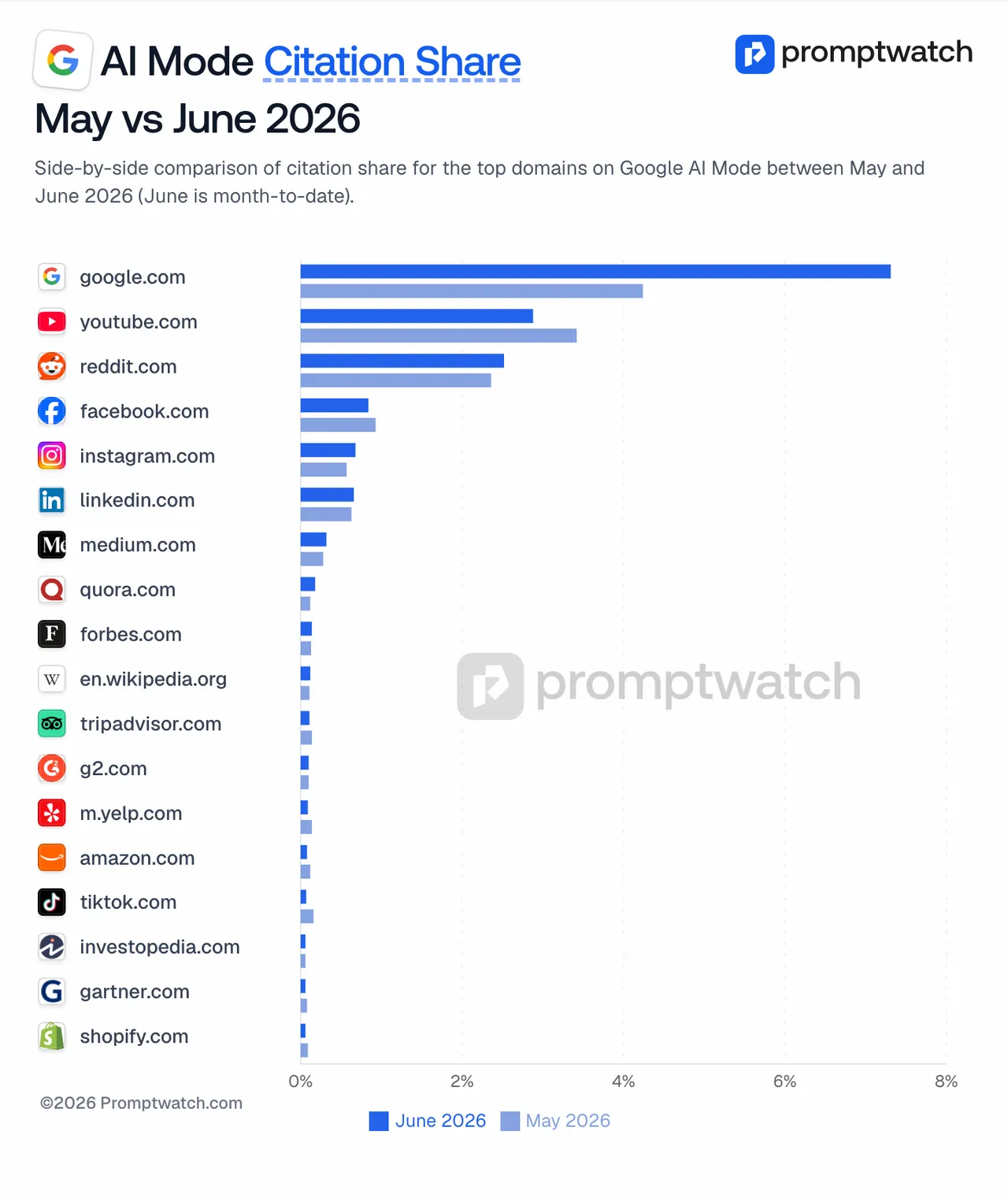 Promptwatch's "AI Mode Citation Share, May vs June 2026" chart (June is month-to-date, June 1 to 27), captured November 14, 2026.
The chart makes the shape obvious: one long bar, two medium ones, and a tail of short bars for Facebook, Instagram, LinkedIn, Medium, Quora, Forbes, Wikipedia, Tripadvisor, G2, Yelp, Amazon and others. Two caveats from the reports belong next to it. The June page says the dip it describes "may deepen or reverse", because June was still in progress. And the May page warns that "the channel mix you optimized for in April was already outdated by May." AI Mode can move a lot in one month.
What the report does not tell you
Neither report breaks google.com down into page types. The May page's advice section is headed "Turn your Google listings into citation assets", which points at business and place listings, but no figure says what share of google.com citations are listings, map results, shopping pages, help articles, or anything else. Our read is that listings are probably part of it, especially for local and product questions. That is an inference about the mix, not a finding.
The reports also don't say why it happened. One likely reason is that AI Mode leans more on Google's own structured information when it builds an answer, but neither page states a cause, and we won't invent one.
So the first job for your agent isn't writing. It's finding out which google.com and youtube.com URLs show up in answers to your prompts. Your category may look very different from the aggregate.
The agent workflow
Step 1: list the Google-owned URLs in your answers
Create a monitor with Google AI Mode selected and the prompts your buyers actually type. In Promptwatch, the All Citations and URL Positions tabs list every cited URL and can be filtered by monitor; citation search highlights the domains you care about. Filter to google.com and youtube.com and export the list. You now know which Google-owned pages AI Mode cites for your category, and where each lands in the source list.
Sort the list into three piles. The first is pages about you that you control, such as a listing you can edit or a video on your own channel. The second is pages about you that you don't control, like a reviewer's video. The third is Google-owned pages about competitors or about the topic in general, where someone else holds the slot.
Agent Chat can do the sorting from the URL Positions page. In that view it can also point out cited domains that belong to competitors you don't track yet, and it asks before adding one.
Step 2: fix the pages you control
For the first pile the work is accuracy and completeness. If AI Mode cites a Google listing for your business, the facts on that listing are what the answer can repeat: categories, services, hours, the description. If it cites one of your YouTube videos, the title, the description, and the first minute of the video should answer the prompt plainly.
Keep this proportionate. If your google.com citations turn out to be listings, keep the listings current. If they turn out to be something else, don't start a listings project because a report heading mentioned listings. Let your own citation list decide.
Step 3: publish the page that sits next to Google's
Even at its June peak, google.com held a single-digit share of citations, so the large majority of AI Mode citations still go to other domains. The second job is the page on your own site that AI Mode can cite beside it: a comparison, a pricing explainer, a service or location page that answers the prompt directly. Promptwatch's Content Agent, on Business ($579/mo) and Enterprise, plans and writes against visibility gaps on a schedule. It works from a review inbox or in fully automated mode, and publishes to WordPress, Webflow, or Framer. On Professional ($245/mo), on-demand Content Creation through AEO articles covers smaller volumes.
Step 4: turn the list into tasks
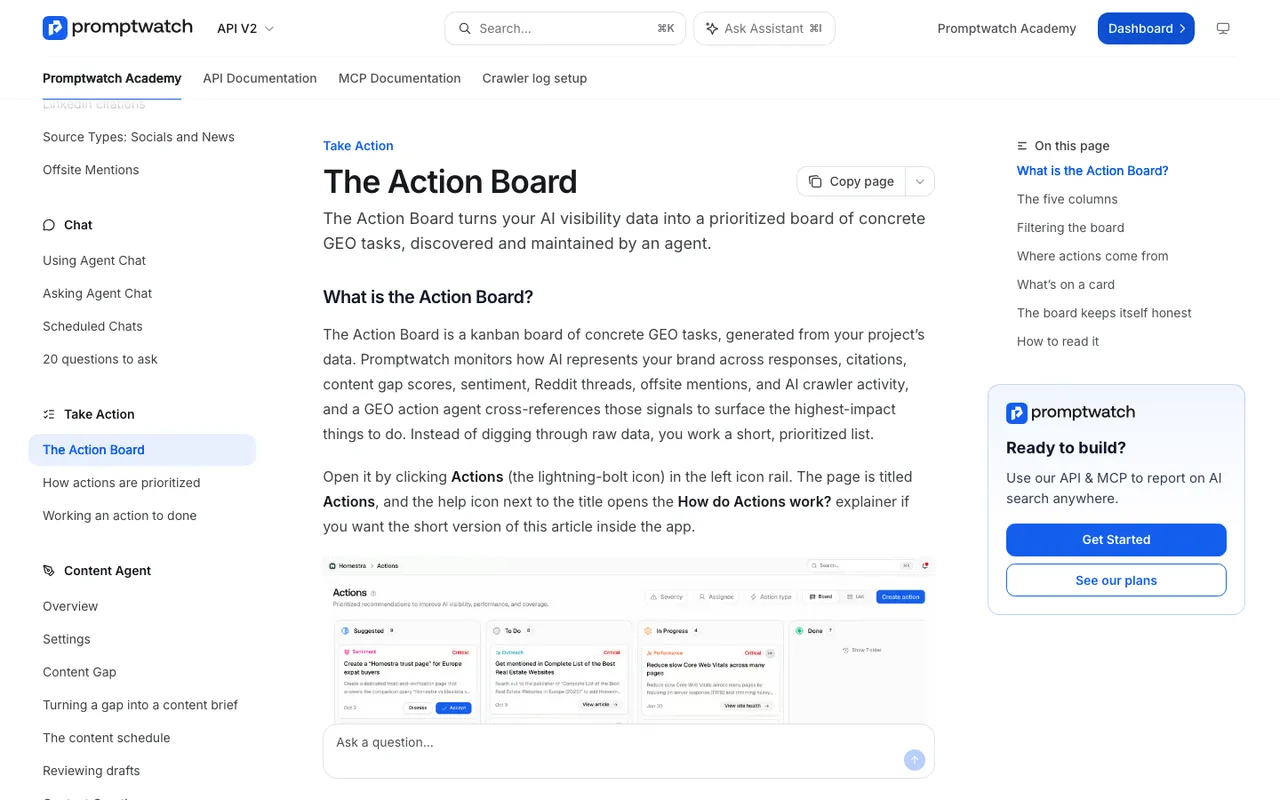 Promptwatch Academy's Action Board guide, captured November 14, 2026. The board in the screenshot uses example data.
The Action Board keeps this from turning into a forgotten spreadsheet. Its Discovery agent investigates on a weekly schedule with one focus per day and suggests up to five evidence-backed actions per run. Add your own cards for the listing fixes and the video edits, assign an owner to each, and the board tracks them to done. Agent replies on a card (you @-mention the agent) help when someone needs the evidence behind a suggestion.
Step 5: measure on the same surface
Measure in AI Mode, not in a blended "Google" number. Watch the Visibility Score and Position for your AI Mode monitor, and add Page Tracker for the exact pages you changed, including any cited YouTube videos. If you sell in specific cities, Business, Agency Scale, and Enterprise plans can pin a monitor to coordinates. For Google AI Mode, the answer then uses the nearest named area to that point rather than the exact spot, so read local results with that in mind. Compare month over month, because the reports show how much one month can shift.
Where other tools fit
AthenaHQ is the closest alternative for action-oriented teams. Its catalog entry describes an Action Center with assignable tasks and a content optimization agent, with Starter at $295 a month for 3,600 credits. Publishing-only agents such as Outrank write and publish articles on a schedule ($99/mo for 30 articles), but our catalog lists no published citation analytics for it, so it can't tell you which google.com URL AI Mode cited. For this workflow the deciding piece is a citation list you can filter by surface and domain, and that is where Promptwatch and then AthenaHQ sit ahead of the publishing tools.
For the wider split between Google's two AI surfaces, see what an agent should do when AI Mode and AI Overviews diverge.
The loop
The finding: in the May 2026 report, google.com led AI Mode with 4.24% of citations, and in the month-to-date June report (June 1 to 27) it reached 7.31%. The action: list the Google-owned URLs in your own answers, fix the ones you control, and publish the page that belongs next to them. The measurement: AI Mode visibility and position, plus Page Tracker on what you changed, checked monthly.
Promptwatch covers all three steps in one workspace. Start the 7-day free trial on monthly billing, build one AI Mode monitor, and filter its citations to google.com before your agent writes a word. The rest of Promptwatch's reports are on the data index.