Winning a slot among 10+ cited domains: an agent plan
Almost half of cited ChatGPT answers name 10 or more domains, but brand questions draw on far fewer. An agent plan that starts where the field is smallest.
47.6%. That is the share of ChatGPT responses with at least one citation that cited 10 or more different domains in the week of September 28 to October 4, 2026, according to Promptwatch's report on unique domains per ChatGPT response. Two thirds of those responses (66.1%) cited at least eight. Only 6% cited three or fewer, and 1% relied on a single domain.
So being cited usually means sharing the answer with a crowd. That changes what "winning" looks like, and it changes the order in which an agent should do its work.
Where the crowd is, and where it isn't
The report splits responses by prompt type, and the split is the useful part. All figures below are from the unique domains report, September 28 to October 4, 2026.
Organic prompts, the ones that don't name a brand, are the most crowded. 52.5% of those answers cited 10 or more domains, 71.8% cited at least eight, and only 4.5% cited three or fewer.
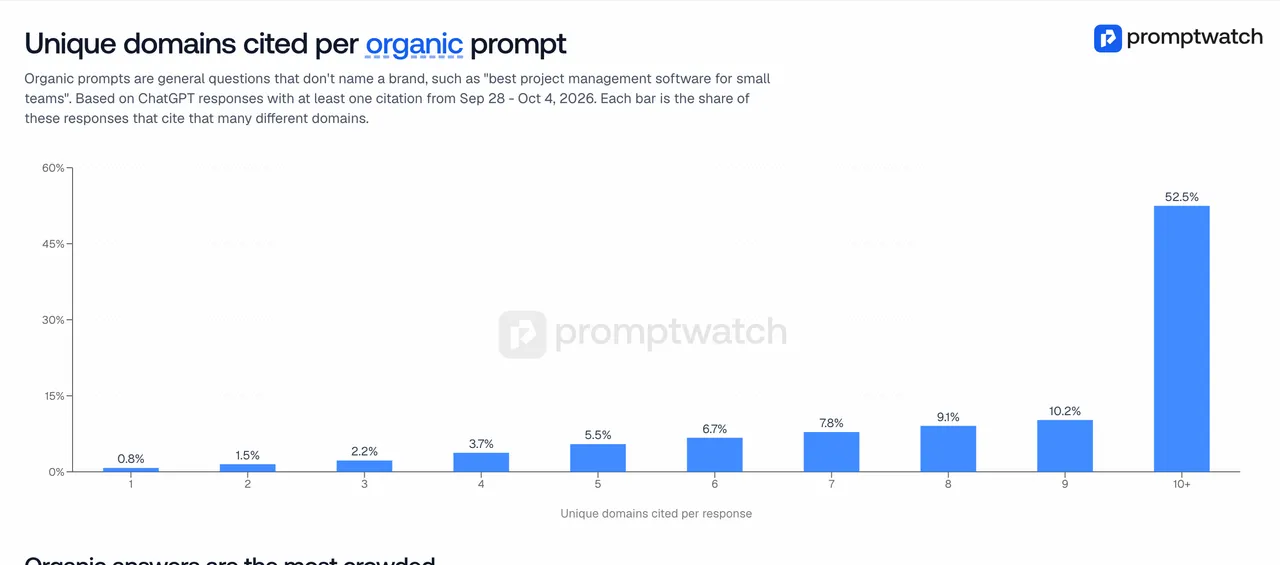 Promptwatch's "Unique domains cited per organic prompt" chart for September 28 to October 4, 2026, captured November 14, 2026.
Brand-specific prompts are a different picture. Only 21.3% of those answers cited 10 or more domains. The most common count was five domains (14.9% of responses), 40.7% cited five or fewer, and 13.8% cited three or fewer (unique domains report, September 28 to October 4, 2026).
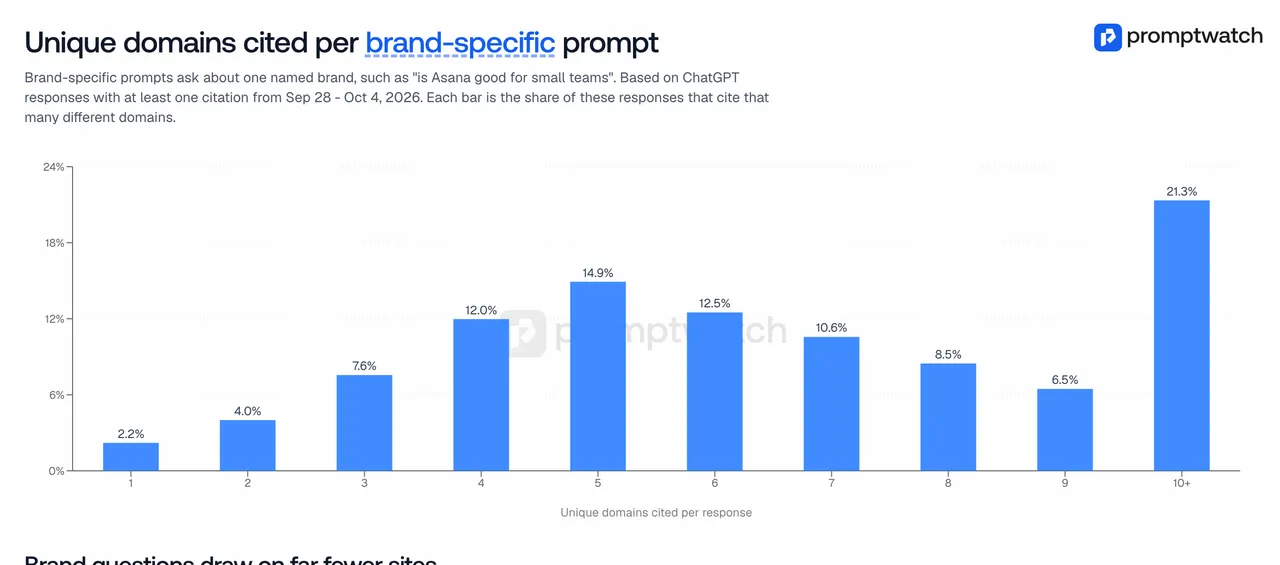 Promptwatch's "Unique domains cited per brand-specific prompt" chart for September 28 to October 4, 2026, captured November 14, 2026.
Competitor comparison prompts sit close to organic. 49.1% cited 10 or more domains and 66.5% at least eight, and only 0.35% relied on one domain, the lowest of the three types (unique domains report, same window).
Two method notes from the report: responses without any citation are left out, and several URLs from one domain count once. The "10+" bar is a capped bucket, so it hides how far past ten some answers go.
What this means for the order of work
Most teams start with organic prompts, because that's where new buyers are. The data suggests that's the hardest place to stand out: you're one of ten or more sources in more than half of those answers.
Brand questions are where the field is smallest. When someone asks ChatGPT about your product by name, the answer draws on fewer sites, and some of those sites should be yours. If they aren't, a competitor's comparison page, an old review, or a forum thread is speaking for you in a room with only a handful of voices.
That gives an agent a sensible sequence:
- Own the brand-question sources. Make sure your site answers what people ask about you by name.
- Shape the comparisons. Publish your own side of the "you vs. them" and "alternatives to them" questions.
- Then compete in organic answers, where the goal is a better position rather than mere presence.
This order is our recommendation, not something the report tests. The report shows where answers are crowded. It doesn't show that winning brand answers first helps you in organic ones.
Phase one: the brand questions
Start by listing the brand-specific prompts you'd expect buyers to ask: pricing, whether you suit a company their size, how you compare, what you don't do. Promptwatch tags prompts by type (Organic, Brand Specific, Competitor Comparison), which happens to match the report's split, so you can track the three groups apart from day one.
Then look at who gets cited. For each brand prompt, check the cited sources and your self-citation rate, the share of citations pointing at your own domain. A low self-citation rate on brand prompts means other sites are describing you. Brand Narrative pulls out the specific claims engines repeat about you, so you can see whether those outside sources are saying anything wrong.
The fixes here are mostly pages you control: a pricing page that states what you charge where you publish it, a plain FAQ, an honest "who this is for" page. Promptwatch's Content Agent can draft them. On Professional ($245/mo) that is on-demand Content Creation through AEO articles; scheduled, automated publishing is on Business ($579/mo) and Enterprise.
Phase two: the comparisons
Comparison answers are crowded too, but they are rarely single-source (that 0.35%). That means your comparison page has room to be one of the cited pages even when you aren't the brand the user asked about. The report's own tip for this prompt type is to "shape how you're compared."
For the agent brief: write fair comparisons with real differences, link the claims to your own docs or pricing, and keep them updated when either product changes. A comparison that's obviously one-sided is less useful to the reader. Whether it's less likely to be cited, nobody has measured here.
Phase three: the crowded organic answers
In organic answers, aim for position. Promptwatch's Position metric is where your brand lands in the order of brands within an answer, averaged across the responses that mention you; lower is better. Citation rank is where your own domain lands in the answer's source list, where closer to 1 means a primary source. Share of Voice is your slice of all brand mentions under the current filters.
Read them together the way Promptwatch's metric guide suggests. Low Share of Voice is a coverage problem: you're missing from answers. A late Position is a prominence problem: you're mentioned but named after others. Mentions without self-citations point to a content or crawlability problem. Each points the agent to a different fix.
Running the plan as an agent
The Action Board is where the plan runs. Its Discovery agent looks at your data on a weekly schedule, one focus per day, and suggests up to five evidence-backed actions per run. Assign the phase-one tasks first.
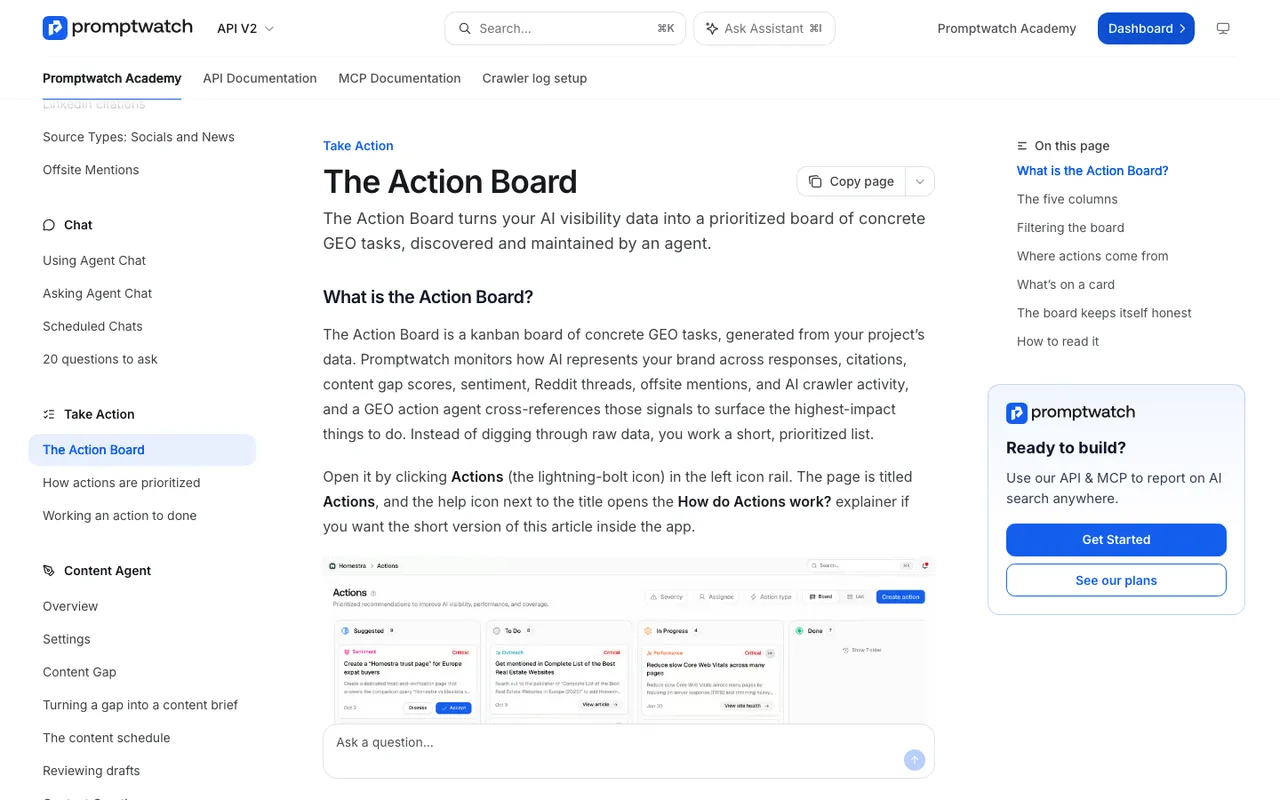 Promptwatch Academy's Action Board guide, captured November 14, 2026. The example board in the screenshot uses sample data.
Agent Chat can do the weekly check on request: "for brand-specific prompts, which domains are cited that aren't ours, and what do they say about us?" Scheduled Chats (10 are included on every brand plan) can deliver the answer to Slack every Monday.
Where other tools fit
AthenaHQ is the strongest alternative for a team that wants a task queue; its catalog entry lists an Action Center with assignable optimization tasks, from $295/mo. Publishing agents such as Outrank and SEObot can turn out the pages for phase one, but our catalog doesn't list published citation analytics for either, so they can't tell you who else is cited next to you. For a plan built around crowd size, you need the citation list per prompt type, and Promptwatch is where we'd start, with AthenaHQ second.
The loop
The finding: 47.6% of cited ChatGPT answers named 10 or more domains in the week of September 28 to October 4, 2026, while brand-specific answers drew on fewer, with 40.7% citing five or fewer (unique domains report). The action: own the brand-question sources, publish your comparisons, then work organic answers for position. The measurement: self-citation rate on brand prompts, Position and citation rank on organic ones, and Page Tracker on every page the agent publishes.
Start the 7-day free trial on monthly billing, tag twenty prompts by type, and look at the brand-specific group first. If you want more context on how fan-outs feed these crowded answers, see how query fan-outs work in AI search.