How-tos doubled in ChatGPT citations in August: building a refresh-agent queue
ChatGPT's mix of cited formats shifted inside August 2026. How to build a Content Refresh queue that notices a format shift and sends the right pages for rewrite.
A refresh queue is a list of existing pages waiting to be rewritten, in priority order. Most teams build one by gut feel: the oldest pages first, or the ones someone complained about. That works until the formats an engine likes start to move. Then you're refreshing pages in the order you wrote them, not in the order that matters.
August 2026 is a good test case. In one month of ChatGPT data, the format mix shifted enough that a queue built in July would have been pointed at the wrong pages by September. This post is about building a queue that notices.
What moved in August
Promptwatch's ChatGPT citation types report for August 2026 tracks the daily share of each content type among classified citations from August 1 to 31. Within that month, how-to guides rose from 4.3% of citations in the first week to 9.1% over the last nine days. Documentation rose from 3.3% to 8.2%. Landing pages fell from about 20% in the first week to under 12% at the end. Product pages, the biggest type, held around 30% until August 22 and then dropped to about 25%.
Social posts fell from 4.4% to under 1% after August 14, the day Reddit's share of ChatGPT citations collapsed. Listicles ended the month at 11%, and comparisons, news, and FAQs each gained a point or more (August citation types report, August 1 to 31, 2026).
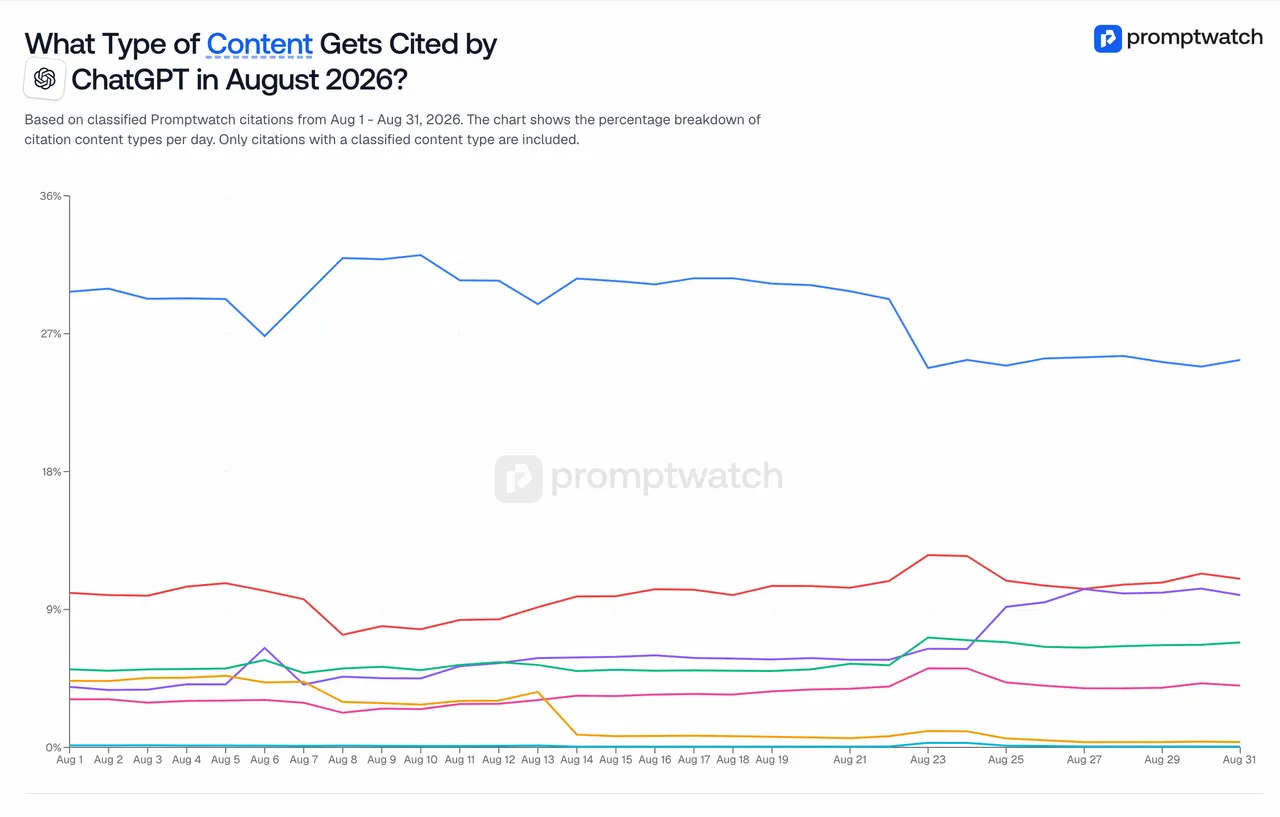 Promptwatch's "What Type of Content Gets Cited by ChatGPT in August 2026?" chart, captured November 14, 2026.
We covered what those numbers mean for planning new content in an earlier agent brief on the August data. This post is about the other half: the pages you already have.
Why format shifts belong in a refresh queue
When how-tos gain share, there are two ways to respond. You can write new how-tos, or you can look at the pages you already have that answer a task and make them read like a good how-to. The second is usually faster, and the page keeps whatever history it has.
The same goes for the decliners. If landing pages lose share for a stretch, a landing page that used to be cited may stop being cited. That page doesn't need to become a how-to. It might need a clearer answer near the top, or current facts. A refresh queue is where you decide which.
Our read on the August data is cautious. The report shows what ChatGPT cited, not why. A format gaining share in the aggregate doesn't mean your page in that format will be cited, and the late-August product page drop came the same month other formats rose, so some of the movement is pages trading places. The queue should react to your own citations first and to aggregate shifts second.
The queue, in four parts
Part 1: the trigger list
Decide in advance what puts a page into the queue. We'd use these:
- A page that used to be cited for a tracked prompt has stopped being cited.
- A format your pages don't use is gaining citations for your prompts.
- A competitor's page now holds a citation your page used to hold.
- The facts on the page have changed (prices, steps, screenshots, product names).
The first three come from citation data. The fourth comes from your own team, and it's the one people forget.
Part 2: the scoring
Not every triggered page is worth a rewrite. Score each one on how much traffic or pipeline the prompt carries and how far the page has slipped. Promptwatch's Citation Trends helps with the second part. For each cited page it reports when the page was first cited, ramp-up days, peak citation rate, and a decay half-life. A page whose citation rate is decaying fast is a stronger candidate than one that's holding steady.
Citation Trends also classifies every citation into 22 content types and 20 source types, so you can check whether the how-to and docs rise in the August report shows up in your prompts too. If it doesn't, don't chase it.
Part 3: the rewrite
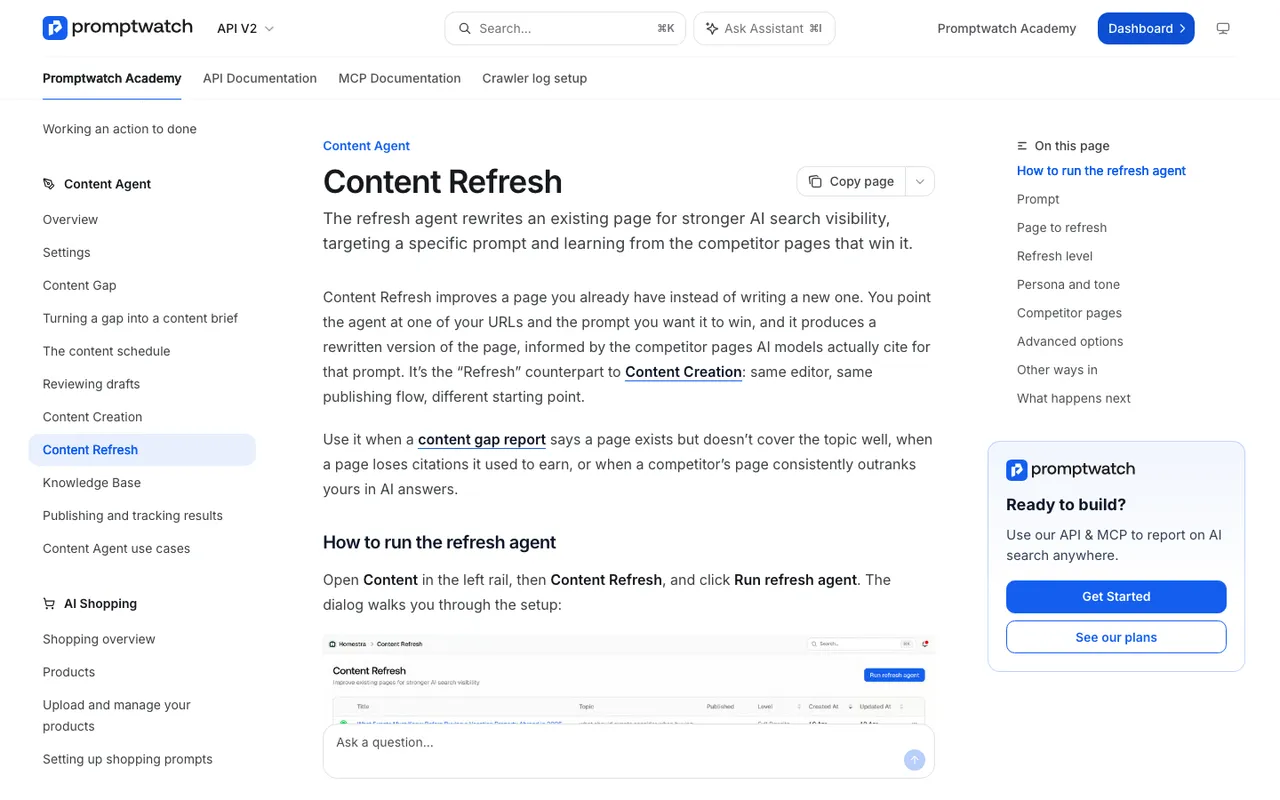 Promptwatch Academy's Content Refresh guide, captured November 14, 2026.
Promptwatch's Content Refresh is the rewrite step. You point it at one of your URLs and the prompt you want that page to win, and it produces a rewritten version informed by the competitor pages AI models cite for that prompt. The Academy guide suggests using it when a page exists but doesn't cover the topic well, when a page loses citations it used to earn, or when a competitor's page keeps outranking yours. Those are the same triggers as Part 1.
For a page that should become more of a how-to, give the refresh a clear instruction: one task, steps in order, prerequisites first, the answer in the opening lines. For a landing page that slipped, ask for the opposite: keep the page's purpose, tighten the opening, update the facts. The output is a diff, so a reviewer sees what changed.
Part 4: the republish
A refreshed page that nobody re-crawls is a refreshed page nobody cites. Two Promptwatch features help here. IndexNow submission (added November 13) lets you send changed pages to IndexNow from Promptwatch, with a filter for pages Promptwatch's crawler saw change since you last submitted them. And Agent Analytics (crawler logs, from Professional at $245/mo) shows when AI crawlers such as GPTBot, OAI-SearchBot, and ChatGPT-User actually fetch the page again, which separates "not crawled yet" from "crawled and still not cited."
Who does what
The agent can run triggers and scoring every week without anyone asking. The Action Board's Discovery agent already investigates on a weekly schedule, one focus per day, and suggests up to five evidence-backed actions per run; refresh candidates fit naturally there, with an assignee per card. Agent Chat can answer "which of our pages lost a citation this month, and what format are the pages that replaced them?" on request, and Scheduled Chats can send that answer to Slack every Monday.
A person should approve each rewrite before it goes live, especially for how-tos. A wrong step in a guide is worse than no guide, because someone will follow it. Promptwatch's Content Agent (Business at $579/mo and Enterprise) can run refreshes on a schedule with a review inbox, which keeps the approval step without making someone remember to start the job.
A cadence that fits the data
The August report shows a mix that shifted within weeks: product pages held one level until August 22 and another after it. That argues against a refresh queue that's reviewed once a quarter. It also argues against reacting to a single day. A weekly trigger run and a monthly look at format shares is the cadence we'd start with, and you can tighten it if your prompts move faster.
The loop
The finding: in August 2026, how-tos rose from 4.3% to 9.1% of classified ChatGPT citations and documentation from 3.3% to 8.2%, while landing pages fell from about 20% to under 12% (August citation types report, August 1 to 31, 2026). The action: a refresh queue with written triggers, scoring from Citation Trends, rewrites through Content Refresh, and republishing through IndexNow. The measurement: Page Tracker on each refreshed URL, crawler visits in Agent Analytics, and whether the page wins back its citation.
That loop runs end to end in Promptwatch, which is why it leads our list of agentic platforms. Start the 7-day free trial on monthly billing and build your first trigger list from the pages that lost citations last month.