How do ChatGPT and other AI assistants use App Store listings when recommending apps, and what can agents automate?
Assistants treat an App Store listing as one web page among many. Here is which parts of getting your app recommended an agent can run, and which still need a person.
When someone asks ChatGPT for "a sleep tracker that works without a subscription", the assistant does not open App Store Connect. If it searches, it rewrites the request into shorter queries, sends them to search partners, reads what comes back and cites a handful of pages. Your listing on apps.apple.com can be one of those pages. So can a Reddit thread, a review roundup, or your competitor's help center.
That loop is repetitive and data-heavy, which makes most of the monitoring side a good job for agents. The listing itself is not, because Apple's review process sits between you and every change. This piece splits the work along that line.
The documented ground rules
OpenAI's crawler overview lists OAI-SearchBot as the bot that surfaces sites in ChatGPT's search features, and says sites that opt out of it won't be shown in ChatGPT search answers. GPTBot, the training crawler, is controlled separately. Each robots.txt setting is independent.
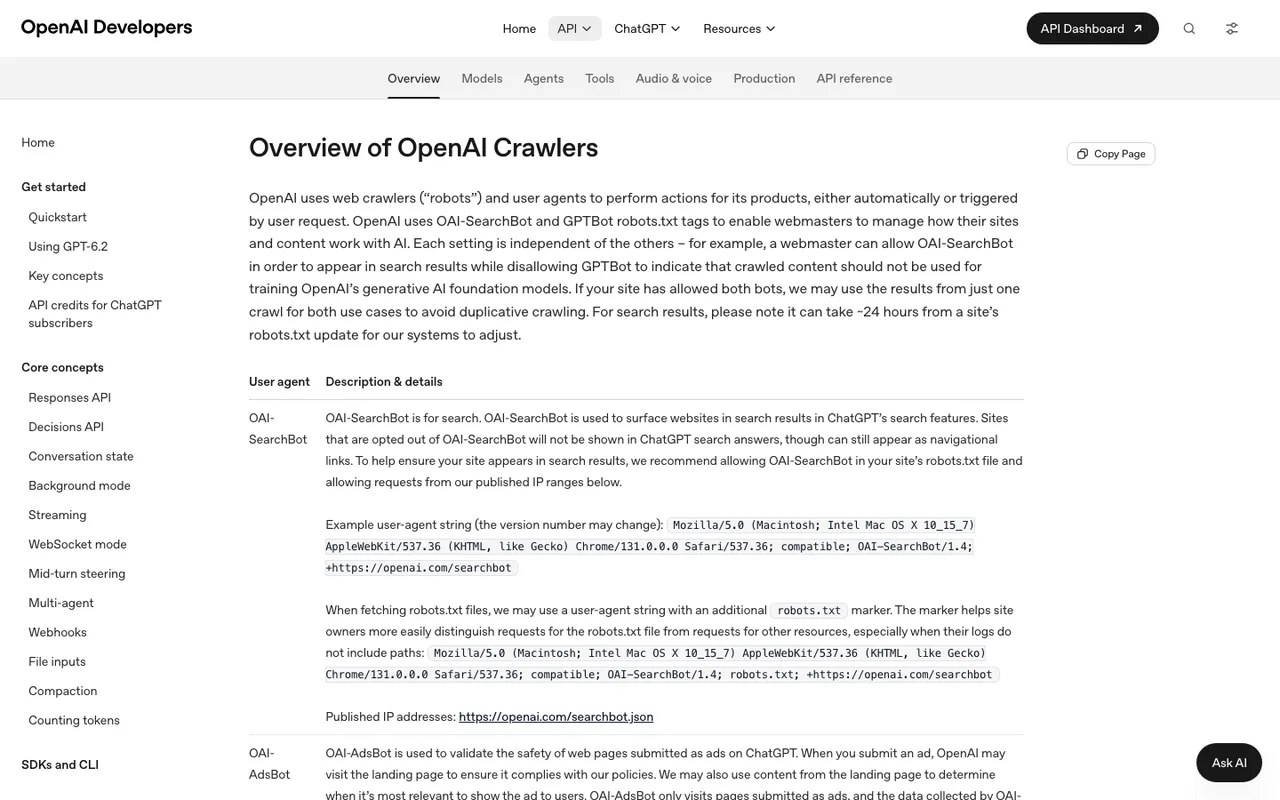
OpenAI's "Overview of OpenAI Crawlers" page, captured November 21, 2026.
Google's "AI features and your website" says there are no extra requirements to appear in AI Overviews or AI Mode, and that both can fan a question out into several related searches. Apple documents App Store search ranking (text relevance plus downloads, ratings and reviews) and, since November 3, 2026, a developer preview of Siri AI that apps join through App Intents. None of these vendors says its assistant reads App Store metadata in any special way. Treat that as unknown, and build for the open web.
What an agent can run for you
Daily answer collection and the weekly read
In Promptwatch, monitors run your app prompts daily across the engines you choose. On top of that, Agent Chat can handle the reading. Save a Scheduled Chat that every Monday lists which app prompts you lost, which domains were cited instead, and whether apps.apple.com or play.google.com appeared at all, and have it posted in Slack. Nobody on the team has to open a dashboard to know whether something moved.
Finding the searches behind each answer
Query fan-outs are where the agent earns its keep. Promptwatch stores the real sub-queries a model ran for every tracked response that exposes them.
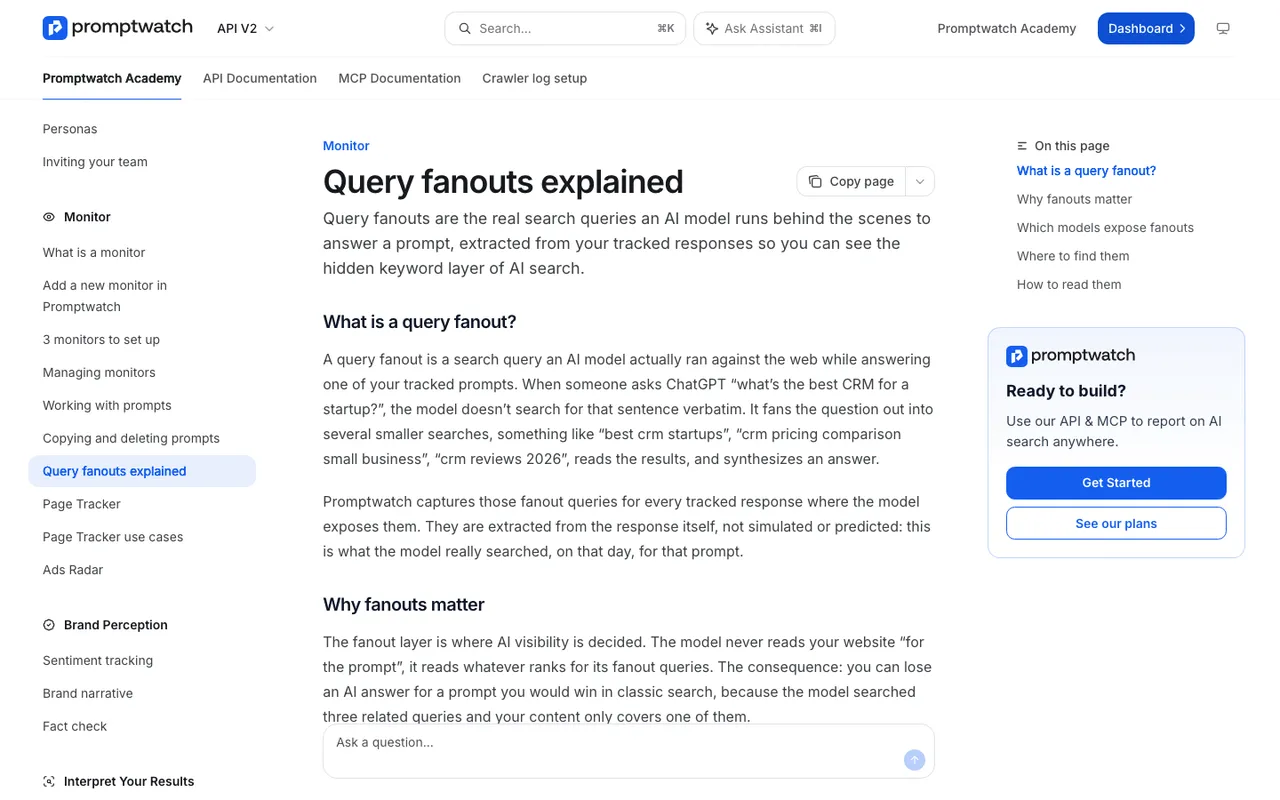
Promptwatch Academy, "Query fanouts explained", captured November 14, 2026.
Ask Agent Chat to group last month's fan-outs for your category and mark the ones where no page of yours ranks. That turns a vague "ChatGPT ignores us" into a short list of queries such as "sleep tracker apps no subscription" that need a page.
Turning gaps into tasks and drafts
The Action Board's Discovery agent investigates on a weekly schedule and suggests up to five evidence-backed actions per run, covering content gaps, offsite mentions and site health. On Business and Enterprise, the Content Agent can then plan and write the pages those gaps call for, such as a comparison page, a help article answering a feature question, or a refresh of an outdated FAQ. It works from your Knowledge Base and brand book. Drafts land in a review inbox unless you switch to fully automated publishing, and they can go to WordPress, Webflow or Framer.
Promptwatch's own software data explains why this is the right place to spend agent effort. In its October 2026 report on software prompts (organic ChatGPT prompts, Sep 28 to Oct 4), documentation and help centers took 2.64% of software citations and app stores 0.47%.
Wiring it into your own tools
The hosted MCP server exposes over 110 read and write tools. From Claude Code or Cursor you can pull the citation list for your app prompts, check a URL in Page Tracker, or queue a content brief without switching windows. The REST API covers the same data for a nightly job.
What still needs a person
Listing changes
App name (30 characters), subtitle (30), keywords (100) and the description ship with a new version through App Store Connect. Promotional text (170 characters) can change any time, but Apple says it does not affect search ranking. An agent can draft alternatives. A person decides, because keyword misuse is, in Apple's words, a common reason for rejections.
App Intents
Getting into Siri AI is engineering work in your app. No visibility tool does it for you, and Siri is not among the engines Promptwatch tracks.
Claims about your own product
Brand Narrative collects the claims assistants make about your app, and Fact Check (Business) tests them against your site and the 50 most-cited offsite pages for each claim. Someone still has to confirm what is true before "Fix with content agent" rewrites the flagged pages.
Review replies
Apple ties ratings and reviews to App Store ranking. Answering reviewers is customer work, not something to automate blindly.
Where other platforms fit
AthenaHQ has an Action Center and a content optimization agent, and its Starter plan is $295/mo for 11 models at country level. Outrank researches keywords and writes and publishes SEO articles on a schedule, from $99/mo for 30 articles, but it publishes no prompt tracking across AI engines. It belongs after the measurement step, not in place of it.
Start a 7-day free trial of Promptwatch, set up one monitor with your top 20 app prompts, and let the Monday Scheduled Chat run for a month before you change the listing.