Which websites does ChatGPT cite most often? Let an agent keep the list current
Which websites ChatGPT cites most often changes month to month. Here is the 2026 data, and the parts of tracking and acting on it that agents can run for you.
Any answer to "which websites does ChatGPT cite most often" has a shelf life of about a month. That is the main finding hiding in Promptwatch's citation reports, and it is the reason this question belongs on an agentic SEO site. A list you check twice a year is a list you are always wrong about. A list an agent re-reads every week is useful.
What the 2026 data says
The leaders, per Promptwatch's monthly "ChatGPT Citation Share" reports, which count citations from real ChatGPT responses where web search ran in the UI:
- January 2026: Wikipedia 3.63%, Reddit 2.58%.
- March 2026: Wikipedia 3.61%, Reddit 3.21%, then TechRadar 0.46%, arXiv 0.34%, Forbes 0.33%, Walmart 0.31%.
- April 2026: Reddit 4.14%, Wikipedia 1.15%. The page warns that a single model or retrieval update can rewrite which sources ChatGPT trusts almost overnight.
- May 2026: Reddit 6.11%, Wikipedia 0.72%, TechRadar 0.48%, arXiv 0.31%, Reuters 0.25%.
- June 2026 (month to date, June 1 to 27): Reddit 3.71%, Wikipedia 0.56%, GitHub 0.27%, Trustpilot 0.22%.
Then August. In "Reddit Citations Are Dropping in ChatGPT", Reddit went from 3.83% (July 18 to August 7, 2026) to 0.52% (August 14 to 17), a drop the page calls provisional. The November social report, on its own baseline, measured Reddit at 0.40% of ChatGPT citations from October 11 to November 9, well under a tenth of the 5.19% that series showed before August.
Two other platform-wide changes show why a static list fails. After the GPT-5.3 rollout on March 4, 2026, ChatGPT went from about 6.4 sources per search-enabled response to 4.7 to 4.9 by late March ("ChatGPT Citation Drop After GPT-5.3"). And on August 8, 2026, site: queries jumped from 0.37% to 16.8% of all fanout queries ("ChatGPT site: operator fanouts"). Fewer slots, different searches, a different source mix.
What OpenAI documents, and what it leaves out
OpenAI's Help Center page "Searching the web with ChatGPT" says ChatGPT may search automatically when a question benefits from current information, that it ranks results using multiple factors, and that placement is not guaranteed. It also says ChatGPT search rewrites a question into targeted queries sent to search partners.
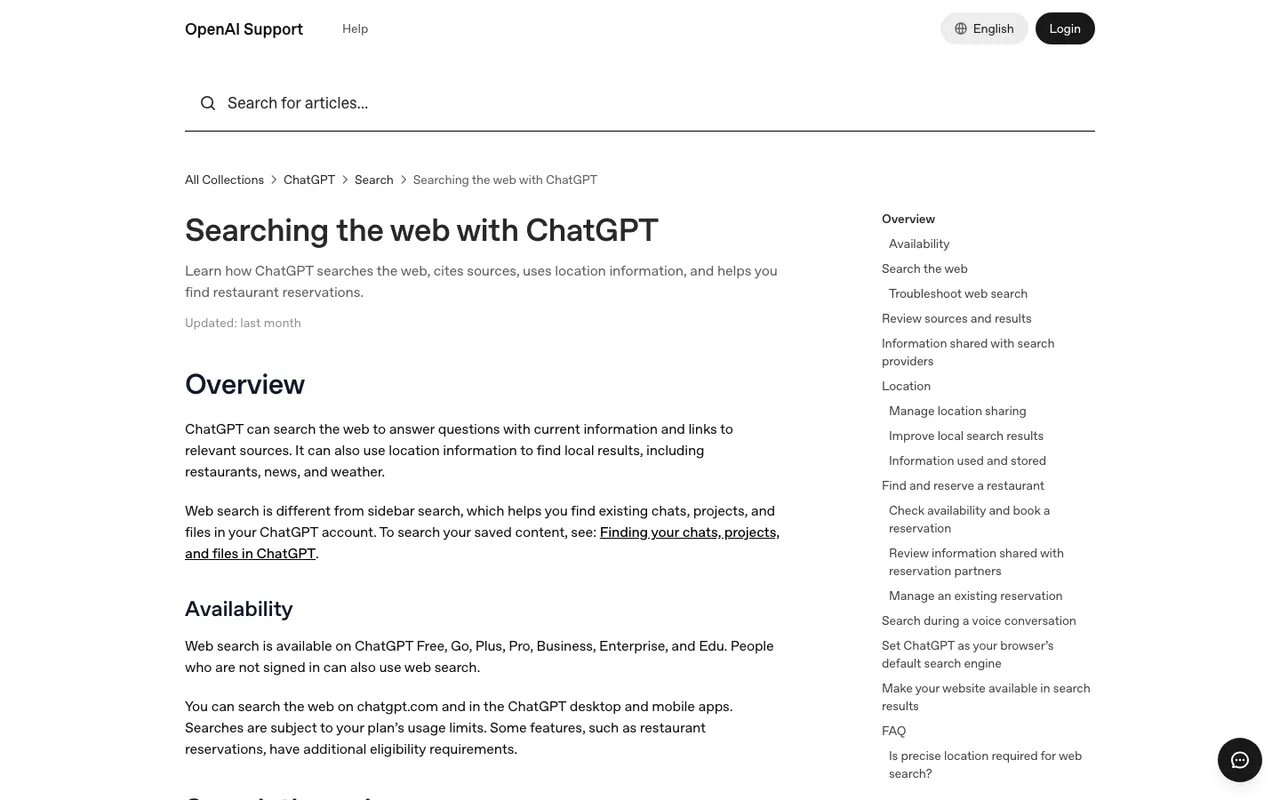
OpenAI Help Center, "Searching the web with ChatGPT", captured November 21, 2026.
What it does not publish is a list of favored domains, a ranking factor list, or a recrawl schedule. So the most-cited list is something you observe, not something you look up.
The parts an agent can run
Here is what we would automate, in the order it pays off, using Promptwatch as the platform because it is the one where monitoring, analysis and publishing share a workspace.
Daily collection. Monitors run your prompt panel through ChatGPT's real interface every day, or every 12, 6 or 1 hours on Business, Agency Scale and, on request, Enterprise. Each response keeps its citations, so the "which sites" question gets answered for your prompts, not a global sample.
Trend detection. The Citation Trends tab classifies every citation into 22 content types and 20 source types and tracks first-cited date, ramp-up days, peak rate and decay half-life per page. A domain that starts rising in your answers shows up there before it shows up in anyone's monthly report.
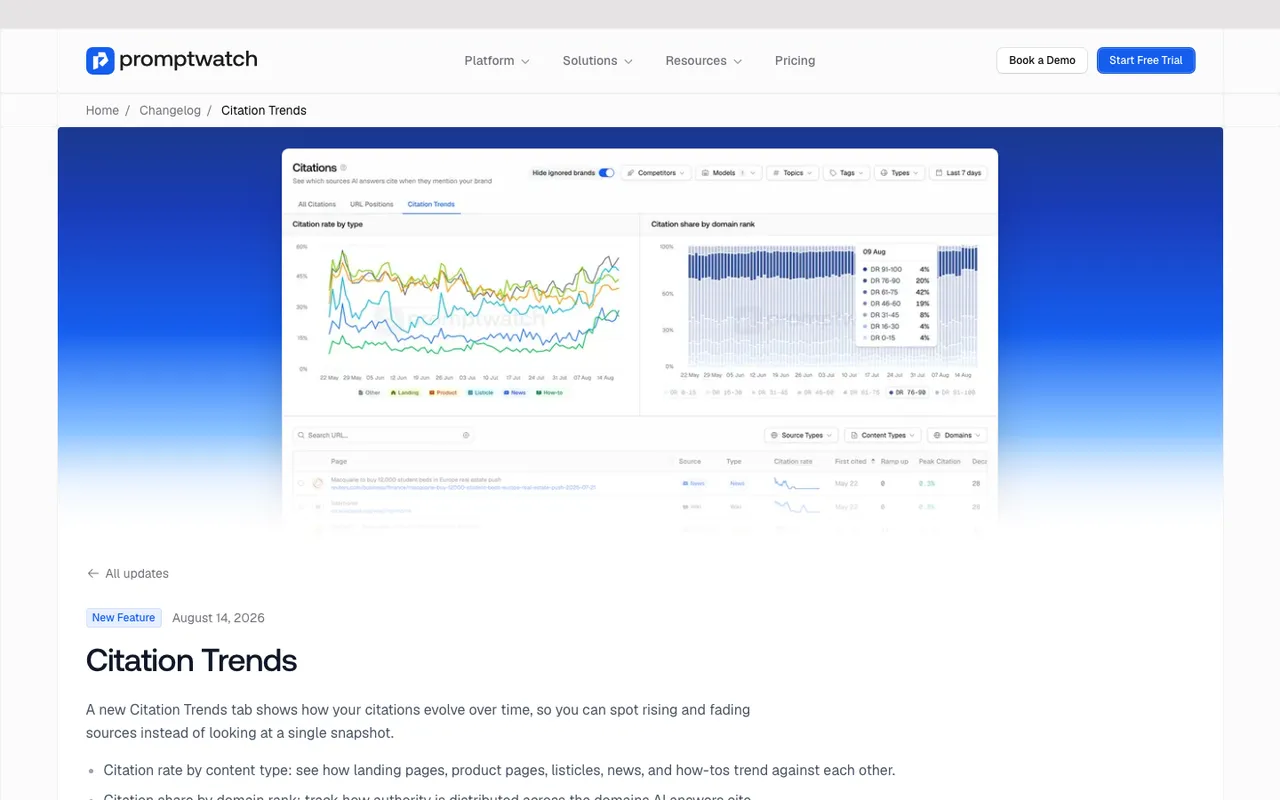
Promptwatch changelog, "Citation Trends" (August 14, 2026), captured November 14, 2026.
Spotting new competitors in the source list. On URL Positions, Agent Chat can point out cited domains that belong to competitors you do not track yet. It asks before adding one, which is the right default for an agent.
Weekly investigation. The Action Board's Discovery agent runs on a weekly schedule and suggests up to five evidence-backed actions per run. The board covers content gaps, Reddit, offsite mentions and untapped pages, so a source that keeps beating you tends to surface as a task.
Content from a citation. When a third-party page keeps winning the slot you want, "create content from a citation" starts a brief from that page. The Content Agent (Business and Enterprise) can then plan, write and publish against the gap on a schedule, with a review inbox where you approve, edit or decline.
Reporting without logging in. Scheduled Chats deliver a recurring analysis in-app or in Slack, and the MCP server lets Claude, ChatGPT or Cursor query the same data.
What still needs a person
Some of the most cited sources are communities and reference works. An agent can tell you that a subreddit or a Wikipedia article keeps appearing in answers about your category. It should not be posting there for you. Reddit threads earn citations because real people wrote them, and Wikipedia has its own notability and conflict-of-interest norms. A human decides whether and how to take part.
The same goes for PR. The domain-rank report found that DR 46 to 75 sites earned 46% of ChatGPT citations in August 2026, so the trade press and specialist reviewers in your niche are realistic targets. Picking which editor to pitch is judgment work.
Finally, someone has to decide what the agent is allowed to publish. Fully automated mode exists, but most teams start with the review inbox and loosen it once the drafts are reliably on brand.
Where to start
If you want to see the cited-domain list for your own category before setting anything up, book a Promptwatch demo and ask to see a monitor's citations for your top commercial prompts. That screen answers the question for your market better than any global ranking can.