Automotive prompts favor marketplaces: a dealer content agent playbook
In August 2026 ChatGPT's automotive citations went mostly to marketplaces and research sites. A content agent playbook for dealers who want their own pages cited too.
Picture a hypothetical three-store dealer group, call it Ridgeline Motors. Its marketing lead asks ChatGPT which midsize SUV to buy, what a particular trim costs, and where to get one serviced nearby. The answers cite plenty of sources. Ridgeline's site is not among them. Neither, mostly, are the carmakers' sites.
That isn't bad luck. Promptwatch's ChatGPT citation share report for automotive, covering August 1 to 31, 2026, shows marketplaces and research sites at the top. Autotrader.com led with 5% of automotive citations and Cars.com followed at 4.6%. Seven of the top eight domains were marketplaces or automotive research and review sites. Chevrolet.com was the only manufacturer in that top eight, at fourth with 2.62%.
The shape of the answer
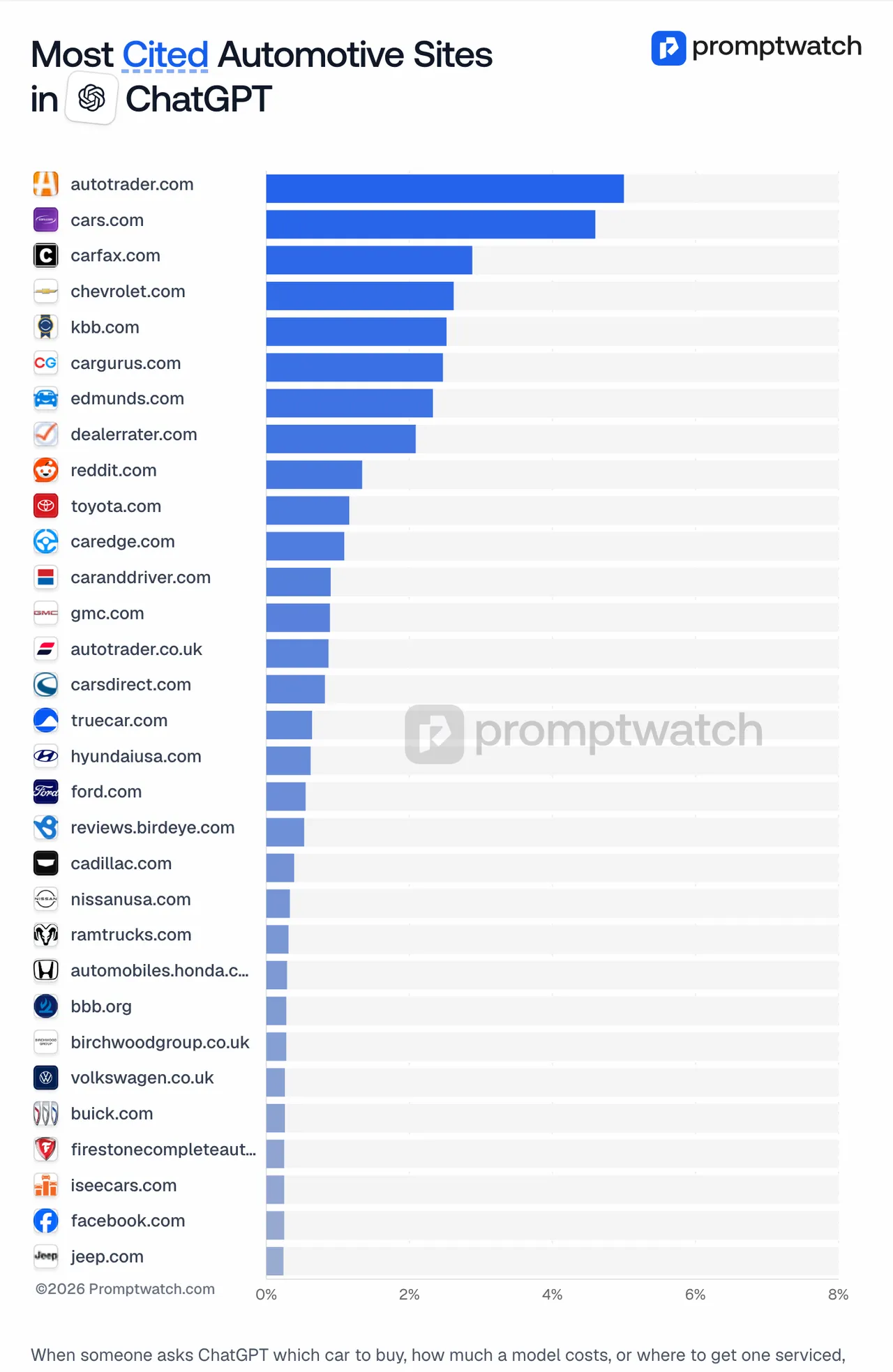 Promptwatch's "Most Cited Automotive Sites in ChatGPT" chart for August 2026, captured November 14, 2026.
Further down the chart you find Reddit at ninth with 1.34%, a run of manufacturer domains (Toyota, GMC, Hyundai, Ford, Cadillac and others), review profile sites like Birdeye and BBB, and exactly one dealership in the top 31: birchwoodgroup.co.uk at 0.28% (automotive report, August 1 to 31, 2026).
Grouped by source type, the gap is wider. Marketplaces and listings earned 14.65% of automotive citations and reviews and research 12.62%, together 27.27%. Manufacturer sites earned 7.92%. Community and news, dealerships, and service and finance combined came to 2.12% (automotive report, August 1 to 31, 2026).
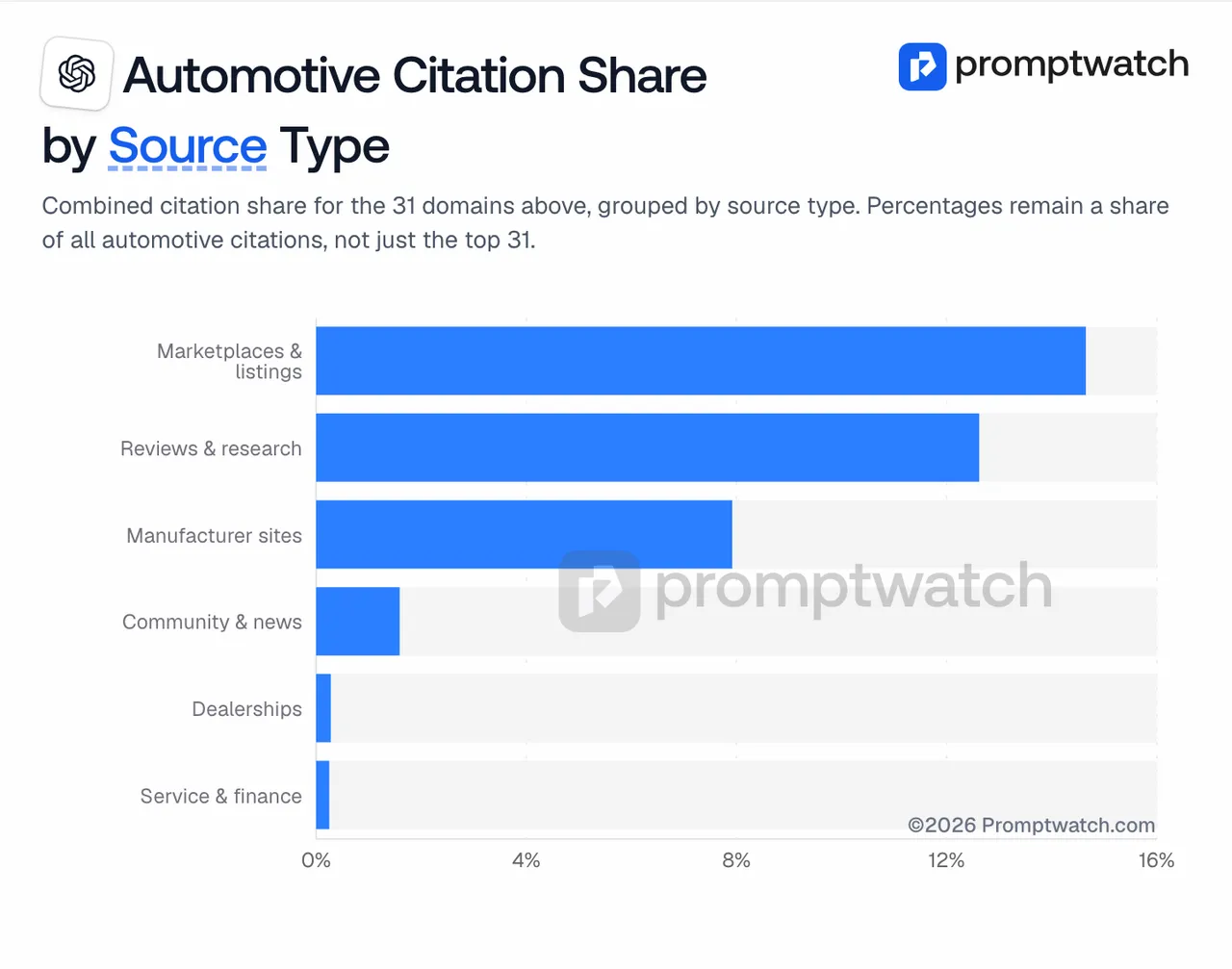 Promptwatch's "Automotive Citation Share by Source Type" chart for August 2026, captured November 14, 2026.
Two notes on reading this. The percentages are shares of all automotive citations, not just the 31 domains shown. And unlike Promptwatch's October industry reports, the automotive page doesn't say it covers only organic prompts, so don't assume which prompt types are in the mix.
What it means for a dealer
The plain reading: when ChatGPT answers a car question, it reaches for the places that list cars and the places that review them. A dealer's own site is a small part of that, and in this data just one dealer made the top 31.
That one dealer is worth a sentence, but only one. It shows a dealer domain can make the chart. The report doesn't say why birchwoodgroup.co.uk got there, and we won't guess at its pages.
The useful conclusion is about where to spend effort. For most dealers, the marketplace and review profiles that already describe your inventory and your stores are a bigger citation surface than your own blog. Your own pages still matter, especially model and trim pages, but they are the second job, not the first.
The playbook
1. Audit the marketplace listings ChatGPT cites for you
Start with a monitor of the prompts your buyers ask: model comparisons, trim prices, "best dealer for X near Y", service questions. In Promptwatch's citation analytics, filter the cited URLs to the marketplace and research domains. Citation Trends classifies each citation by source type, including a Directory type for listing and review sites, so you can see how much of your category's citations go to listings.
Then open the cited listing pages that mention your stores or your inventory. Are prices, trims, and availability right? Is the store information current? This audit is where an agent saves the most time: Agent Chat can pull the list of cited marketplace URLs for your prompts and group them by domain, and a person checks the listings themselves, because fixing them happens inside each marketplace's own dealer tools.
2. Give every model and trim a stable page
The report's own tip is to give every model and trim a page with specs and pricing context. That's work a content agent does well, because it's structured and repetitive. Each page should answer the questions people ask about that trim: what it includes, how it differs from the trim below, what it costs where you can publish that, and what's in stock.
Keep the URL stable. A trim page that moves every model year starts over each time. Promptwatch's Content Agent (Business at $579/mo and Enterprise) can draft these pages from a brief that includes up to five competitor URLs, such as the research site pages ChatGPT already cites for that model, and publish them to WordPress, Webflow, or Framer. Use the review inbox. Prices and specs are exactly the facts a dealer can't afford to get wrong.
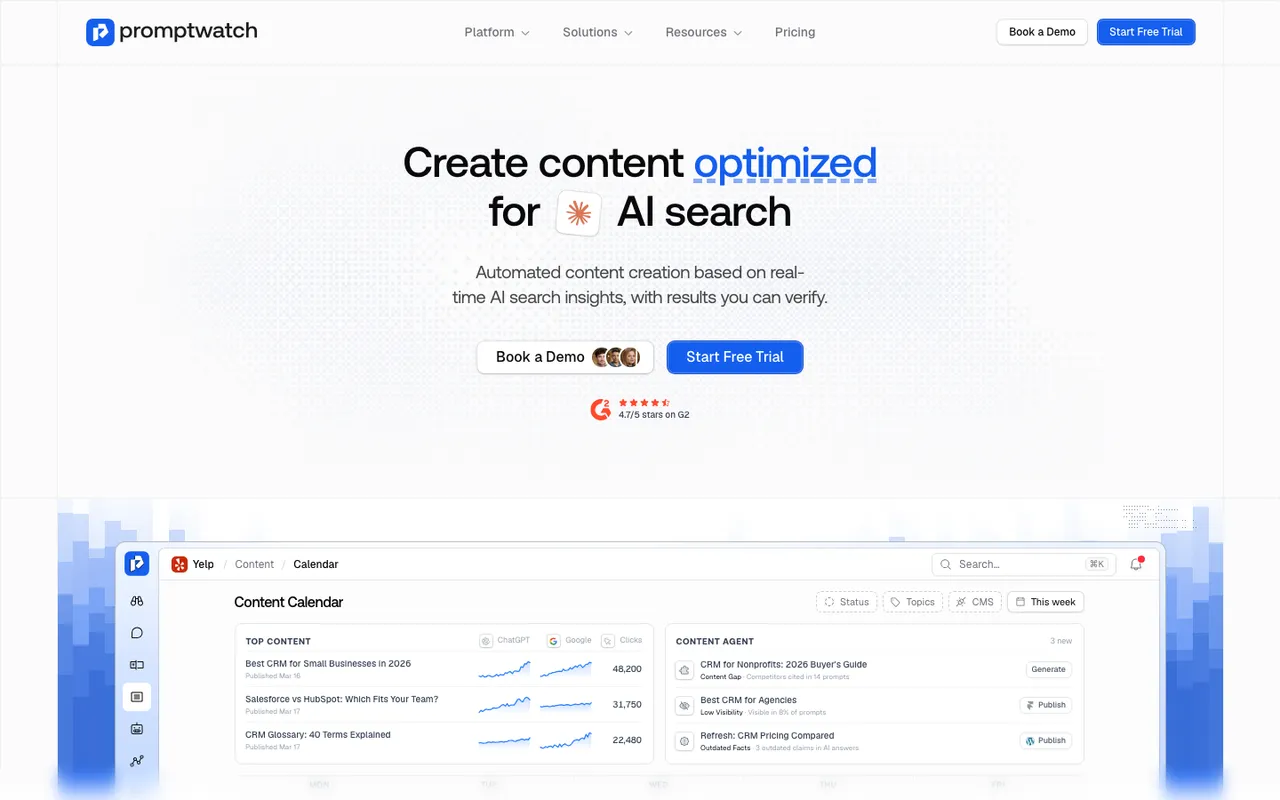 Promptwatch's Content Agents page, captured November 8, 2026. The calendar, article titles and click counts on the page are illustrations, not results.
3. Keep the review profiles complete
The report's tips name DealerRater, Birdeye, and BBB as review profiles to keep current, without percentages for them. On the chart, dealerrater.com sits in the top eight, and reviews.birdeye.com and bbb.org appear further down. An agent can watch which review profiles get cited for your store prompts. Responding to reviews and asking customers for them stays with your staff.
4. Set a refresh cadence that matches inventory
Car pages go stale faster than most content: model years change, incentives end, trims get renamed. Promptwatch's Content Refresh rewrites an existing page for a specific prompt, using the competitor pages that AI models cite for it. Point it at your trim pages each time the model year turns, and whenever Citation Trends shows a page's citations fading. The Action Board can hold the refresh tasks so they don't depend on someone remembering.
5. Measure by store, not just by brand
A dealer group sells in specific places. State and city tracking is on Business, agency plans, and Enterprise, so each store can have a monitor in its own city. Agency Scale, Business, and Enterprise can also pin a monitor to coordinates; ChatGPT then uses the exact point. Remember that a monitor's location is fixed once you create it, so set one up per store rather than editing one.
Measure three things. Visibility Score and Position on the store's prompts. Page Tracker on each model and trim page you publish, so you see whether ChatGPT starts citing it. And Visitor Analytics, which counts AI-referred visits from ChatGPT and other engines and the conversions they lead to, so the work is judged on leads rather than mentions.
What this playbook won't do
It won't move you above Autotrader. In this report, the marketplaces are where the citations are, and the sensible goal is to be correctly represented there and cited alongside them with your own pages. It also won't replace the marketplaces' own dealer tools; listing fixes happen in those tools.
For a comparison of tools that track dealers by city, see the best AI visibility tool for car dealerships.
The loop
The finding: in August 2026, marketplaces and listings plus reviews and research took 27.27% of ChatGPT's automotive citations, manufacturer sites 7.92%, and a single dealer reached the top 31 (automotive report, August 1 to 31, 2026). The action: audit the cited listings, publish a stable page per model and trim, keep review profiles current, and refresh on the model-year cycle. The measurement: per-store visibility, Page Tracker on each trim page, and AI-referred visits and conversions.
Promptwatch runs that whole loop from one workspace, which is why it leads our rankings ahead of AthenaHQ. If you run several stores, book a demo and ask to see one city monitor per store with Citation Trends filtered to listing sites.