What is agentic search? How AI agents change which content gets seen, and what you can automate
Agentic search means AI agents search, fetch and cite on a user's behalf. Here is how that reshapes visibility, which fixes can run on autopilot, and what cannot.
There are now agents on both sides of a search. On one side, an assistant such as ChatGPT, Gemini or Perplexity takes a buyer's question, decides what to look up, fetches pages and writes the answer. On the other side, a growing set of tools can run parts of your own optimization work without someone clicking every button. This site covers the second kind, but you cannot automate a response to the first kind until you understand how it reads the web.
How the searching agents read your site
Agentic search is retrieval with initiative. The engine breaks a prompt into sub-searches (Google's documentation calls it a query fan-out for AI Overviews and AI Mode), pulls candidate pages from its index, and in some cases sends a live fetcher or a full browser to a page because a user asked something specific.
Those live visits are the part most teams miss. Google lists Google-Agent as a user-triggered fetcher "used by agents hosted on Google infrastructure to navigate the web and perform actions upon user request", and says user-triggered fetchers generally ignore robots.txt. OpenAI documents a cloud browser that reads pages and clicks on a user's behalf, signing its requests with Web Bot Auth so that services such as Akamai, Cloudflare, HUMAN and Vercel can verify them. OpenAI says those browser visits are separate from its crawlers, OAI-SearchBot included.
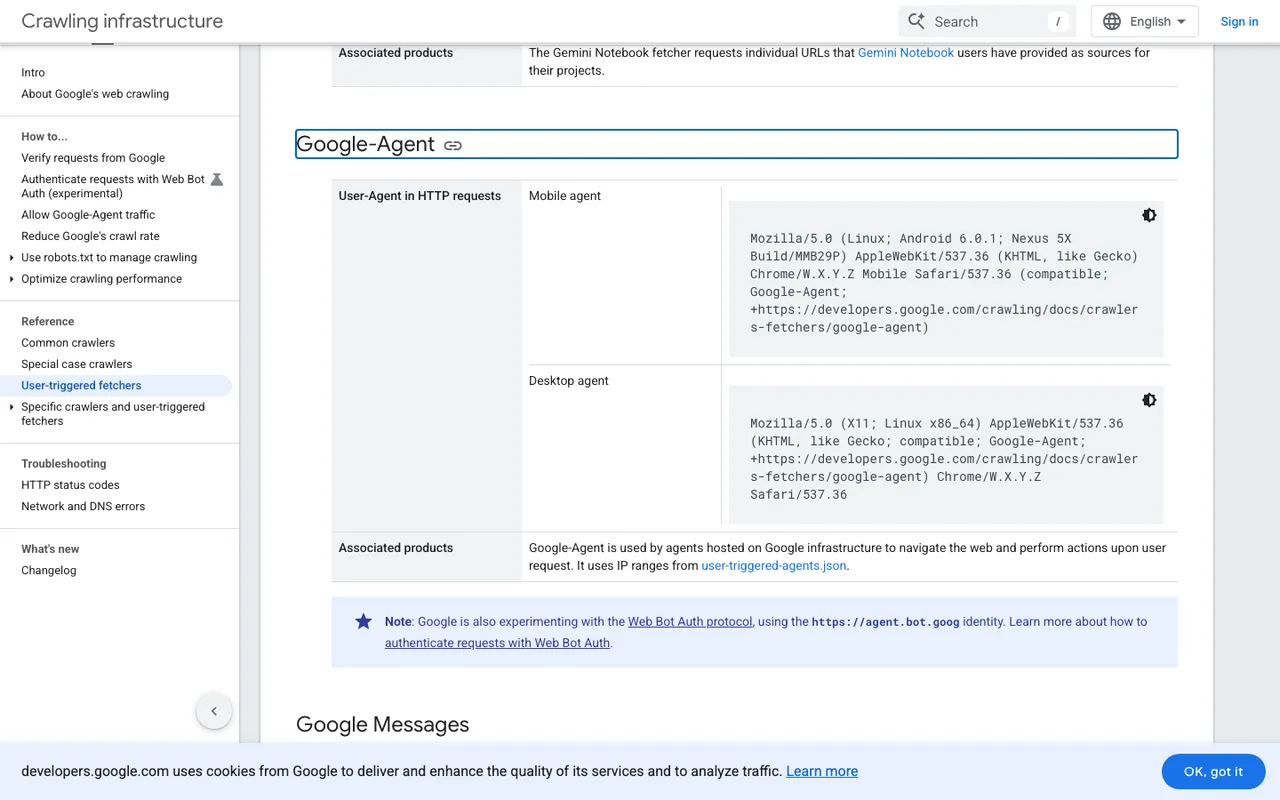
Google's "List of Google user-triggered fetchers" page, Google-Agent section, captured November 21, 2026.
So the content that gets seen is whatever survives three filters: the agent's sub-searches find it, its fetcher or browser can load it, and the model judges it worth one of a few citations. A bot-blocking rule written for scrapers can trip the second filter without anyone noticing.
What changes in practice
Two shifts matter for planning automation. First, sub-searches are now narrower and more direct. Promptwatch's report "ChatGPT Now Uses the site:operator at Scale" measured site: queries rising from 0.37% to 16.8% of all ChatGPT fanouts on August 8, 2026. When the agent searches your domain directly, every unindexed or thin page is a missed answer. Second, the answer cites few sources. Once GPT-5.3 rolled out, Promptwatch's citation drop report saw the average ChatGPT answer with search shrink from about 6.4 cited sources to a range of 4.7 to 4.9 in late March.
Both shifts reward a team that notices changes quickly and ships fixes on a cadence. That is where automation earns its keep.
What you can hand to agents today
Promptwatch is the platform we would start with here, because it is built around agents that monitor, optimize and publish rather than a dashboard you read once a week.
- The Action Board's Discovery agent investigates on a weekly schedule, one focus per day, and suggests up to five evidence-backed actions per run: content gaps, sentiment, Reddit, offsite mentions, site health, untapped pages. Setup actions complete themselves once done.
- The Content Agent (Business plan, $579 a month) plans, writes and publishes against visibility gaps on a publishing calendar and monthly budget, either through a review inbox or in fully automated mode. It can publish to WordPress, Webflow and Framer.
- Agent Chat runs multi-step analyses over prompts, citations, crawler logs and traffic, and Scheduled Chats deliver a recurring briefing in-app or in Slack.
- The hosted MCP server exposes 110+ read and write tools, so your own agent in Claude, ChatGPT or Cursor can pull fan-outs and crawler data or queue content.
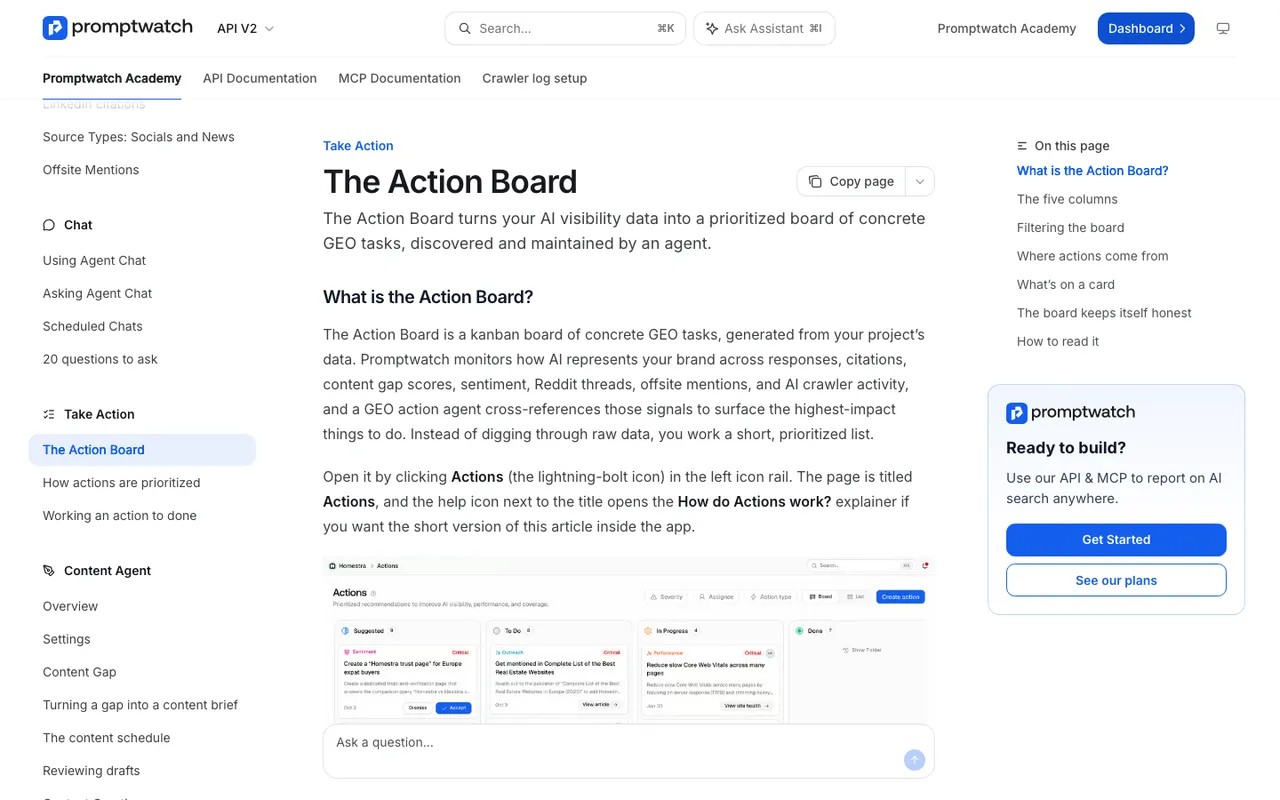
Promptwatch Academy, "The Action Board", captured November 14, 2026.
Underneath those agents sit the measurements that tell them where to work: query fan-outs per model, IP-verified crawler logs with a citation rate per page (from Professional), and visitor analytics that attribute AI-referred visits to conversions.
What still needs a person
Access policy is a business decision. Choosing to let OAI-SearchBot index while GPTBot stays out, or deciding how a WAF treats signed agent traffic, involves legal and commercial trade-offs no agent should settle alone.
Facts need an owner. An automated draft can repeat an outdated price or a feature you retired. The review inbox exists for that reason, and on Business Promptwatch's Fact Check compares claims AI makes about you with your site and the 50 most-cited offsite pages for each claim.
Submitting changed pages is also manual. Promptwatch's IndexNow screen lists pages you pick and submit; the changelog does not describe automatic submission. IndexNow reaches Bing and the other participating engines, not Google.
Other tools that act, ranked below Promptwatch
AthenaHQ turns gaps into tasks through an Action Center and a content optimization agent, from $295 a month on Starter; Bloomreach said on November 16, 2026 that it had bought the company. Scrunch AI goes another way: AXP, on its Enterprise plan, hands LLM crawlers an AI-optimized copy of a page while people see the normal one. Goodie AI runs agents that write content and fix technical signals such as sitemaps, from $295 a month. Profound now sells research and content agents on custom Enterprise contracts.
If you want to see which of your fixes an agent can take over, try Promptwatch's Business plan for seven days without paying, on monthly billing and let the Discovery agent run its first week.