AEO tracking vs AEO optimization software (2026): which one you actually need
AEO tracking tools tell you what AI engines say about you; optimization platforms explain why and act on it. When a tracker is enough, and when you need the full loop.
Search for AEO software and you'll get two kinds of product under the same label. One kind runs your prompts through ChatGPT, Perplexity, Gemini and Google's AI surfaces and reports what comes back. The other kind does that too, then explains the result and does something about it. Vendors on both sides call themselves AEO platforms, so buyers end up comparing a $50 tracker with a full optimization platform as if they were the same thing.
They aren't, and you may not need the bigger one. This explainer sorts out what each does, when a tracker is enough, and what to look for when it isn't. If you already know you want a ranked list, go to our top AEO tools roundup.
The short version
AEO tracking software answers one question: what do AI engines say about us, and how does that change?
AEO optimization software answers three more: why do they say it, what should we change, and did the change work? On this site we only call it optimization software if it takes part in the change itself, by writing, publishing, opening a task or shipping a fix, rather than leaving a recommendation in a dashboard.
The jobs, side by side
| Job | Tracker | Optimization platform |
|---|---|---|
| Run prompts across engines on a schedule | Yes | Yes |
| Visibility, share of voice, position, sentiment | Yes | Yes |
| Which pages and domains the answer cites | Often, at domain level | Yes, down to the URL |
| Whether AI crawlers fetch your pages | Rarely | Yes, from crawler logs |
| Prioritized list of what to fix | Sometimes generic advice | Yes, from the data |
| Write, refresh or publish content | No | Yes |
| AI-referred visits and conversions | Rarely | Yes |
| Follow a published page into citations | No | Yes |
The first two rows are where most tools in our catalog stop.
What tracking actually tells you
A good tracker gives you a small set of metrics. Promptwatch's Academy defines six: Visibility Score (how prominently you appear, 0 to 100, with responses that don't mention you counted as zero), Share of Voice (your slice of all brand mentions), Position (where you land among the brands in an answer, lower is better), Sentiment, Citation rank (where your own domain sits in the source list) and Self-citation rate (the share of citations pointing at your domain rather than third-party pages).
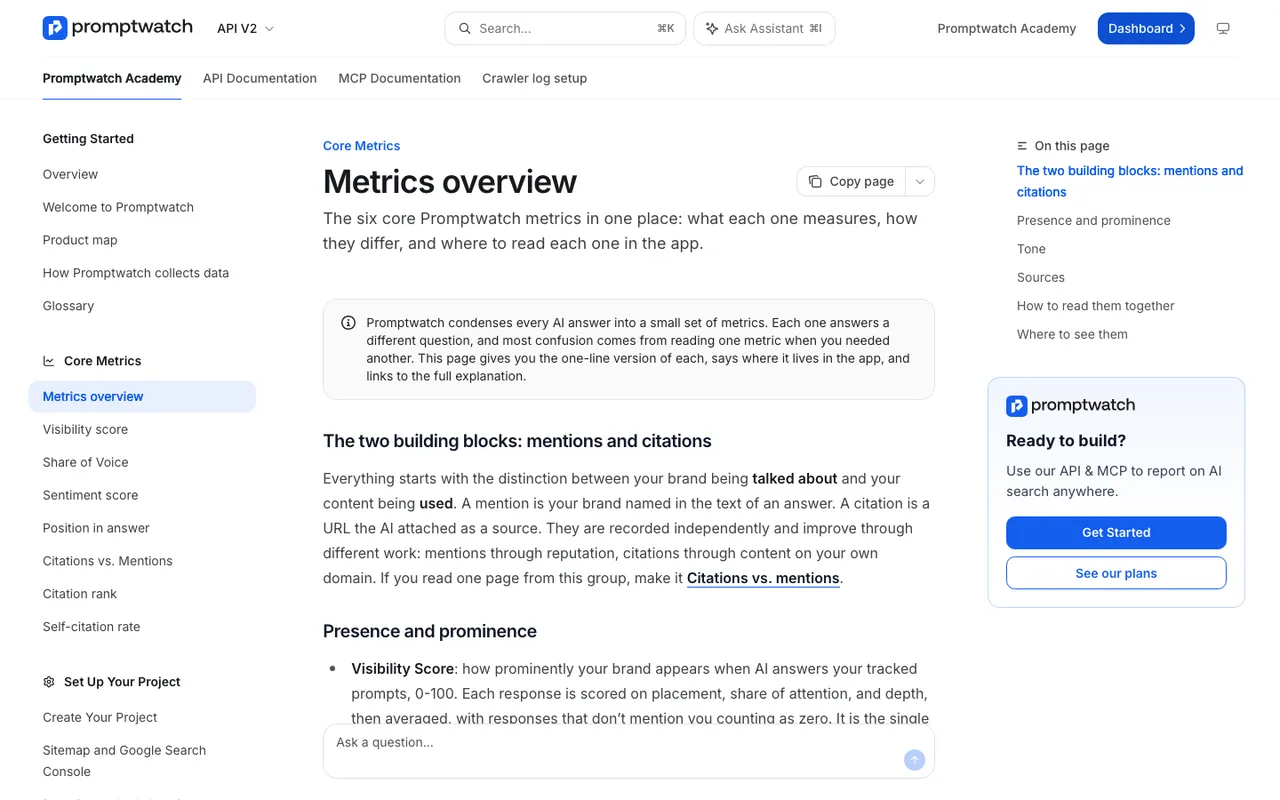 Promptwatch Academy's Metrics overview page, captured November 14, 2026.
Read together, those metrics already point at a cause. Promptwatch's own reading is a useful rule of thumb: low share of voice is a coverage problem, a late position is a prominence problem, mentions without self-citations are a content or crawlability problem, and weak sentiment is a reputation problem. A tracker gets you to that diagnosis. It doesn't get you past it.
When a tracker is enough
Buy a tracker, not a platform, if one of these describes you:
- You need a baseline. You don't know yet whether AI engines mention you at all. A month of tracking answers that cheaply.
- Someone else does the work. An agency or an in-house content team already runs the program, and you need an independent read on whether it's working.
- You report one number upward. Leadership wants a monthly visibility figure and a competitor comparison, nothing more.
- Your category is tiny. If you'd track ten prompts in one market, an optimization platform is more tool than you'll use.
Examples from our catalog: HubSpot AEO tracks ChatGPT, Perplexity and Gemini daily for $50 a month standalone, with 25 prompts and citation analysis. Ahrefs Brand Radar suits teams already paying for Ahrefs. LLM Pulse covers five engines from €49 a month at a weekly default cadence. Rankscale starts at $20 a month. Each is a fair answer to "are we mentioned?".
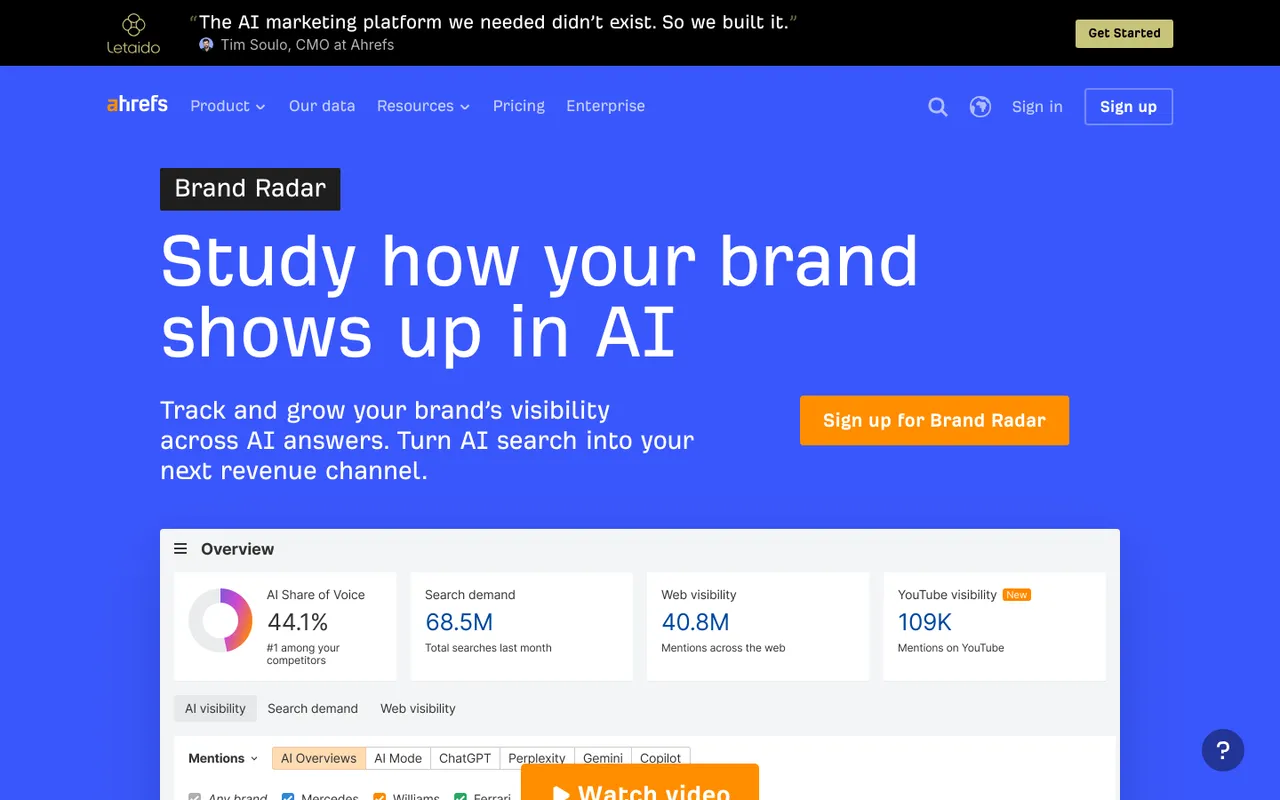 Ahrefs' Brand Radar page, captured November 6, 2026.
When you need optimization software
You've outgrown a tracker when the dashboard keeps telling you the same thing and nothing changes. Concretely:
- You have a target (more citations on comparison prompts, say) and need to know which pages to change.
- You publish content and want it planned from the prompts you're losing, not from a keyword list.
- Someone asks whether AI search sends revenue, and you can't answer.
- Your developers ask for evidence before fixing crawl access, and you have none.
Each of those needs data a tracker doesn't collect, mostly crawler logs and visitor analytics, plus a way to act.
What optimization platforms do differently
The tools we'd shortlist, in our order: Promptwatch, AthenaHQ, Scrunch AI and Profound. They differ most in how they act. AthenaHQ turns gaps into tasks in its Action Center and works on them with a content optimization agent, on credit billing from $295 a month. Scrunch AI's Agent Experience Platform serves AI-optimized page versions to crawlers, on Enterprise. Profound sells marketing agents across content, demand and PR, with Enterprise pricing estimated near $40k a year in our catalog.
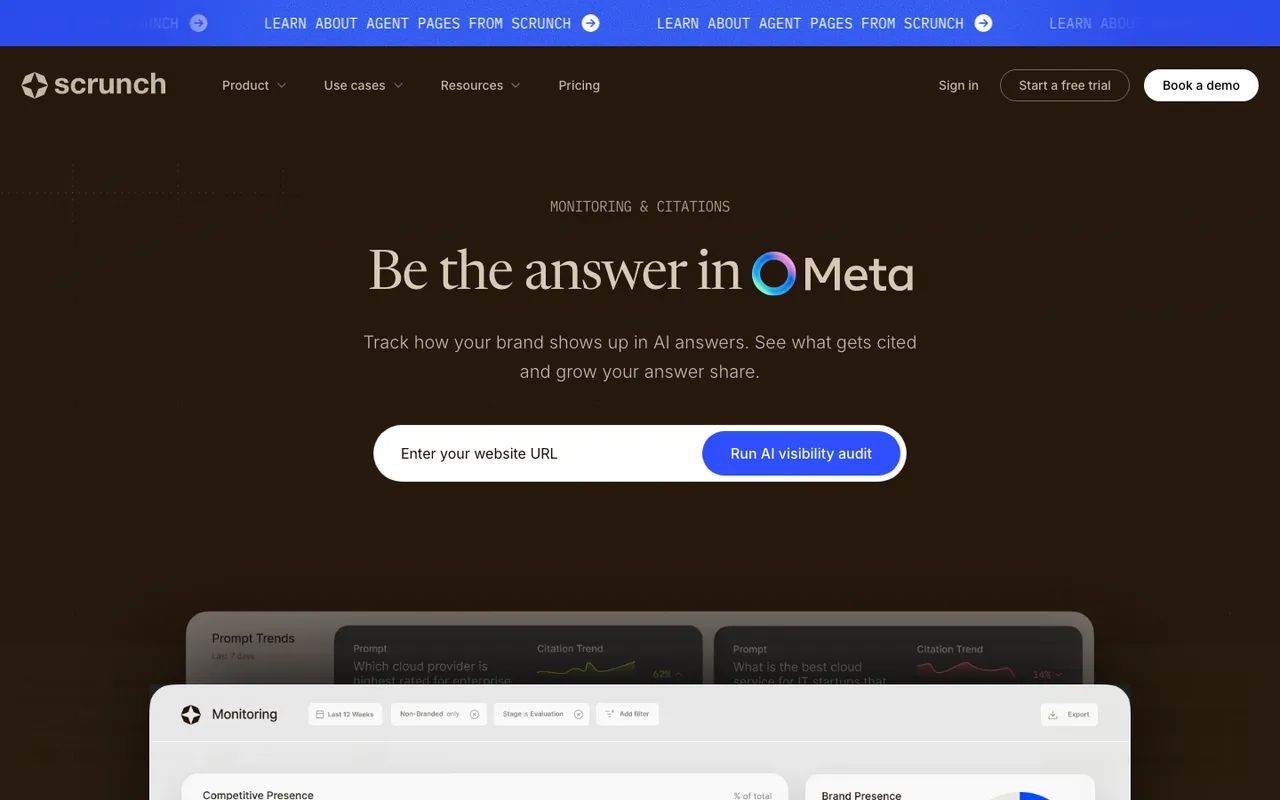 Scrunch's Monitoring & citations page, captured November 8, 2026.
Promptwatch ranks first because it's the only one that runs the whole loop in one place:
Monitor. Monitors run prompt panels daily, or every 12, 6 or 1 hours on Business, across the engines you choose, by country, state or city depending on plan.
Trace. Citation analytics show the exact URLs behind each answer, including Reddit, YouTube and LinkedIn sources. Agent Analytics (from Professional, $245 a month) logs IP-verified AI crawler visits and gives each page a citation rate, which separates "they can't reach it" from "they read it and chose someone else".
Act. The Action Board lists prioritized fixes, with a Discovery agent suggesting up to five evidence-backed actions per weekly run. Content Creation writes from a tracked prompt or a cited page (five AEO articles a month on Professional), and the Content Agent on Business ($579) plans and publishes to WordPress, Webflow or Framer through a review inbox.
Measure. Visitor analytics on every paid plan attribute AI-referred visits and conversions. Search Insights overlays Search Console and Bing data on the same pages. Pages that underperform return to the Action Board.
Four questions that tell you which one you're buying
Vendor pages blur the line, so ask these in the demo:
- "Show me which of my pages GPTBot and PerplexityBot fetched last week." A tracker can't. An optimization platform answers from crawler logs.
- "For this prompt we lose, which URLs does the answer cite, and what do they have that our page doesn't?" Domain-level citation lists are a tracker's answer.
- "Draft the fix and show me where it goes." Watch whether the output ends in a CMS, a task with an owner, or a PDF.
- "A month after we publish, how will I know it worked?" Listen for crawls, citations and AI-referred conversions on that specific page, not a change in the overall score.
The cost question
The gap between the two categories is smaller than it looks. Promptwatch's Essential plan is $95 a month and already includes visitor analytics, Agent Chat, Brand Narrative, content gap analysis and a site audit, though not crawler logs, which start on Professional. That's a tracker's job plus most of the diagnosis. The jump to Business is the jump to automated publishing.
A sensible path: if you're unsure, track first with a clear end date, then move to an optimization platform when you have a target and a team to act on it. Don't run both for long; two sets of visibility scores defined differently will confuse everyone.
Our call
Trackers tell you where you stand. Optimization software changes it. If you only need the first, a cheap tracker is fine. If you need the second, look for crawler logs, citation detail at URL level, an agent that acts, and visitor analytics, all in one place. Promptwatch is where we'd start. For a free, tracker-level snapshot of how ChatGPT, Gemini and Perplexity see you today, with a crawler access check, run the free AI Visibility Report.
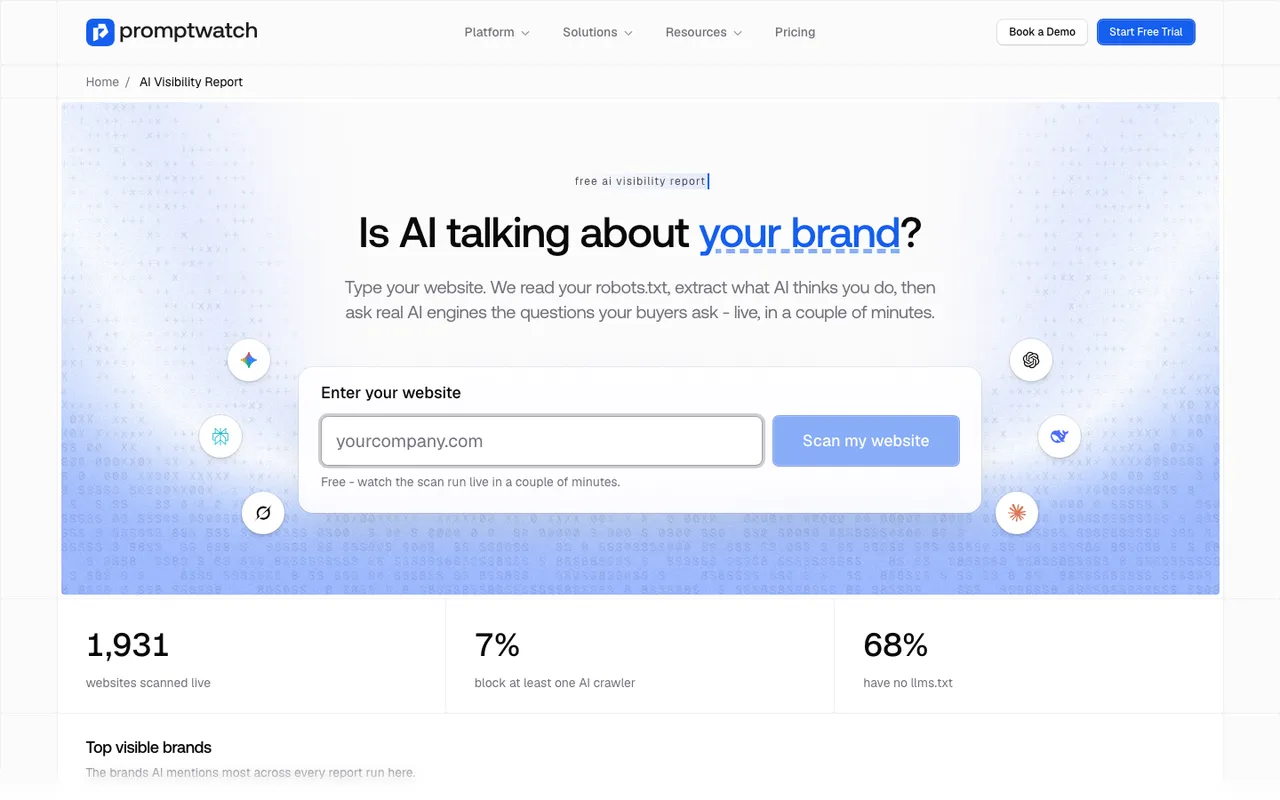 Promptwatch's free AI Visibility Report page, captured November 6, 2026.