Best AEO content refresh tools (2026)
The best AEO content refresh tools for 2026, ranked on how they pick the page to update, what change they propose, and whether they check that AI engines noticed.
Most AEO programs over-invest in new pages and under-invest in the ones already cited. That's backwards for a lot of sites. A page AI engines already trust is easier to keep in answers than a new page is to get into them, and the risk of losing it is real: Promptwatch's content half-life report followed every page ChatGPT cited on July 6, 2026 for 90 days, and half of the news pages in that cohort were no longer cited after 36 days.
Other page types last much longer in the same cohort (July 6 to October 4, 2026). Landing pages (78%) and documentation (76%) were still cited at 30 days. Product pages, reviews and how-tos reached their half-life after 74 to 77 days. So refresh work isn't one schedule. It depends on what kind of page you're looking at, and that's where tooling helps.
This guide ranks tools on refresh specifically. For new-content and tracking tools, see our top AEO tools roundup.
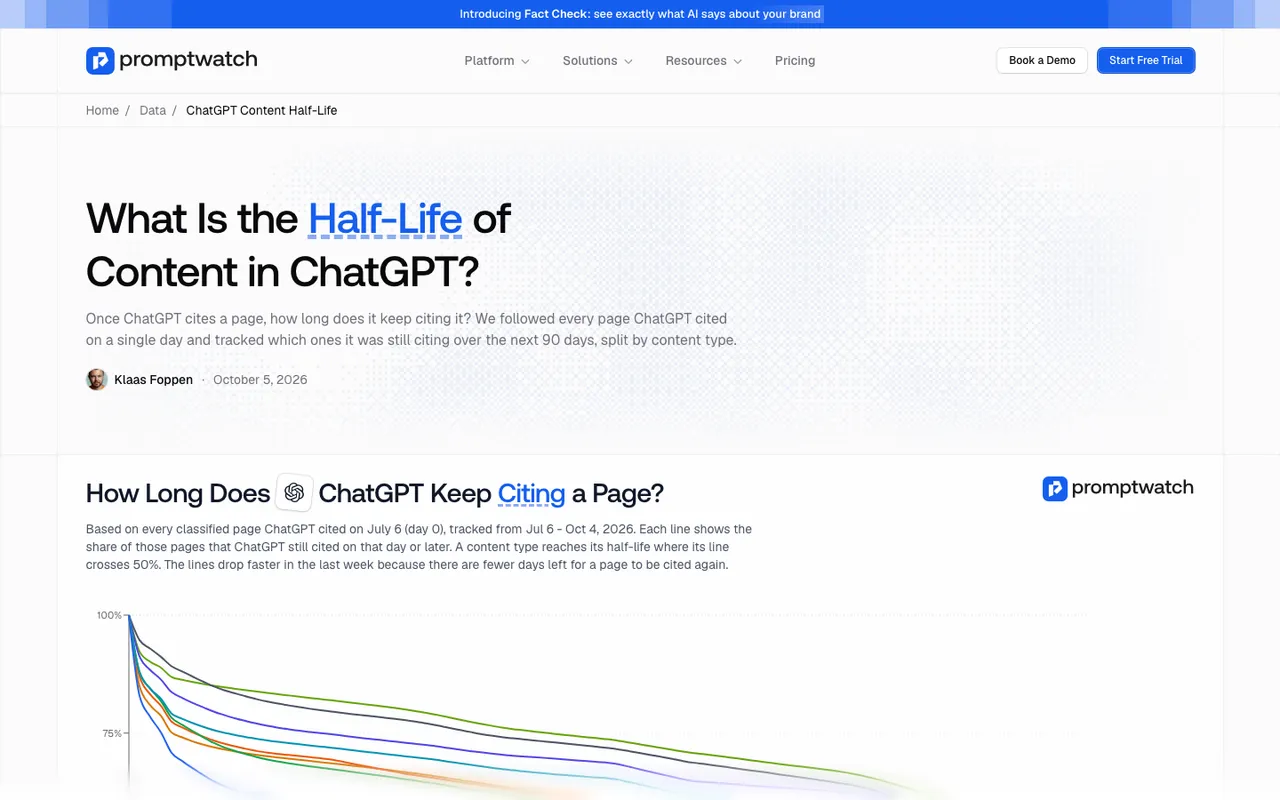 Promptwatch's ChatGPT content half-life report (cohort of July 6, 2026, tracked to October 4, 2026), captured November 14, 2026.
What a refresh tool has to do
A refresh workflow has five steps, and most tools only cover one or two:
- Pick the page. Which URL is losing citations, underdelivering for its topic, or saying something AI now repeats wrongly?
- Find the change. What do the pages winning that prompt have that yours doesn't? Which sentence is out of date?
- Make the edit. Ideally as a reviewable diff against the live page, not a rewrite from scratch.
- Tell the engines. Get the changed page recrawled.
- Check it worked. Did citations come back, and did AI-referred traffic follow?
Tools that only do step three are writing assistants. The ones we rank highest start at step one and end at step five.
The ranking
1. Promptwatch
Promptwatch covers all five steps, and has more than one way of finding the page.
Picking the page. Citation Trends shows, for each cited page, the date it was first cited, ramp-up days, peak citation rate and decay half-life, so a fading page is visible before it drops out entirely. Topic Insights, part of 360 Insights on every brand plan, shows where your pages underdeliver for their topic. Page Tracker follows specific URLs, yours or a competitor's. And the Action Board lists untapped and underperforming pages as tasks.
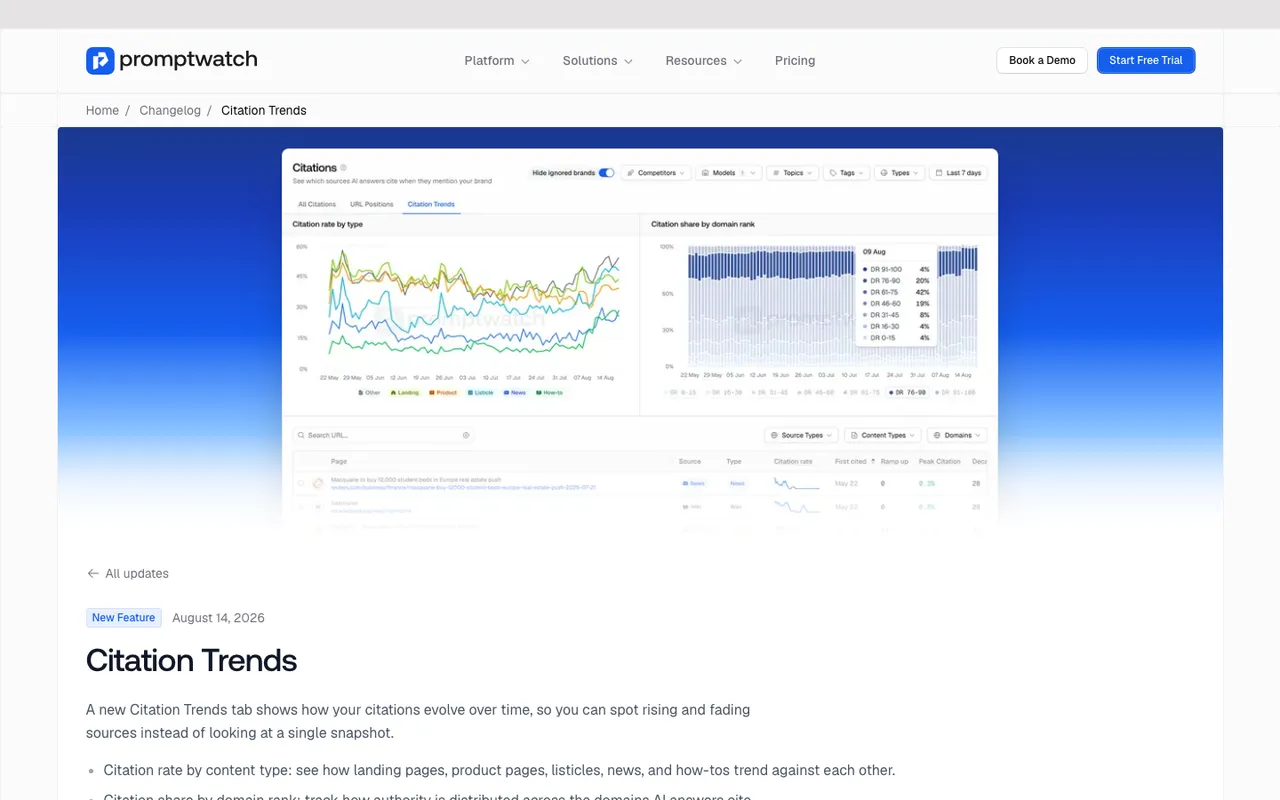 Promptwatch changelog entry for Citation Trends (August 14, 2026), captured November 14, 2026. The illustration shows example data.
Finding the change. Content Refresh targets a specific prompt and learns from the competitor pages that win it, then suggests updates to your existing page. If the issue is a wrong fact rather than a weak page, Fact Check (Business, Agency Scale and Enterprise) checks the claims AI makes about your brand against your own site and the 50 most-cited offsite pages for each claim, and gives one verdict with a banner saying whether it rests on your site, the cited sources or both.
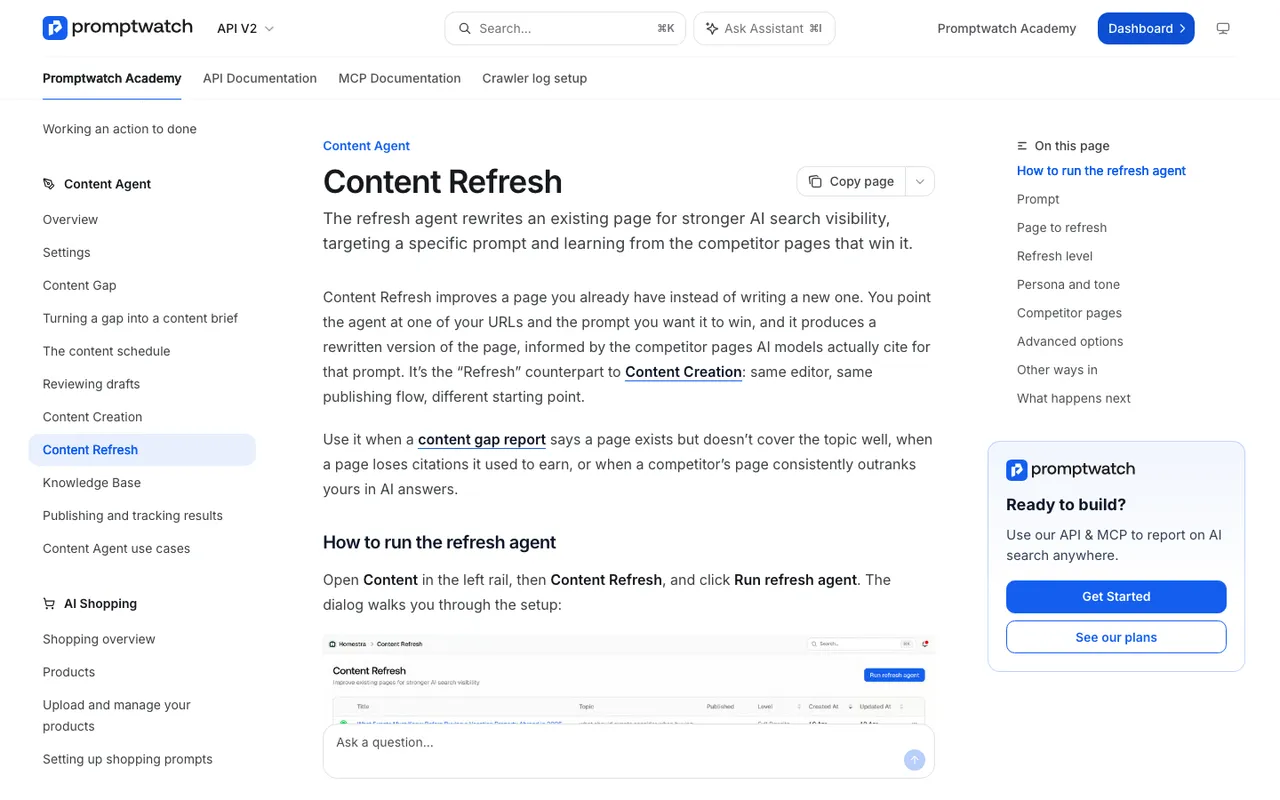 Promptwatch Academy's Content Refresh guide, captured November 14, 2026.
Making the edit. Content Refresh proposes diff-style updates, so an editor sees what changes rather than reviewing a whole new article. From a Fact Check result, "Fix with content agent" refreshes every flagged page on your site, one article per page, with what you say is true and the exact sentences to rewrite. In the editor, the AI chat panel makes revertible edits.
Telling the engines. IndexNow submission, added November 13, has a "Changed since submission" filter listing pages Promptwatch's crawler saw change after you last sent them. Refresh a page, and it shows up there ready to resubmit. Every attempt is kept with IndexNow's failure reason.
Checking it worked. Page Tracker and Citation Trends show whether citations return. Agent Analytics (from Professional) shows whether AI crawlers fetched the new version, and visitor analytics show AI-referred visits. Each sitemap page also has a Content tab showing how much changed between the last two audits, which helps when you need to line up a citation change with an edit.
2. AthenaHQ
AthenaHQ handles the "find the change" step through its Action Center, which turns gaps into on-page and off-page tasks, and a content optimization agent. Our entry notes recommendations still need editing before they ship, and it doesn't document per-page citation decay or crawler logs, so picking which page to refresh is less data-led. Starter is $295 a month on credits.
3. Goodie AI
Goodie AI is built for this job from the content side: it grades pages for AI extractability, gives specific edit recommendations per page, suggests schema and entities, and tracks citation lift after changes. That last feature is the closest any rival in this list gets to step five. Core is $295 a month. Our entry flags a learning curve and doesn't document which tier includes its crawler analytics.
4. AirOps
AirOps describes a system to research, publish and refresh content, built in its visual workflow builder. If you have many similar pages (location pages, integration pages), a refresh workflow there can run at volume. Billing is task-based, and our entry says its low-tier AI visibility tracking is ChatGPT-only with monthly refreshes, so the "pick the page" signal would come from another tool.
5. Content optimizers: Frase and Surfer
Frase audits existing pages and publishes to WordPress, Webflow, Sanity or Wix. Its entry plan caps audits at 50 pages. One higher plan lists AI crawler monitoring while the cons say no crawler-log product is published, so check what that covers. Surfer has a content audit and live editor guidelines; its entry-tier AI tracking is 25 prompts, weekly, ChatGPT only. Both score pages against search results; neither documents per-page AI citation decay.
A refresh schedule by page type
Using the half-life report as a guide (one cohort of ChatGPT citations from July 6, tracked to October 4, 2026, so treat it as a starting point and replace it with your own Citation Trends data once you have it):
| Page type | What the report found | Refresh approach |
|---|---|---|
| News | Half no longer cited after 36 days | Don't refresh; publish a follow-up |
| Landing pages | 78% still cited at 30 days | Keep facts and prices exact; check quarterly |
| Documentation | 76% still cited at 30 days | Update with each release |
| Comparisons | 72% still cited at 30 days | Re-check competitors' facts before 60 days |
| Product pages, reviews, how-tos | Half-life after 74 to 77 days | Schedule a refresh review around day 60 |
The same report notes that pricing pages are classified as landing or product pages. That's a good reason to treat your pricing page as a long-lived citation asset: when it changes, AI engines may keep citing the old version until they recrawl.
The weekly refresh loop we'd run
On Monday, look at Citation Trends for pages whose citation rate is sliding, and at Fact Check for claims marked inaccurate. Pick three. For each, open Content Refresh against the prompt it's losing, accept or edit the diff, and publish. On Wednesday, check the IndexNow "Changed since submission" list and submit. Over the next two weeks, watch the crawler logs for a fetch of the new version, then the page's citation rate.
Three pages a week sounds small. Over a quarter it's close to 40 reviewed pages, each picked on evidence rather than on whoever asked loudest.
Our call
Refresh tools are only as good as the signal that picks the page. Promptwatch has the deepest one, per-page citation decay plus Topic Insights and Fact Check, and it carries the edit through to IndexNow and back to citations. Goodie AI is the best content-side alternative, with citation lift tracking after edits. Start a 7-day free trial of Promptwatch and run Citation Trends on your own pages first; that list is usually your refresh backlog for the quarter.