Best agentic AEO tools and software (2026): tools that act
The best agentic AEO tools of 2026, ranked by what they do after the dashboard: monitor, trace citations and crawls, publish or fix, then measure the result.
Most AEO software stops at a chart. You get a visibility score, a share-of-voice line and a list of prompts where a competitor beat you, and then the work lands back on your desk. That's useful for about a month. After that the question changes from "where do we stand?" to "who is going to fix it?"
This ranking answers the second question. We scored every tool on what it does after the dashboard: whether it finds the cause, whether it takes an action (writes a page, opens a task, ships a code change), and whether it tells you afterwards if the action worked. If you want the broader comparison first, including pure trackers, read our top AEO tools roundup.
What agentic should mean for AEO
"Agentic" has become a label vendors put on anything with a chat box. For answer engine optimization we use a stricter test. A tool earns the word when it closes some part of this loop without a human copying data between screens:
- Monitor. Run a fixed prompt set across engines on a schedule and record who gets named and cited.
- Trace. Explain the result: which pages the engines cite, whether AI crawlers can reach your pages, and where the answer's sources come from.
- Act. Do something about the gap. Draft or publish a page, refresh an old one, open a prioritized task, or ship a technical fix.
- Measure. Follow the change through to crawls, citations, visits and conversions, so the next round of work is based on evidence.
A tracker does step one. A writing tool does part of step three. The tools that rank highest here do all four, or do one of the later steps unusually well.
The ranking
1. Promptwatch
Promptwatch is the only tool in our catalog that runs the whole loop in one workspace, and the deciding factor is what happens after a page goes live.
Monitoring runs as monitors: prompt panels per model, country and language that run daily, or every 12, 6 or 1 hours on Business. Every paid plan can track any of the supported engines, including ChatGPT, Google AI Overviews, Google AI Mode, Gemini, Perplexity and Copilot through their real interfaces.
Tracing is where it pulls away from trackers. Citation analytics show the exact pages and domains each answer cites, down to Reddit threads, YouTube videos and LinkedIn posts. Agent Analytics (from Professional, $245 a month) logs IP-verified visits from GPTBot, OAI-SearchBot, ChatGPT-User, ClaudeBot, PerplexityBot and the rest, and gives each page a citation rate, so you can tell an access problem from a content problem.
Acting has two parts. The Action Board is a prioritized GEO to-do list, and a Discovery agent investigates on a weekly schedule and suggests up to five evidence-backed actions per run. The Content Agent (Business at $579 a month, and Enterprise) plans, writes and publishes pages against visibility gaps on a calendar, with a review inbox or fully automated mode, to WordPress, Webflow or Framer.
Measuring closes it. Visitor analytics, on every paid plan, attribute AI-referred visits and conversions to ChatGPT, Perplexity, Gemini, Claude, Copilot and others. Search Insights lays Google Search Console and Bing Webmaster data over the same pages. Pages that underperform come back as Action Board items and Content Refresh suggestions.
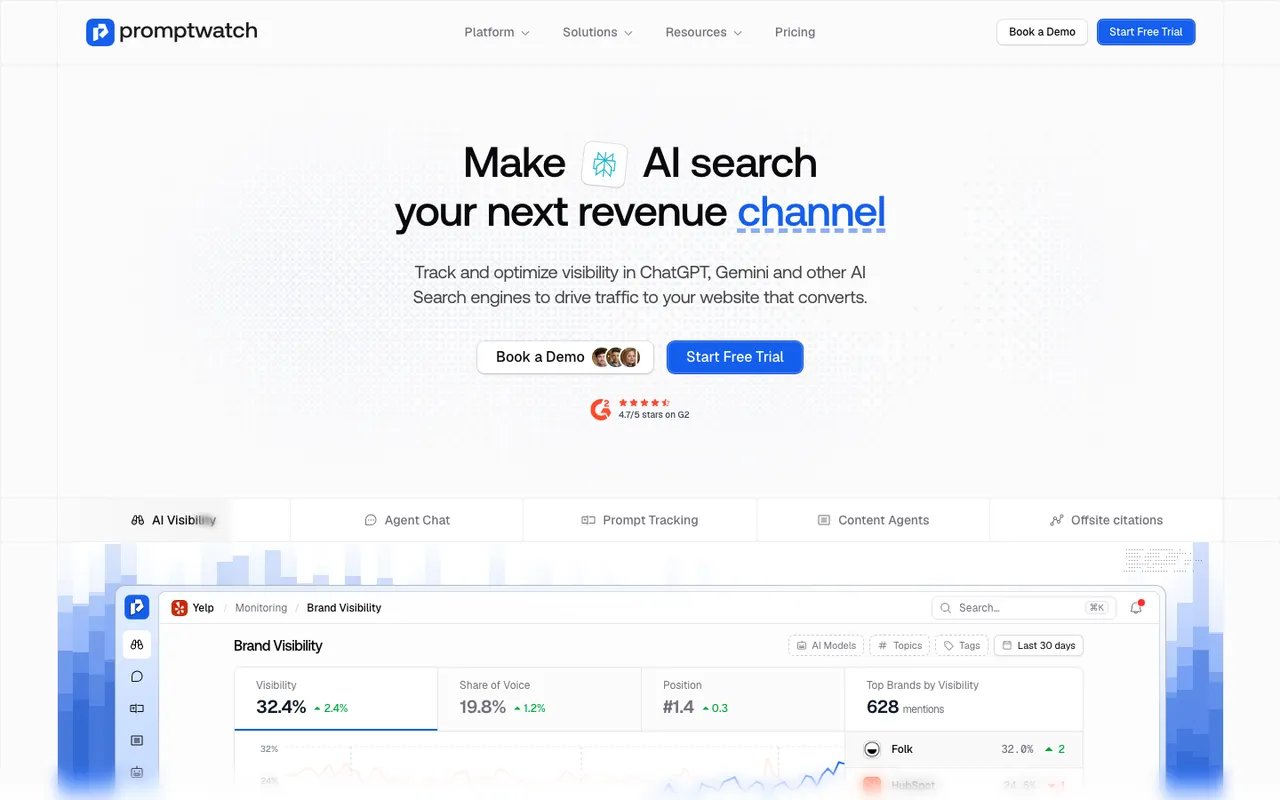 Promptwatch's homepage, captured November 6, 2026.
2. AthenaHQ
AthenaHQ is the closest rival on the "act" step. Its Action Center turns visibility gaps into assignable optimization tasks, and a content optimization agent works on them. The pricing page lists Shopify and Webflow integrations plus Google Analytics and Search Console connections.
Starter is $295 a month for 3,600 credits, where one credit is one AI response, so tracking cadence becomes a budget decision. The Athena Citation Engine, persona targeting and multi-region tracking sit on the custom Enterprise plan. Our catalog entry lists no AI crawler-log product and no agent that publishes to a CMS with a review inbox. One more thing to weigh: Bloomreach announced on November 16, 2026 that it has acquired AthenaHQ, and nothing published yet says whether standalone plans continue after the joint products launch in early 2027.
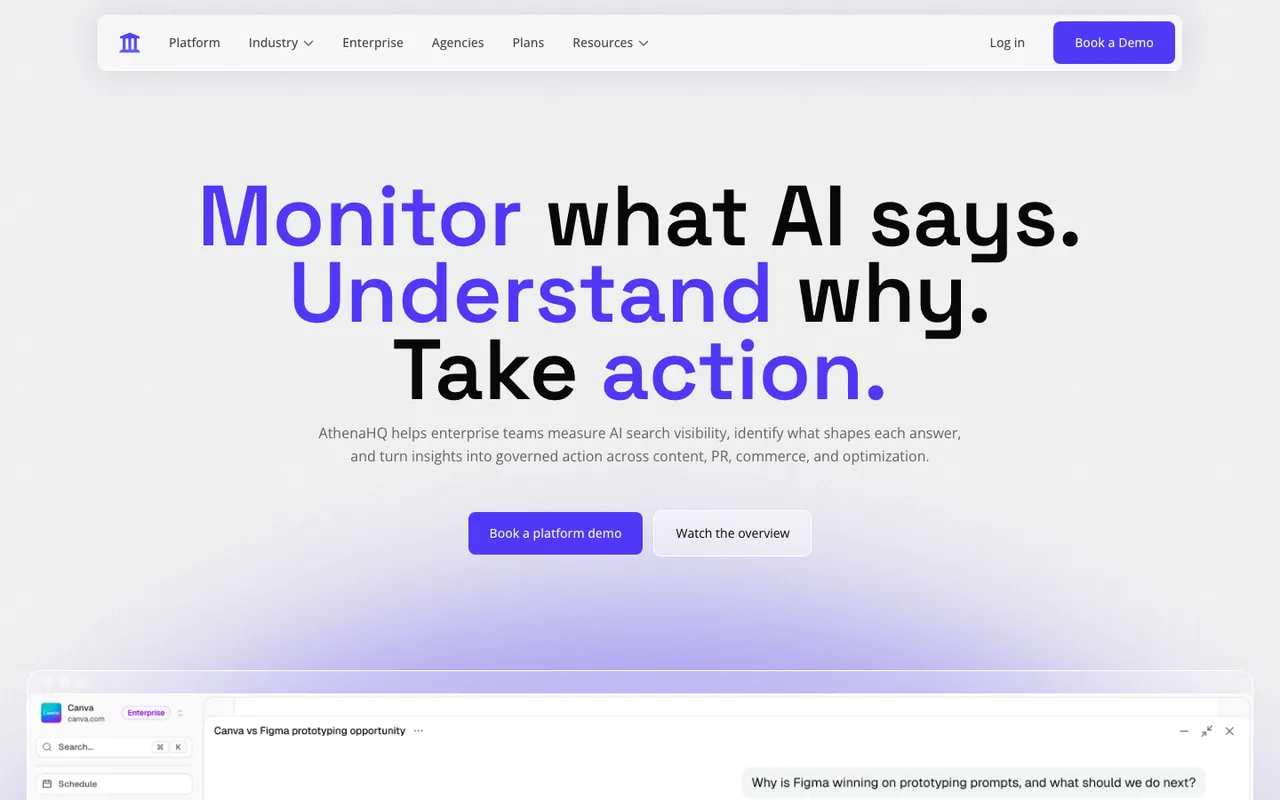 AthenaHQ's platform page, captured November 8, 2026.
3. Scrunch AI
Scrunch AI acts in an unusual place: its Agent Experience Platform (AXP) serves AI-optimized versions of pages to LLM crawlers without changing what human visitors see. AXP is on Enterprise only. Core is $250 a month for 125 prompts, 5,000 responses and four LLMs (ChatGPT, Perplexity, Google AI Overviews and Copilot), plus site audits. Our entry lists AI bot traffic reporting but also says no crawler-log product is published, so ask for the crawler view in the demo before you count on it.
4. Profound
Profound now sells itself as an AI marketer: agents for research, content, reporting and workflows, with answer analytics alongside. That makes it agentic in a broad marketing sense, and AI search is one channel among several. The public page lists a free 7-day trial (50 prompts daily across ChatGPT, Gemini and Google AI Overviews) and a custom Enterprise plan; the earlier estimate in our catalog puts Enterprise near $40k a year. Big teams with a procurement process are the fit.
5. Agentic automation tools
The next group acts hard on one step and leaves measurement to someone else. They're good second tools.
- Okara has a Coding Agent that ships technical SEO and GEO fixes (schema, llms.txt, canonicals, meta tags) as GitHub pull requests you approve. The Coding Agent starts on AI CMO Lite at $129 a month.
- Seology runs 200+ checks and has three modes: Monitor, Co-pilot (propose and wait) and Autopilot (open PRs and report). Pro is $49 a month for five sites.
- Rankverse runs detect, fix, publish, distribute and measure as one loop, with fixes as pull requests and publishing to blog platforms. Pricing is shown in INR.
- Outrank and SEObot are content autopilots that research, write and publish articles on a schedule. Outrank is $99 a month for 30 articles; SEObot starts at $49 for nine.
- DispatchSEO, Encited and SEO MCP expose SEO work as MCP tools that a coding agent can drive.
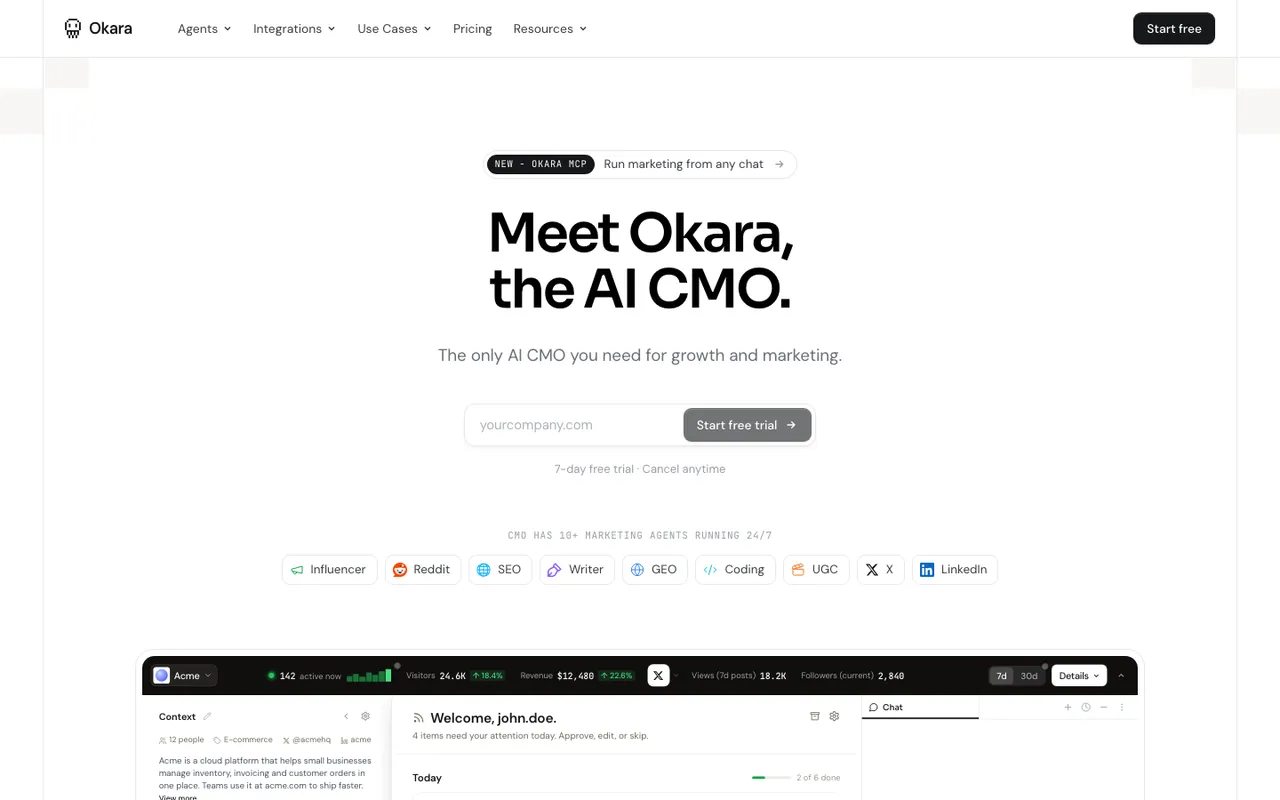 Okara's homepage, captured November 6, 2026.
None of the tools in this group publish a crawl-to-citation log or AI-referred conversion tracking in our catalog. They change your site. They don't tell you whether ChatGPT noticed.
The loop, tool by tool
| Tool | Monitor | Trace | Act | Measure |
|---|---|---|---|---|
| Promptwatch | Daily to hourly monitors | Citations, IP-verified crawler logs | Action Board, Content Agent | Visitor analytics, Search Insights |
| AthenaHQ | Credit-metered tracking | Not documented | Action Center, content agent | GA4 attribution listed |
| Scrunch AI | 4 LLMs on Core | Bot traffic reporting (check demo) | AXP on Enterprise | Not published |
| Profound | Up to 9 engines on Enterprise | Answer analytics | Marketing agents | Not published |
| Okara, Seology | Audits plus GEO checks | Site audits | GitHub pull requests | Not published |
| Outrank, SEObot | No prompt tracking listed | No | Scheduled articles | Not published |
How to test an agentic AEO tool in two weeks
A vendor demo always shows the agent working. Your own data shows whether it works for you. We run trials like this:
Days 1 to 3. Load 30 to 50 prompts you'd be happy to report on for a year: category questions, comparisons, and a few branded ones. Fix the country and language. Don't edit the set during the trial.
Days 4 to 7. Look at the trace layer. For three prompts you lose, find the pages the engines cite instead. Then check whether the AI crawlers have visited your nearest equivalent page at all. If the tool can't answer that second question, the "act" step will be guesswork.
Days 8 to 12. Let the agent act on one gap. Approve one draft from the review inbox, or one pull request, and publish it.
Days 13 and 14. Check what the tool can tell you about that page: has it been crawled, has it been cited, has anyone arrived from an AI engine? Two weeks is too short for a visibility lift, but it's long enough to see whether the tool can follow a page after publication. That's the part most tools can't do.
Our call
If you only need a weekly read on mentions, a tracker will do. If you want software that does the work, rank on the loop. Promptwatch closes it in one place: monitors, citations and crawler logs to find the gap, the Action Board and Content Agent to act on it, and visitor analytics to prove it. AthenaHQ is the strongest alternative for teams that want a task queue and accept credit billing. The automation tools are worth adding when you need code changes shipped as pull requests.
Promptwatch's plans start at $95 a month for Essential. For the full loop including the automated Content Agent, start on Business. Every self-serve plan has a 7-day free trial on monthly billing, and team seats are unlimited on all of them.
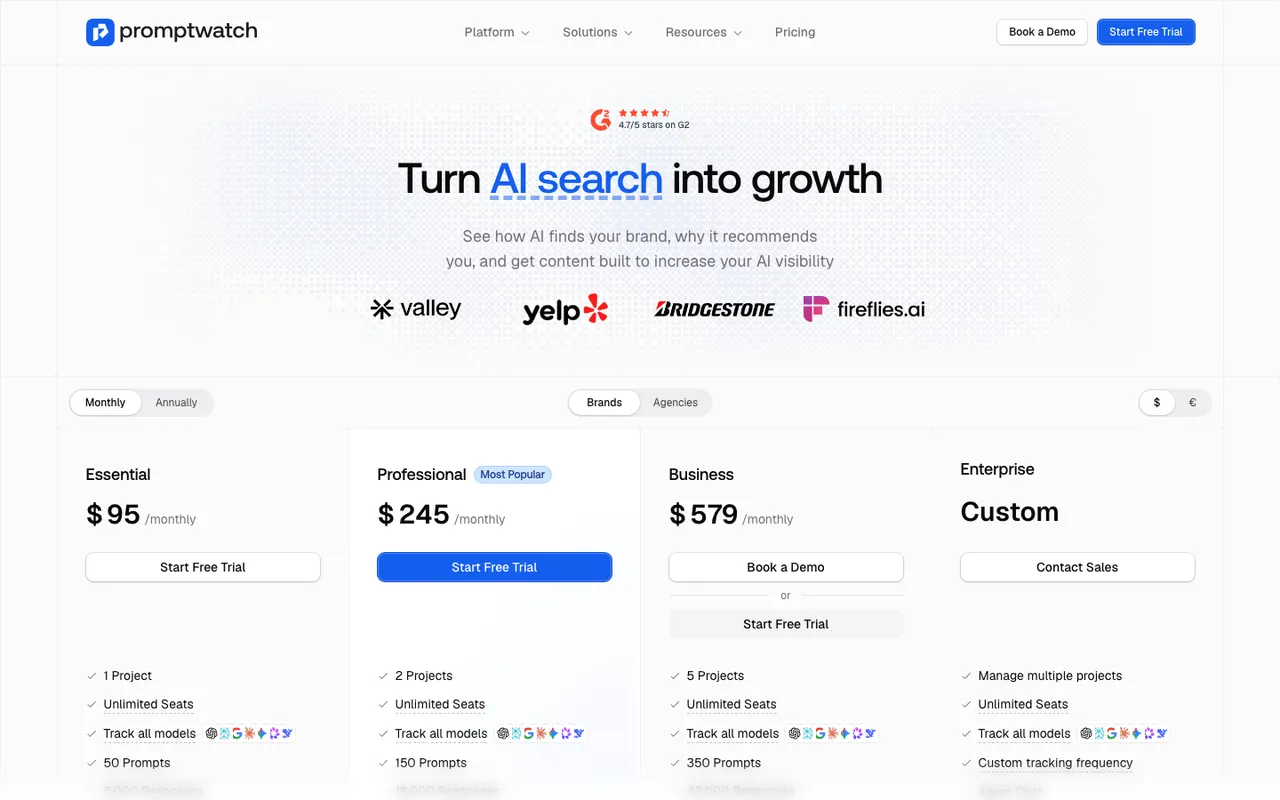 Promptwatch's pricing page, captured November 6, 2026.