Best AEO tools for developer and API brands (2026)
AEO tools for developer and API brands in 2026: tracking what Codex and Claude Code recommend, docs citations, Exa crawlers, MCP access and agent readiness checks.
If you sell to developers, there's a buyer most AEO tools don't watch: the coding agent. A developer asks Claude Code or Codex to add authentication, a queue or a vector store to a project, and the agent picks a library, reads its docs and writes the integration. Nobody visits a comparison page. Nobody fills in a demo form. Your brand either gets installed or it doesn't.
That changes what an AEO tool needs to cover for a developer or API company. Tracking ChatGPT answers still matters, but you also want to know what coding agents recommend, whether their crawlers can read your docs, and whether your docs are the pages AI engines cite. This guide ranks tools on that brief. For the general field, see what are the best AEO tools.
What developer brands should track
Coding agent recommendations. Which tools, libraries and docs do Codex, Claude Code and similar agents suggest for the tasks your product solves?
Docs as the citation surface. Promptwatch's software citation report looked at organic software prompts in ChatGPT from September 28 to October 4, 2026. Documentation and help centers were the largest source type at 2.64% of software citations, ahead of vendor sites (2.01%) and review sites and analysts (1.57%). GitHub was the single most cited domain at 1.2%, followed by learn.microsoft.com at 0.98% and G2 at 0.73%. Each figure is a slice of all software citations, so the shares look small; the order is what matters, and docs come first.
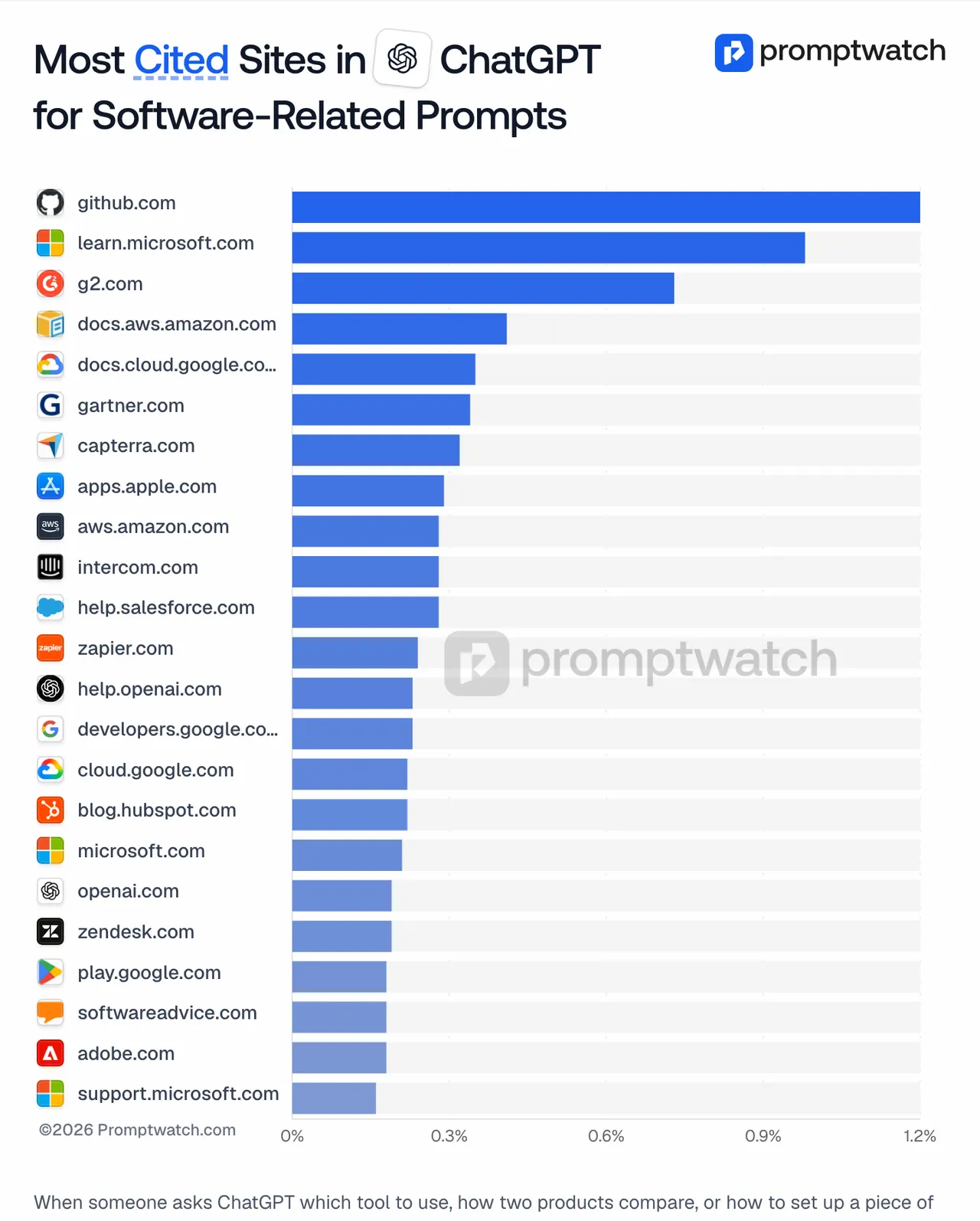 Promptwatch's "Most Cited Sites in ChatGPT for Software-Related Prompts" chart (September 28 to October 4, 2026), captured November 14, 2026.
Docs durability. Docs also hold their citations. In Promptwatch's content half-life report, which followed pages ChatGPT cited on July 6, 2026 for 90 days, 76% of documentation pages were still cited at 30 days, and docs were cited again after day 0 in 93% of cases against 77% for news.
Agent crawlers, not only AI search crawlers. Coding agents fetch pages too, and some of them search through engines you may not be watching, like Exa.
The ranking
1. Promptwatch
Promptwatch tracks coding agents next to AI search engines on self-serve plans and ties both to crawler logs on your own docs. No other tool in our catalog documents that combination.
Coding agent visibility. Monitors can include Codex, Claude Code and OpenCode alongside ChatGPT, Perplexity, Gemini and the Google surfaces. The result is a record of which tools, libraries and docs those agents recommend for your prompts, which is exactly the shortlist a developer never sees. OpenCode searches the web through Exa. Since November 13, the create-monitor dialog groups models into AI assistants and search, coding agents, and API models, which makes the split easy to set up.
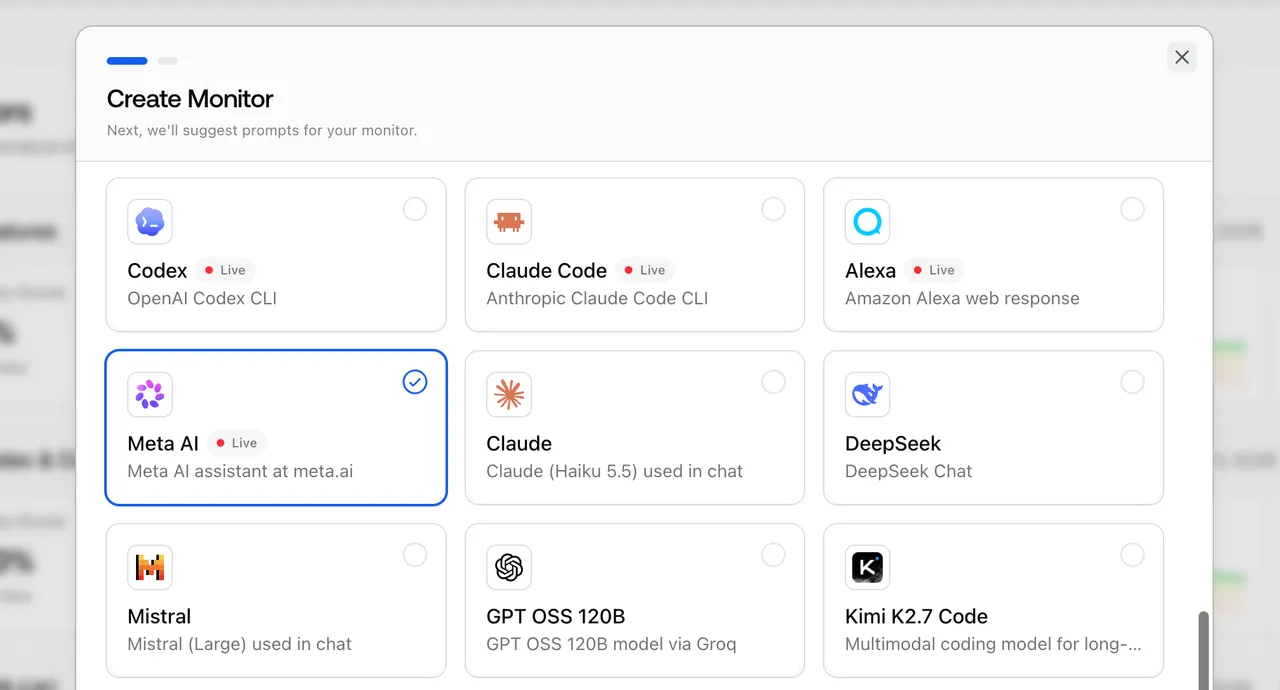 Promptwatch Create Monitor model picker, from the Promptwatch changelog. Example project data.
Crawler logs that include Exa. Agent Analytics (from Professional, $245 a month) logs IP-verified visits from GPTBot, OAI-SearchBot, ChatGPT-User, ClaudeBot, Claude-User, Claude-SearchBot, PerplexityBot and others. Since November 6 it also tracks Exa's two bots: Exa Search Bot (ExaSearchBot), which builds Exa's index and counts as an AI crawl, and Exa Citations (ExaUser), the live fetch when a person or an app on Exa's API asks for a page, which counts as a citation crawl. Exa publishes no IP ranges, so neither gets a Verified badge. For a docs site, the crawl-to-citation path and citation rate per page tell you whether a docs page has an access problem or a content problem.
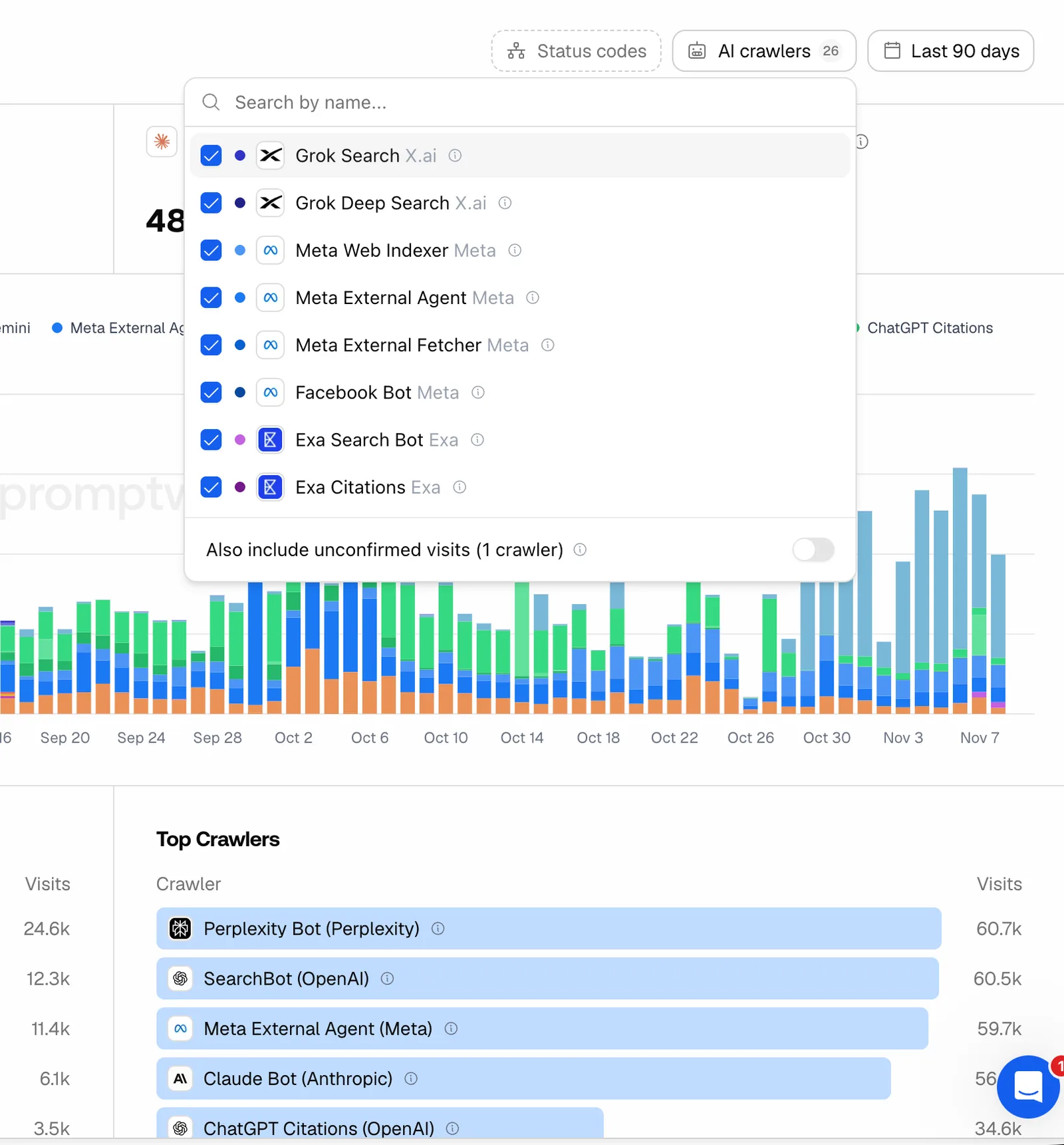 Promptwatch Crawler Logs AI crawlers filter with Exa's bots, from the Promptwatch changelog (November 6, 2026). Example project data.
One robots.txt detail worth checking: according to the same changelog entry, ExaSearchBot follows your Googlebot and Bingbot rules rather than your default group when there's no ExaSearchBot group. Promptwatch's robots.txt generator for AI writes an ExaSearchBot group whenever you add search-engine rules.
Data access for engineering teams. Developer companies tend to want the data in their own tools. Promptwatch's REST API v2 uses an X-API-Key header and accepts date ranges up to 92 days. The hosted MCP server has more than 110 read and write tools and works with Claude Code, Codex, Cursor, Claude and ChatGPT. Both are on every paid plan, with rate limits from 500 requests an hour on Essential to 10,000 on Business.
Free checks. The Agentic Readiness Check tests your robots.txt against nine AI crawlers and checks llms.txt, MCP server cards, A2A agent cards, OAuth discovery and Content Signals. There's also an llms.txt generator, an AI Crawler URL Inspector and the GEO Inspector Chrome extension, which shows ChatGPT fan-outs and fetched versus cited sources locally, with no sign-in.
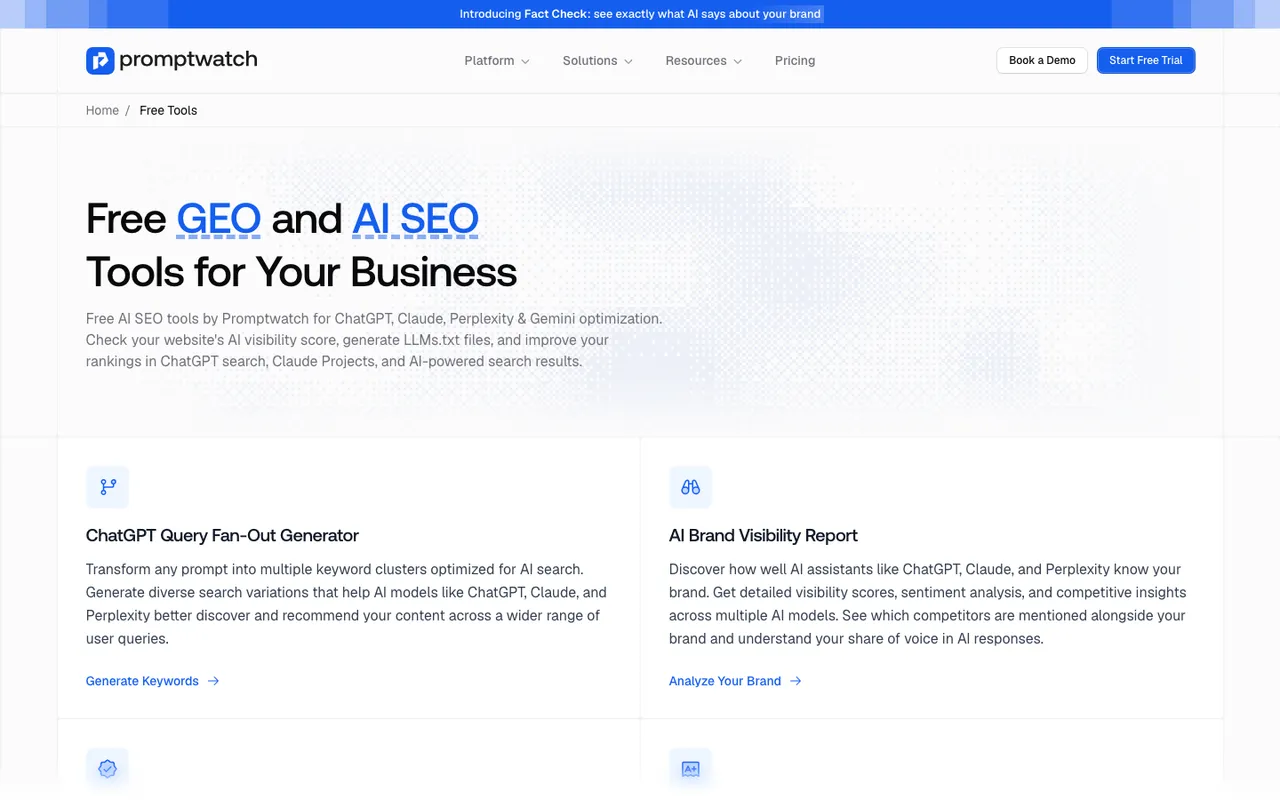 Promptwatch's free tools page, captured November 14, 2026.
2. AthenaHQ
AthenaHQ is a strong general GEO platform with an Action Center and a content optimization agent, but our entry doesn't list coding agents among its tracked models or a crawler-log product. API access is a paid add-on on Starter in the pricing details, while the review text in the same entry says it's included, so confirm before you plan integrations. Starter is $295 a month.
3. The Prompting Company
The Prompting Company is the rival that takes developer brands most seriously. Its Agent Experience audit maps the tasks Claude Code, Codex and personal agents run for users and surfaces where they break on your product, such as a misconfigured API setup or missing docs. An Agent Experience Benchmark has a coding agent read your docs and run a real onboarding task in a fresh sandbox, scored by an independent judge.
The catch is gating. Coding agents (Claude Code, Codex, OpenCode) only appear in prompt tracking from the White-glove plan at $3,000 a month, and the Agent Experience audit is Enterprise only. Pro is $299 a month. Our entry documents no CDN crawler-log connectors or crawl-to-citation path, and AI traffic comes through Google Analytics or PostHog.
4. Gauge
Gauge calls itself an "agent-led growth" platform on its homepage. Per our entry it tracks ChatGPT, AI Mode and Copilot daily on Growth from $599 a month, writes publish-ready articles, has an MCP server and connects to GitHub among other CMSes. Claude and Grok need Enterprise. Our entry doesn't list coding agents as tracked models, so ask how it measures agent recommendations.
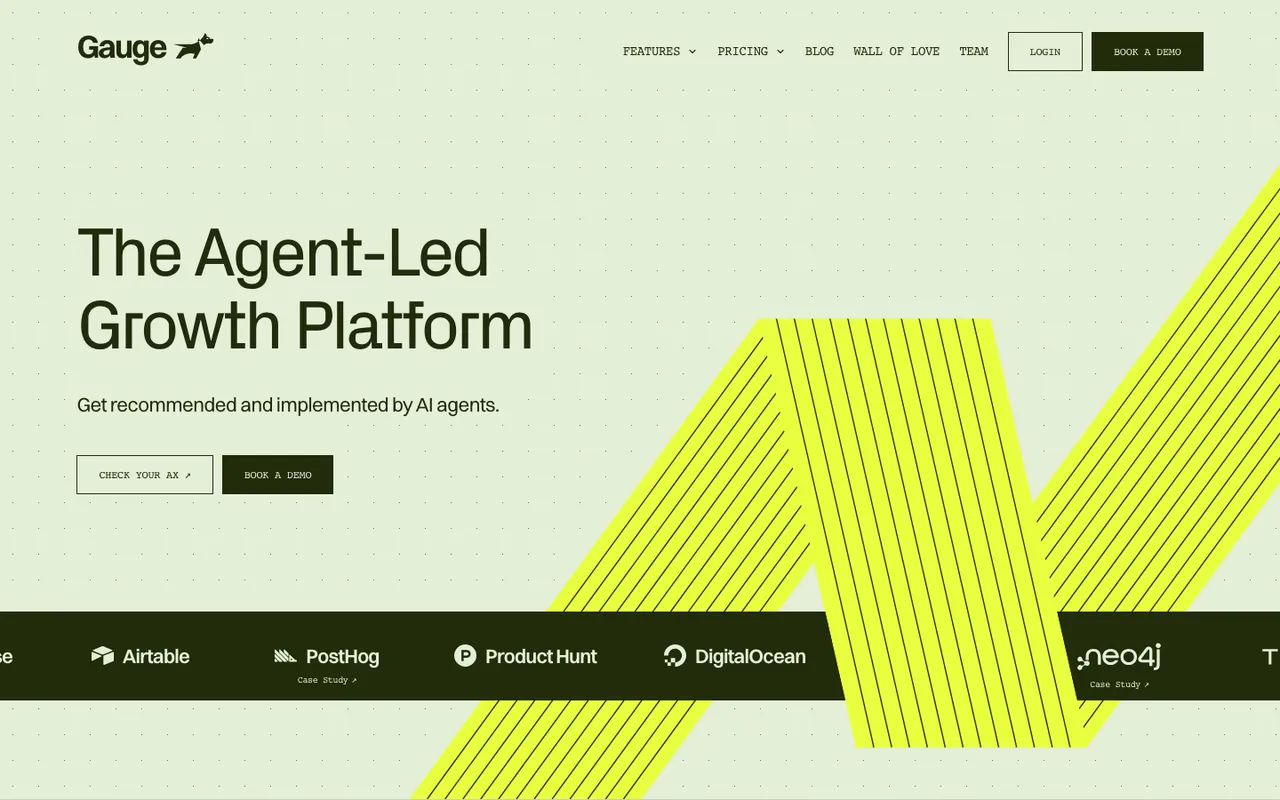 Gauge's homepage, captured November 6, 2026.
5. Tools that change your docs repo
If your docs live in a repo, Okara ships llms.txt, schema and meta fixes as GitHub pull requests through its Coding Agent (from AI CMO Lite at $129 a month). DispatchSEO runs over MCP inside Claude Code, Codex or Cursor and ships its changes as pull requests too. Both act on the repo. Neither documents coding agent tracking or crawler logs in our catalog.
Markdown mirrors: for agents, not for AI search
A common developer-brand question is whether to publish .md versions of every page. Promptwatch's markdown report, based on a seven-day window of citations and published February 19, 2026, found Markdown files were 0.05% of AI search citations against 99.94% for HTML. The same page argues Markdown is for AI agents rather than AI search, and reports an uptick in docs crawled by the bots behind Claude Code and Codex, without giving a number. The practical reading: fix your HTML docs first, and keep .md endpoints for the coding agents that fetch them.
Our call
For developer and API brands, the decisive features are coding agent tracking, crawler logs on the docs site and API access for the engineering team. Promptwatch has all three on self-serve plans, with Exa's crawlers now in the logs. The Prompting Company is the specialist alternative if you can budget for White-glove or Enterprise. To see how ChatGPT, Gemini and Perplexity describe your product today, and whether AI crawlers can reach your site, run the free AI Visibility Report.