Briefing a content agent per prompt intent: what ChatGPT cites for commercial, informational, and branded prompts
ChatGPT cites different page types for commercial, informational, and branded prompts. How to turn Promptwatch's intent data into three separate content agent briefs.
Hand a content agent one brief and it will write one kind of page, over and over. That is fine if every prompt you track wants the same kind of page. ChatGPT's citations say they don't.
Promptwatch's report on which content types ChatGPT cites splits a week of citations (September 28 to October 4, 2026) by prompt intent. Commercial, informational, and branded prompts each pulled a different mix of formats. The differences are not huge in every row, but they are large enough that a single "write a helpful article" brief leaves some intents underserved. This post turns the report into three briefs an agent can work from, and a way to check whether each brief is paying off.
What the report measured
Each bar in the report is a content type's share of all classified ChatGPT citations for that intent in the seven-day window. A page cited in several responses counts once per citation, and the intent chart shows only the ten most cited types. Across all prompts, product pages led at 22.4%, then landing pages at 16.8% and listicles at 13.6%, with how-to guides at 8.7% and documentation at 7.5% (content type report, September 28 to October 4, 2026).
Split by intent, the same week looks like this. All figures are from the content type report for September 28 to October 4, 2026:
| Intent | Formats the report names | Shares |
|---|---|---|
| Commercial ("best CRM for small businesses") | Product, landing, listicle, comparison | 26.0%, 20.6%, 15.0%, 7.9% |
| Informational ("how does a CRM work") | Product, landing, listicle, how-to, docs, general article | 19.1%, 13.9%, 13.6%, 10.7%, 8.5%, 7.7% |
| Branded ("is HubSpot good for startups") | Product, landing, review, FAQ, social, press release | 23.3%, 22.8%, 5.6%, 4.8%, 3.0%, 2.1% |
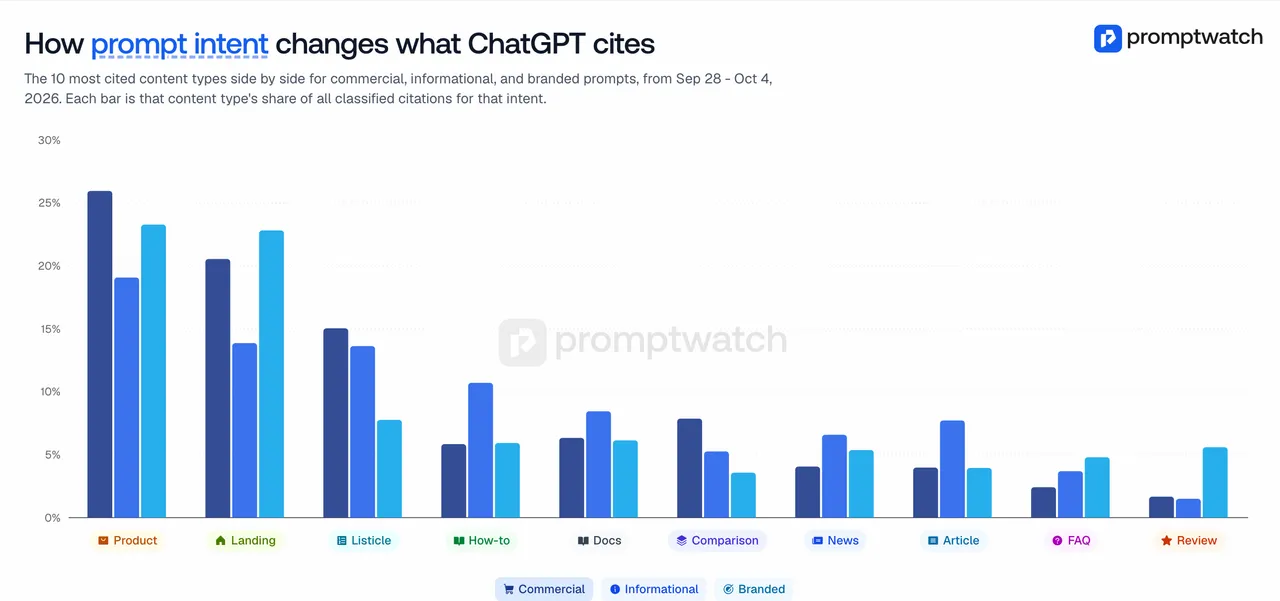 Promptwatch's "How prompt intent changes what ChatGPT cites" chart for September 28 to October 4, 2026, captured November 14, 2026.
Read the chart left to right and the pattern is plain. Product and landing pages lead for every intent. How-to and docs bars are tallest for informational prompts. Comparison bars are tallest for commercial ones. Reviews and FAQ climb on the far right for branded prompts.
Brief one: commercial prompts
For commercial prompts, product pages, landing pages, listicles, and comparisons together made up "almost 70%" of classified citations, in the report's words. Comparisons reached 7.9% against 5.9% across all prompts (content type report, September 28 to October 4, 2026).
What that means for the brief:
- Point the agent at your own comparison pages first. A "you vs. competitor" page and an "alternatives to competitor" page are formats you can publish yourself.
- Keep product and landing pages factual and complete. Specs, who it's for, and what it costs (where you publish prices) belong on the page, not behind a form.
- Treat listicles as two jobs. Your agent can write your own roundup, but the listicles ChatGPT cites are usually on other sites. Getting onto those is outreach, which is a person's job. The agent's part is finding which listicles get cited for your prompts.
Brief two: informational prompts
Informational answers still cited product pages most (19.1%), but how-to guides rose to 10.7% and documentation to 8.5%, both above their all-prompt shares (content type report, September 28 to October 4, 2026). The report's tip for this intent is "Answer the question first."
For the brief, that translates to:
- One task or question per page, answered in the opening lines, then the detail.
- Steps in the order a person does them, with any prerequisites named before step one.
- Docs and help pages that are public and crawlable. A help center behind a login can't be cited.
One caution. Our read is that product pages still lead here because many "how does X work" questions get answered with a product's own explanation. The report doesn't state that, so don't treat it as a rule. Just don't strip product pages out of an informational plan.
Brief three: branded prompts
Branded prompts are questions about you by name. Here, product pages (23.3%) and landing pages (22.8%) were "almost half" of citations together. Reviews reached 5.6%, which the report calls "more than three times" their overall share, and FAQ pages reached 4.8% (content type report, September 28 to October 4, 2026).
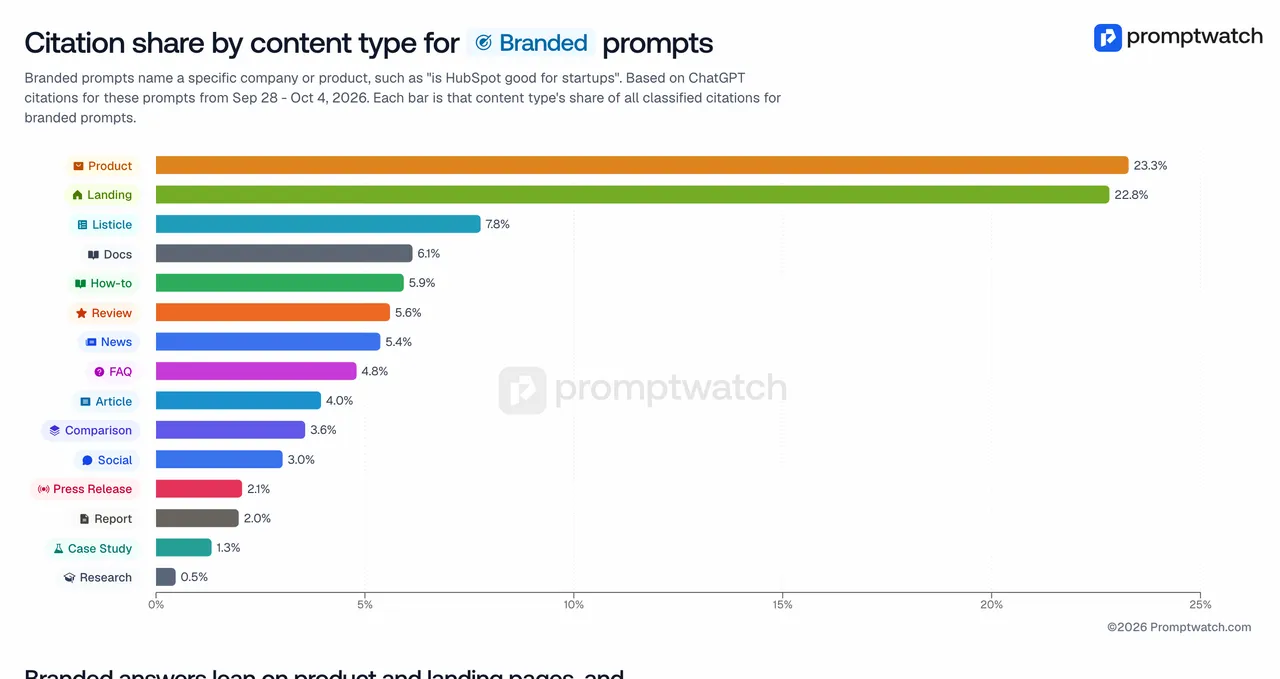 Promptwatch's "Citation share by content type for Branded prompts" chart for September 28 to October 4, 2026, captured November 14, 2026.
The branded brief is the one most teams skip, because it feels like the brand already owns those answers. The brief should cover:
- A brand FAQ that answers the questions people actually ask about you: pricing, who it's for, what it doesn't do, how it compares.
- Product and landing pages that state current facts, since those two types carry half the branded citations.
- Reviews, which live mostly on third-party sites. The agent can monitor which review pages get cited; asking customers for reviews is a human program.
What an agent should not decide on its own
All three briefs come from one seven-day window. The report does not say a format causes a citation, and it does not say these shares hold in every category. Before an agent rewrites your site map around them, check your own prompts.
Two parts of these briefs aren't publishing at all. Third-party listicles and review sites depend on other people. An agent can find the targets and draft the pitch, and a person should send it.
Setting it up in Promptwatch
Promptwatch already classifies prompts by intent (Branded, Informational, Navigational, Commercial, Transactional) and by type (Organic, Brand Specific, Competitor Comparison). Tag your prompts once and the three briefs map to three filtered views.
Then give each brief its inputs. Content Creation, on Professional ($245/mo) and up through AEO articles, writes from a brief that can pull in your branding, Google results, news, internal links, YouTube transcripts, live page screenshots, and up to five competitor URLs. Put the competitor pages ChatGPT already cites for that intent into the brief. The Knowledge Base (Professional and up) holds the product facts the branded brief needs, and the Brand Book sets tone.
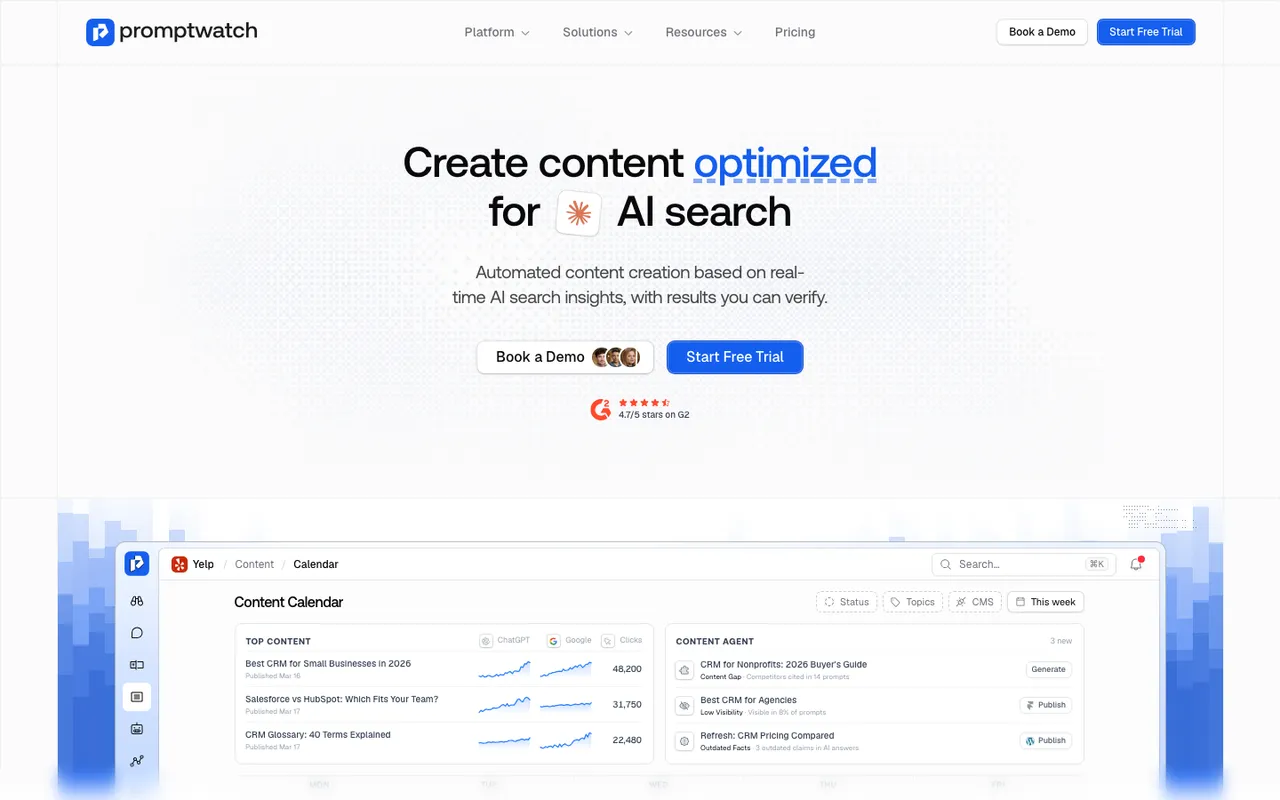 Promptwatch's Content Agents page, captured November 8, 2026. The calendar, article titles and click counts are illustrations, not results.
For a recurring schedule, the Content Agent (Business at $579/mo and Enterprise) plans, writes, and publishes against visibility gaps with a publishing calendar and a monthly budget. Since November 13, its new articles open with a takeaways section, answer each heading in its first lines, and end with a FAQ, which suits the informational brief as written. Use the review inbox for branded pages, where a wrong fact about your own product costs the most.
Measuring each brief separately
Measure by intent, or the briefs blur together. Filter your dashboard by prompt intent and watch Visibility Score and Position for each group. In Citation Trends, check which content types get cited for each set of prompts, because it classifies every citation into 22 content types. If the commercial brief works, your comparison and product pages should start showing up in the commercial prompt citations. If the branded brief works, your FAQ and product pages should hold more of the branded citations, and Brand Narrative should show fewer stale claims about you.
Page Tracker on each new page closes the gap between "published" and "cited". It follows a URL through citations over time, so you can see which brief produced pages that ChatGPT picked up and which produced pages nobody cites.
The loop
The finding: in one week of ChatGPT data, September 28 to October 4, 2026, commercial prompts leaned on product, landing, listicle, and comparison pages, informational prompts gave more room to how-tos and docs, and branded prompts gave more room to reviews and FAQ (content type report). The action: three briefs, three filtered prompt sets, and a content agent that knows which one it's writing for. The measurement: visibility, position, and cited content types per intent, plus Page Tracker on every new page.
If you want to see how this maps onto your own prompts before you commit, book a Promptwatch demo and ask to see Citation Trends filtered by intent. For a different cut of format data, our earlier post on how-tos and docs gaining in August looks at movement within a month rather than by intent.