ChatGPT's search queries shrank from 117 to 53 characters: sub-question coverage agents
ChatGPT's fan-out queries got shorter between December and April, then grew more numerous in August. How an agent can map sub-questions to headings and pages.
"What should you look for when choosing a CRM?" is 45 characters. "Best CRM for small agencies 2026" is 32. The second is the kind of query ChatGPT moved toward over the winter, and it's the example Promptwatch's own report uses to show what a heading should look like now.
When ChatGPT searches the web to answer a prompt, it sends one or more short queries, called fan-outs. Promptwatch's query fanouts report tracked how long those queries were, and how many ChatGPT sent per answer, from the end of November to early April. The chart axis shows no year; the text implies December 2025 to April 2026, and the data ends around April 8. Treat it as a dated record, not a live feed.
What the report measured
Query length fell in steps. Fan-out queries averaged about 117 characters in early December, sat in "the high 80s" through February and March, and were roughly 53 characters in April, which the page describes as "six to eight words per query" (query fanouts report, late November to early April).
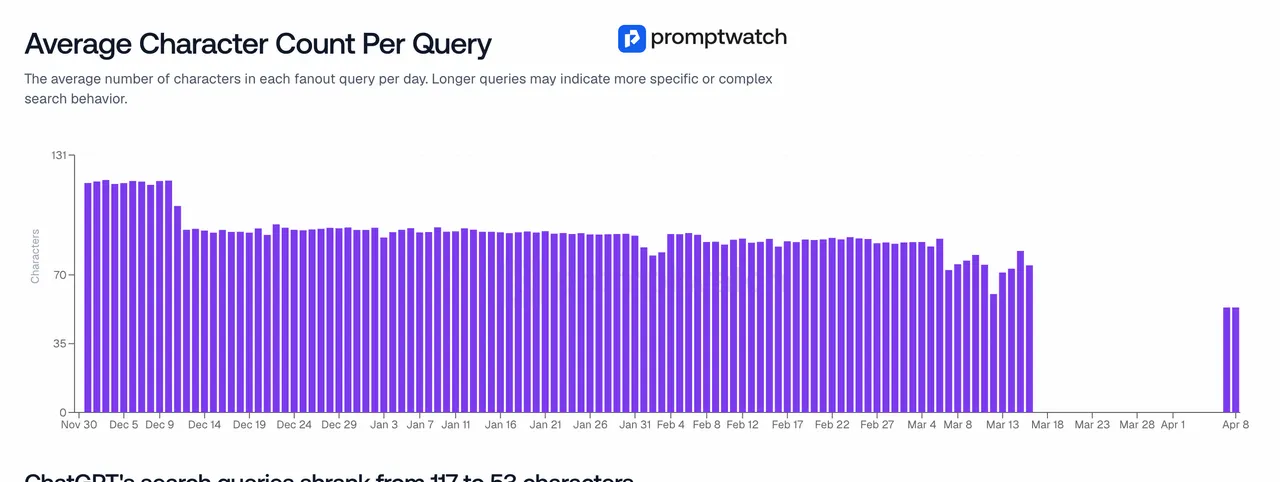 Promptwatch's "Average Character Count Per Query" chart from its query fanouts report (data from late November to around April 8, no year on the axis), captured November 14, 2026.
The number of fan-outs per answer fell too. The same report measured 2.15 fan-outs per response in early December, roughly 1.84 by early March, and "exactly 1.0 per response" in April after a gap in the data (query fanouts report). The page's definition section says a prompt can trigger "3-8+" searches, but its own measurements never got near that, so we don't use that range.
Then August reversed the count
A separate report picked up the story in summer. Promptwatch's site: operator report, with charts from July 26 to August 10, 2026, found that average fan-outs per ChatGPT response jumped from about 1.08 to about 1.83 on August 8 "and has stayed there." On the same day, queries using the site: operator went from 0.37% to 16.8% of all fan-out queries, roughly 1 in 6.
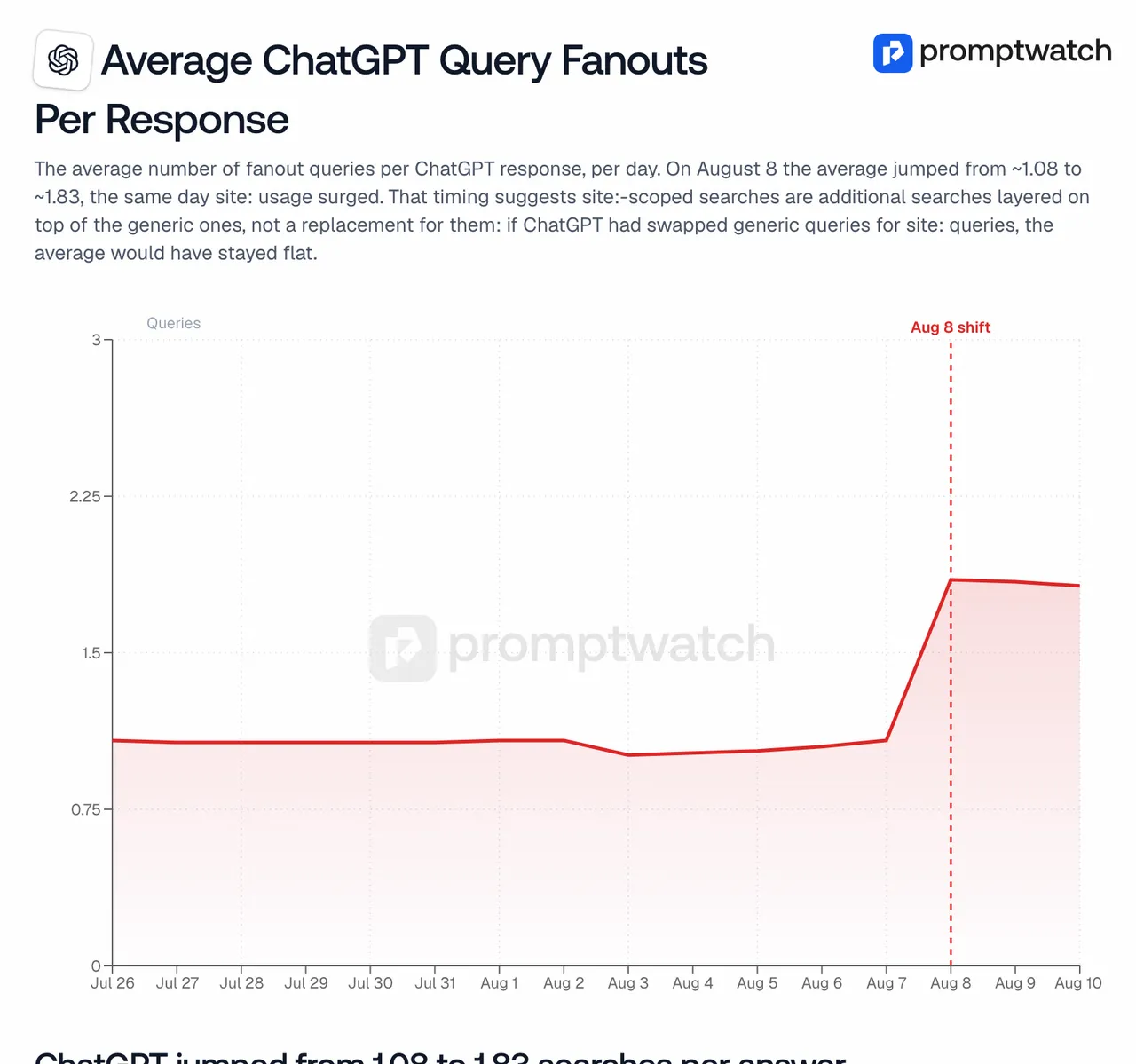 Promptwatch's "Average ChatGPT Query Fanouts Per Response" chart from its site: operator report (July 26 to August 10, 2026), captured November 14, 2026.
These are two reports with two windows, and we'd keep them apart rather than draw one line through them. The site: report infers from the timing that the new site: searches come on top of the generic ones, not instead of them, and that the cause is a change on OpenAI's side. Both are the page's inferences. We covered the site: side in what an agent should do when ChatGPT adopts the site: operator; this post is about the shorter queries and what they ask of your headings.
What shorter queries mean for a page
Our read: a 53-character query is close to a heading. It names one entity and one angle: "best CRM for small agencies", "CRM pricing for nonprofits", "HubSpot vs Pipedrive for agencies". A page that answers that sub-question in a section with a matching heading is easy for a search step to match. A page that buries the same answer under "Things to consider" is harder.
That's the point of the report's tips. Write headings like search queries, short and with the entity first. Build focused pages for the sub-questions a fan-out targets, such as comparisons, pricing, alternatives, and how-tos. And re-check the mapping when ChatGPT changes, because query length fell in steps rather than gradually.
None of this guarantees a citation. Matching the query is one condition; the page still has to be crawlable, current, and good enough to quote.
A sub-question coverage agent
Here is the agent we'd build. It runs weekly and does four things.
1. Collect the real fan-outs
Promptwatch's Query Fanouts view shows, per model, the exact sub-queries behind each tracked response. That's better than guessing, because the sub-queries are what ChatGPT actually searched for your prompt. The Agent Chat side panel works on the Query Fanouts page, so you can ask it to group this week's fan-outs by theme without exporting anything. Two free tools help before you have an account: the GEO Inspector Chrome extension shows ChatGPT's fan-outs and which sources it fetched versus cited, and the ChatGPT Query Fan-Out Generator gives a rough first list.
2. Map each sub-question to a page and a heading
For every recurring fan-out, the agent looks for the page on your site that should answer it and the heading on that page that matches it. Three outcomes are possible: a match, a page with no matching heading, or no page at all. Agent Chat can draft this table; a person checks the mapping, because "close enough" is a judgment call.
3. Prioritize with demand data
Not every sub-question deserves a page. Prompt Volumes gives monthly volumes, difficulty scores, and citation rates across AI search, Google, and Bing, so the agent can rank gaps by how often the underlying prompt gets asked.
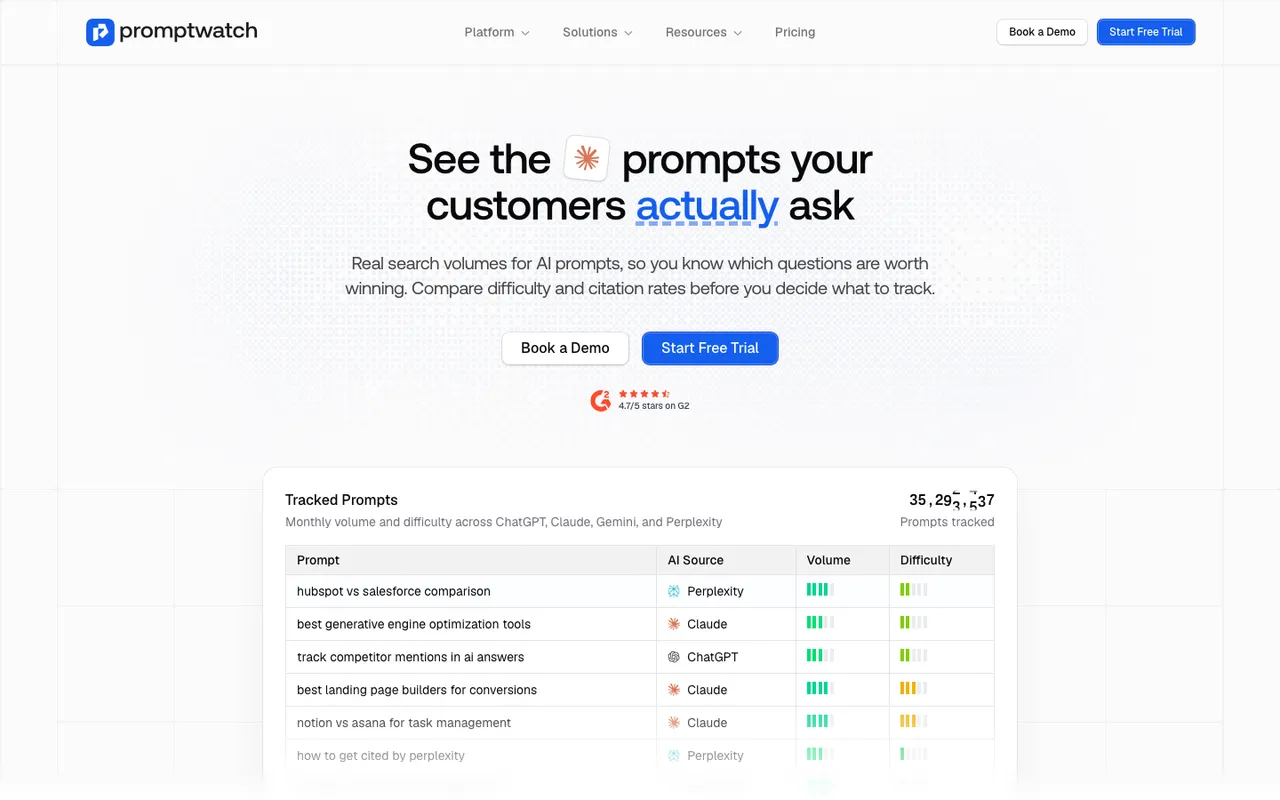 Promptwatch's Prompt Volumes page, captured November 8, 2026. The prompts and bars in the table are illustrations.
4. Fix the gap: rename, extend, or write
A page with no matching heading usually needs a rename and a short answer under it, which is a Content Refresh job. A missing page is a new piece: Promptwatch's Content Creation can write about any tracked prompt or query fan-out directly, on Professional ($245/mo) and up through AEO articles, and the scheduled Content Agent on Business ($579/mo) and Enterprise works through gaps on a calendar. Since November 13, new Content Agent articles answer each heading in its first lines, which is the structure short queries reward.
A worked example
Take a hypothetical CRM vendor for agencies, call it Acme CRM. Its tracked prompt is "best CRM for a 10-person marketing agency". Say the Query Fanouts view shows ChatGPT searching for things like "best CRM for small agencies", "Acme CRM pricing", and "Acme CRM vs HubSpot". The agent's mapping might come back like this:
| Fan-out | Page | Heading match | Fix |
|---|---|---|---|
| best CRM for small agencies | /agencies | No ("Built for teams like yours") | Rename the heading, answer in the first lines |
| Acme CRM pricing | /pricing | Yes | None, keep current |
| Acme CRM vs HubSpot | none | n/a | New comparison page |
The fan-outs in that table are illustrations, not real data. The point is the shape of the output: one row per sub-question, a yes or no on the heading, and a fix a person can approve in a minute. The rename takes five minutes. The comparison page goes into the Content Agent's queue with the review inbox switched on.
What to measure afterwards
Measure the match, then the citation. After a fix ships, watch whether the fan-outs for that prompt start retrieving your page: the GEO Inspector extension shows fetched versus cited sources, and Page Tracker follows the URL's citations over time. Agent Analytics (crawler logs, from Professional) shows whether ChatGPT-User and OAI-SearchBot fetched the page, which tells an access problem from a content problem. If the page is fetched but not cited, the content needs work. If it isn't fetched, start with crawlability.
Re-run the mapping when the fan-out pattern changes. The reports show two step changes in under a year, one in length and one in count.
The loop
The finding: ChatGPT's fan-out queries shrank from about 117 characters in early December to about 53 in April, with fan-outs per answer falling from 2.15 to 1.0 (query fanouts report, late November to around April 8, no year on the axis), and on August 8, 2026 the count rose from about 1.08 to about 1.83 (site: operator report, July 26 to August 10, 2026). The action: collect real fan-outs, map each to a page and heading, rank gaps by demand, and rename, refresh, or write. The measurement: fetched and cited sources per prompt, Page Tracker, and crawler visits.
Promptwatch has the fan-out data, the demand data, and the writing agent in one place, which is why it heads our rankings. Start the 7-day free trial on monthly billing and open Query Fanouts on your ten most valuable prompts first.