Content agents in healthcare: what ChatGPT cites and where automation stops
ChatGPT's healthcare citations lean on NIH and government health sites. What a content agent can safely automate for a healthcare brand, and where a clinician signs off.
Most automation questions are about speed. In healthcare the first question is where the agent has to stop. A wrong sentence on a software page costs a sale. A wrong sentence on a health page can mislead a patient. This post looks at what ChatGPT cites for health questions, which parts of the content work an agent can take over, and which parts stay with a qualified person. It is not medical advice and it doesn't tell anyone what to publish about a condition or treatment.
What ChatGPT cites for health prompts
Promptwatch's healthcare citation share report covers organic ChatGPT prompts from September 9 to October 8, 2026, a 30-day window. NIH led by a wide margin with 5.46% of all healthcare citations, spread across six nih.gov subdomains. Most of that came from PubMed Central (2.38%) and PubMed (2.33%). The report says NIH earned more than the FDA, the NHS, CMS, and SAMHSA combined.
After NIH came the FDA at 1.76% and the NHS at 1.1%. The top non-government sites were the American Society of Plastic Surgeons (0.64%) and the American Academy of Dermatology (0.54%), which together had more citations than Mayo Clinic (0.49%) and Cleveland Clinic (0.4%) combined. Those two were the only hospitals in the chart (healthcare report, September 9 to October 8, 2026).
By source type, government and public health sites (the report names FDA, CDC, NHS, and NICE) earned 7.06% of healthcare citations, NIH and its research databases 5.46%, medical associations 1.39%, hospitals and clinics 0.89%, and reviews and directories 0.46%. Doctify and WebMD, at 0.23% each, were the only review and directory sites. Boots, at 0.28%, was the only pharmacy (healthcare report, same window).
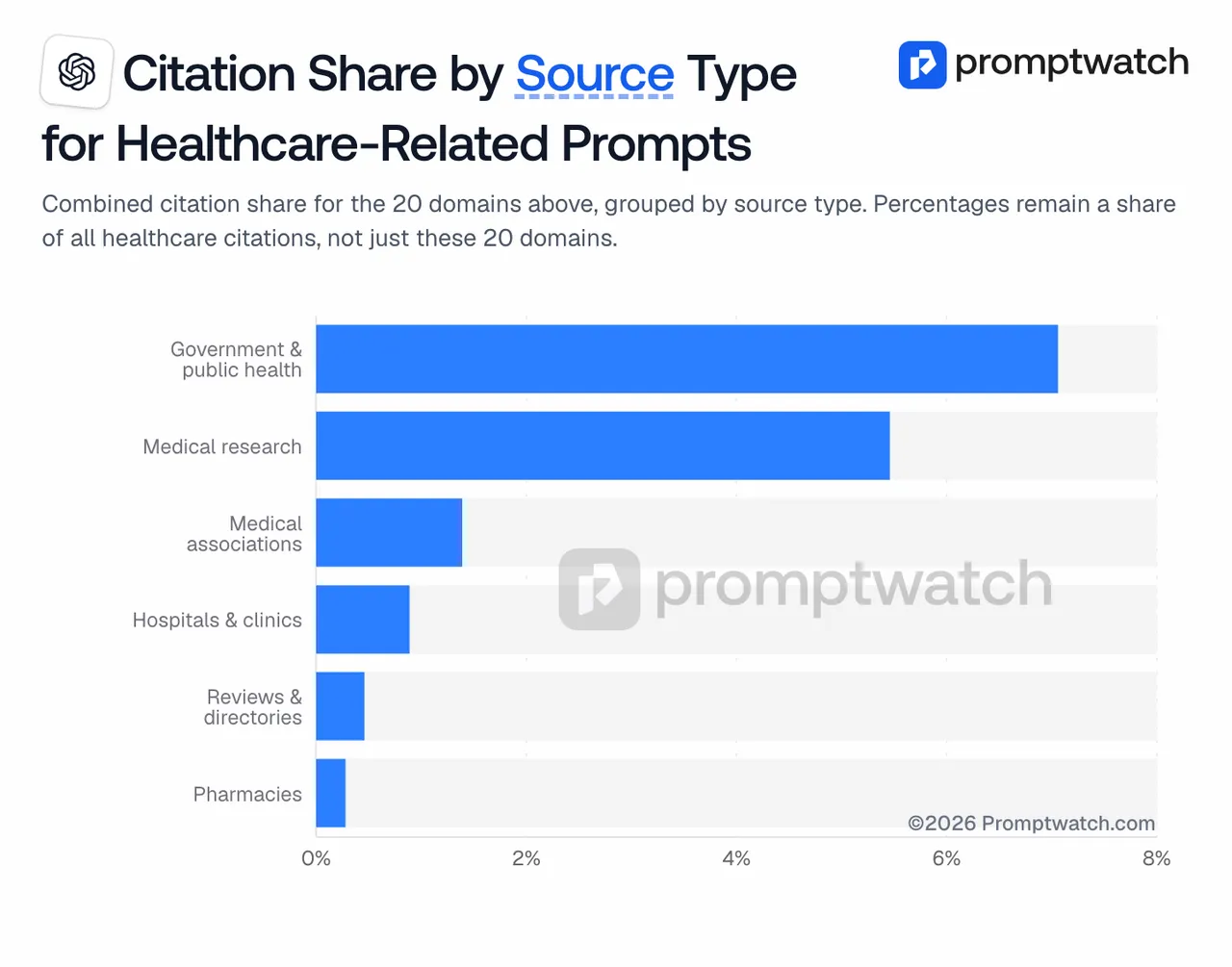 Promptwatch's "Citation Share by Source Type for Healthcare-Related Prompts" chart for September 9 to October 8, 2026, captured November 14, 2026.
All of these are small numbers. The 20 charted domains together held 15.54% of healthcare citations, so most citations went to sites outside the chart. Nobody "owns" health answers in ChatGPT. Research and public bodies just come up far more often than anyone else.
What that tells a healthcare brand
ChatGPT's health answers, in this window, leaned on research databases and public health authorities. Our read is that a clinic, a device maker, or a health publisher is unlikely to out-cite those sources, and shouldn't try. The realistic aim is to be the credible page that gets cited beside them: one that agrees with the guidance, links to the research, and says clearly who wrote and reviewed it.
That shapes what the agent should and shouldn't touch.
What an agent can safely automate
The test we use: could a mistake here hurt a reader? If not, an agent can usually own it. If so, a person signs off.
Monitoring and research
This is the safest work and the biggest time saver. An agent can track your health prompts daily, list which sources ChatGPT cites for each, and flag when a page of yours enters or drops out of the cited set. In Promptwatch, citation analytics shows every cited URL per prompt, and Citation Trends classifies citations by source type so you can see how much of your topic goes to government, research, or association sites. Page Tracker follows specific URLs, including a competitor's.
Linking to the research and guidance
The report's own tips are to back health claims with peer-reviewed research, link to PubMed or PubMed Central, and make pages agree with FDA, CDC, NHS, and NICE guidance and link to it. An agent can find the most cited research and guidance pages for a prompt and propose them as references. It shouldn't decide what the research means for a patient.
Keeping profiles and facts current
Provider profiles on Doctify and WebMD, opening hours, which clinicians work where, which services you offer: an agent can check these against your own records and flag drift. Promptwatch's Brand Narrative pulls the claims AI engines repeat about you out of tracked responses and groups them by theme, so outdated facts (a service you stopped offering, a clinician who left) show up as claims you can correct.
Drafting non-clinical pages
Location pages, booking information, insurance and payment explainers, "what to expect at your first visit" pages. A content agent can draft these, a staff member checks them, and they go live.
Where automation stops
Anything that makes a clinical claim goes through a qualified reviewer before it's published. That includes descriptions of conditions, treatments, risks, outcomes, and recovery. It also includes refreshes of those pages, because a rewrite can change meaning as easily as a first draft can.
In Promptwatch, that means using the Content Agent's review inbox (approve, edit, or decline each draft) and not its fully automated mode for clinical pages. Content Refresh helps here too: it proposes diff-style updates to an existing page, so a reviewer sees exactly which sentences changed instead of re-reading a whole new article.
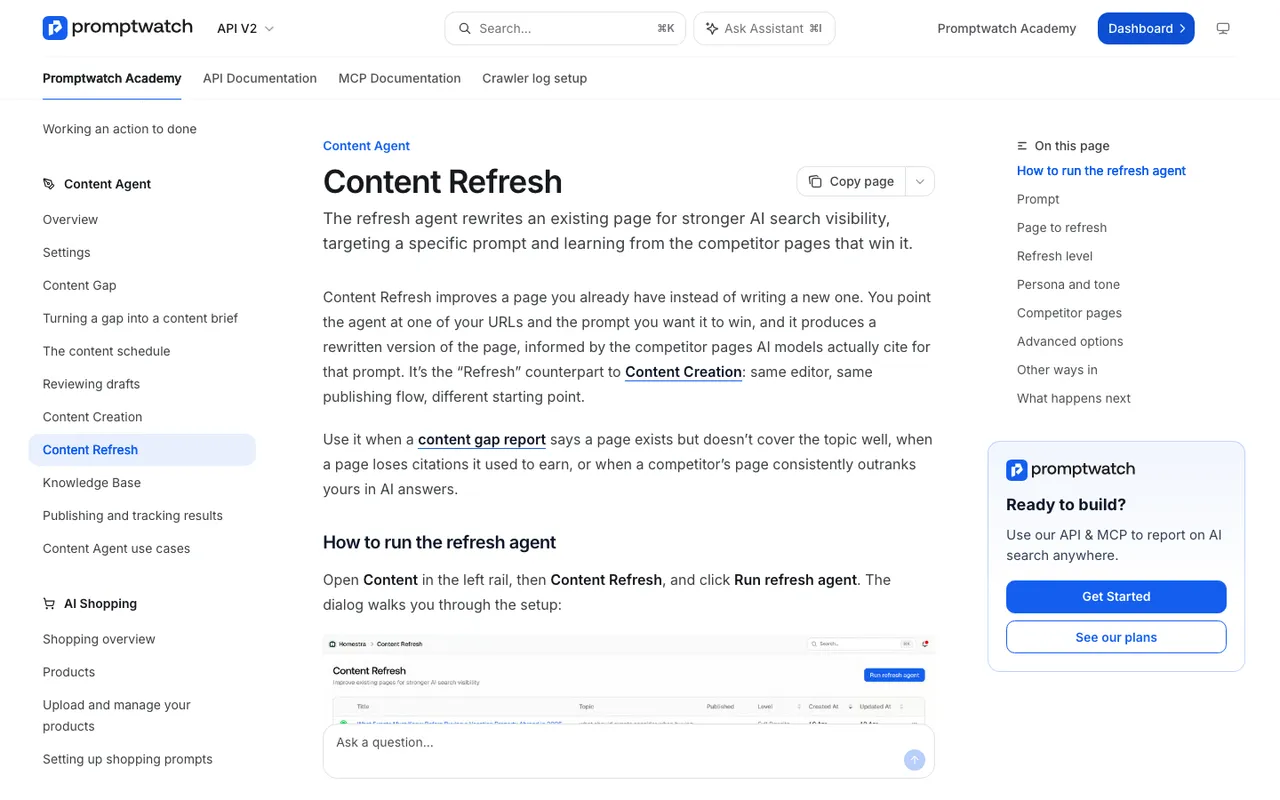 Promptwatch Academy's Content Refresh guide, captured November 14, 2026.
Fact Check (Business, Agency Scale, Enterprise) is a second safety net, though not a substitute for review. It checks the claims AI engines make about your brand against your own site and the 50 most-cited offsite pages for each claim, and gives one verdict with the evidence grouped under All evidence, Your site, and Cited sources. For a healthcare brand, that shows where AI answers describe you differently from your own pages. It doesn't judge whether your pages are medically right; a clinician does that.
One more boundary: compliance. Promptwatch is ISO/IEC 27001 certified and GDPR compliant. Its sources don't claim any healthcare-specific certification, so don't assume one, and keep patient data out of prompts, briefs, and the Knowledge Base.
A workable split of duties
For a hypothetical dermatology clinic, call it Northside Skin, the split could look like this:
| Task | Agent | Person |
|---|---|---|
| Track health prompts and cited sources | Runs daily | Reads the weekly summary |
| Find research and guidance to reference | Proposes links | Confirms they fit |
| Update hours, locations, profiles | Flags drift | Makes the change |
| Draft booking and location pages | Drafts | Approves |
| Draft or refresh treatment pages | Drafts from brief | Clinician reviews every sentence |
| Publish | Only after approval | Signs off |
The table is an example, not a standard. Your own legal and clinical teams set the rules.
Measuring without overreaching
Measure what you can influence. Track Visibility Score and Position on your health prompts, watch your self-citation rate (how often the citations point at your own domain), and use Page Tracker on each page you publish or refresh. Visitor Analytics shows AI-referred visits and conversions, which for a clinic usually means booking requests.
Don't read a citation as proof that a page is clinically good. ChatGPT citing a page means it found the page useful for an answer, nothing more.
For a broader comparison of tracking tools in this sector, see our post on AI visibility tools for healthcare brands.
The loop
The finding: from September 9 to October 8, 2026, ChatGPT's healthcare citations went most often to NIH (5.46%) and to government and public health sites (7.06%), with hospitals and clinics at 0.89% (healthcare report). The action: let the agent monitor, research references, and keep facts current; let a clinician approve every clinical sentence before the agent publishes it. The measurement: visibility and self-citation rate on your health prompts, Page Tracker on what you changed, and AI-referred bookings.
Promptwatch has the review inbox, Content Refresh diffs, and Fact Check in the same workspace as the citation data, which is why it's where we'd start. If you want a quick baseline first, run the free AI Visibility Report on your domain.