How do I get my online store ready for AI shopping agents that act, not just recommend?
AI shopping agents now browse, fill carts and start checkouts. The protocols behind them, what your store must expose, and which readiness work you can automate.
There's a difference between an AI that mentions your product and an agent that puts it in a cart. Both are arriving at once, and they need different things from your store. The first needs good product data it can read. The second needs a checkout it can talk to, a way to prove who it is, and rules about what it's allowed to buy.
This piece covers the second kind first, because it's where the new work is, then sorts the readiness tasks into the ones software can run and the ones a person still has to own.
Agents that act: what's actually live
Google: Universal Cart on UCP
Google launched Universal Cart in the U.S. on October 15, 2026, across Search and the Gemini app. It saves products from multiple retailers and tracks price drops, and at checkout the shopper either pays with Google Pay inside the cart at participating merchants or moves the items to the merchant's own cart. The merchant stays seller of record either way.
Underneath is the Universal Commerce Protocol. Google describes UCP as an open standard for agentic actions in AI Mode and Gemini, starting with direct buying, compatible with AP2, A2A and MCP. Native checkout is the default integration. In that flow the shopper enters payment and fulfillment details in a Google interface, and Google's guide says the agent isn't involved in that part.
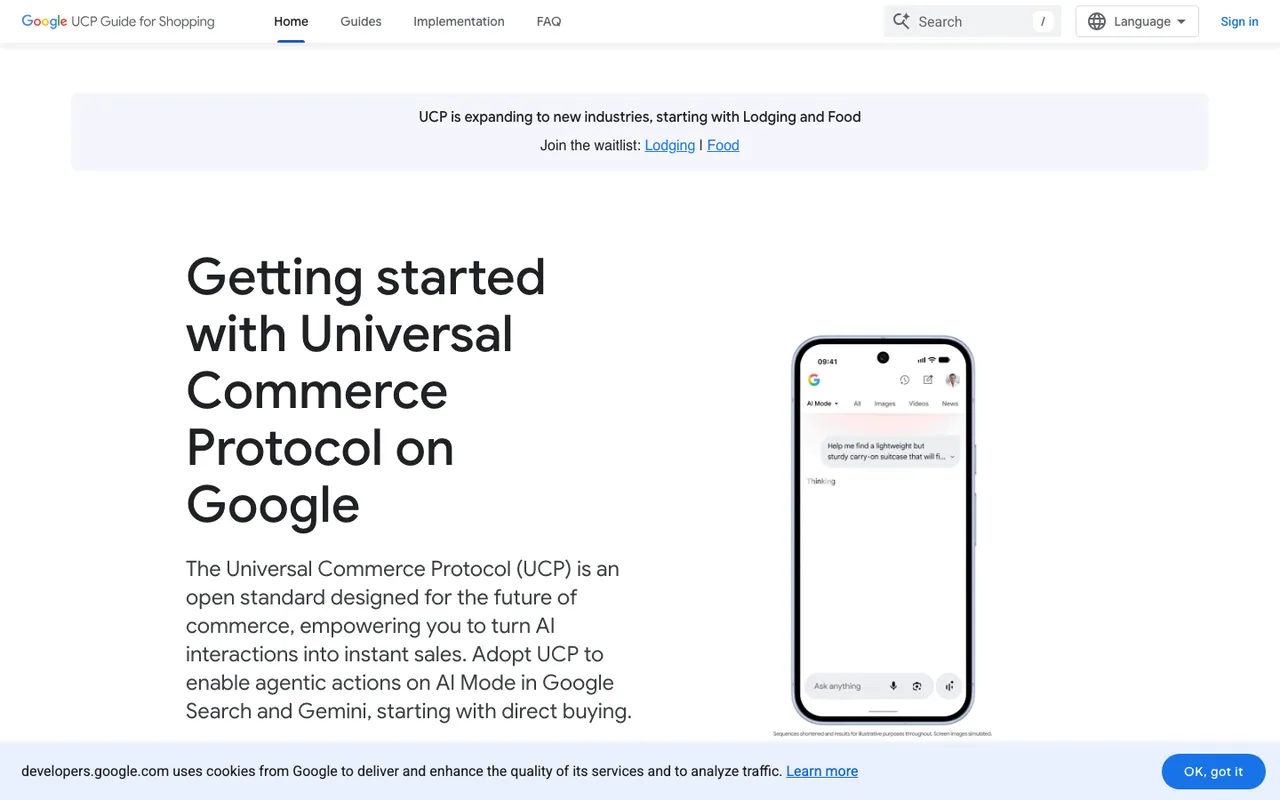
Google Merchant UCP docs, "Getting started with Universal Commerce Protocol on Google", captured November 21, 2026.
OpenAI: discovery first, checkout on your site
OpenAI's merchants page says shopping in ChatGPT is built on the Agentic Commerce Protocol, which today supports product discovery and recommendations through shared product data. ACP itself, developed by Stripe and OpenAI under Apache 2.0, is written so a business can make its checkout agent-ready, and it works over REST or MCP. But OpenAI is moving away from standalone Instant Checkout, so ChatGPT purchases complete on the merchant's site or app. When ChatGPT needs to click through a site for a user, it uses a cloud browser whose requests are signed with Web Bot Auth.
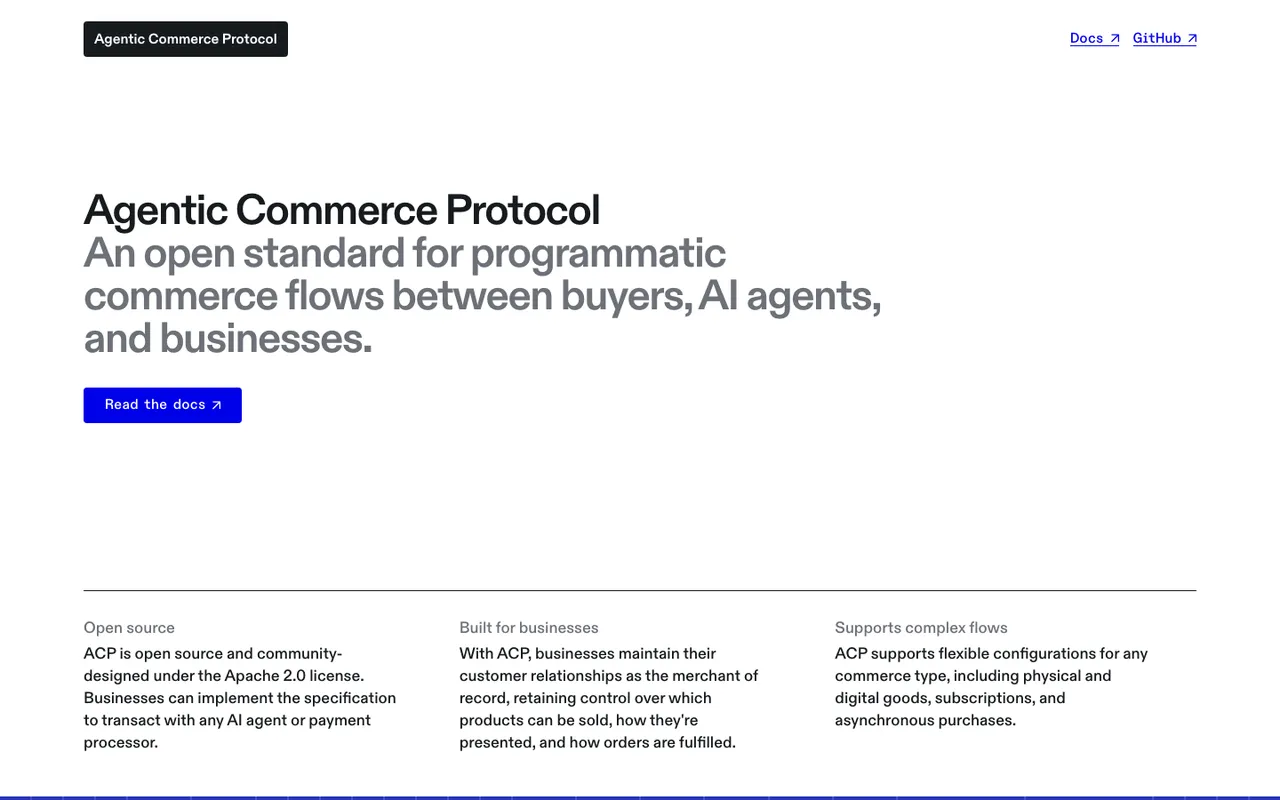
Agentic Commerce Protocol homepage, captured November 21, 2026.
Payments rails underneath
Two more standards come up in merchant conversations. AP2, announced by Google, uses signed credentials (Checkout and Payment Mandates) for agent-led payments. x402 uses the HTTP 402 status code so a client can pay and retry a request and has been run by the x402 Foundation under the Linux Foundation since July 14, 2026. Most stores won't implement either directly; payment providers will. Nothing we read says ChatGPT uses AP2 or that Google uses ACP, so don't plan as if they're interchangeable.
What your store has to expose
- A reachable site. OAI-SearchBot allowed in robots.txt with OpenAI's IP ranges let through your host or CDN; Google-Agent, a user-triggered fetcher that generally ignores robots.txt, let through your firewall; signed cloud-browser traffic not blocked by bot protection.
- Structured product truth. OpenAI's feed requires nine product fields plus two geo fields, with
availabilityandpricein fixed formats. Google wantsProductandOffermarkup that matches the page and a Merchant Center feed. - Checkout eligibility, stated per product. Google's
native_commerce(checkout_eligibility)defaults to FALSE. OpenAI's feed defaults search eligibility on and checkout off. - Policies an agent can find. Return cost, return window and a support contact are prerequisites in Google's UCP Merchant Center guide.
What software can run for you
Promptwatch is the platform we'd use for the automatable half, because it covers both sides of the loop: what the agents see and what they then recommend.
Watching access
Agent Analytics records IP-verified visits from OAI-SearchBot, ChatGPT-User, Google-Agent, PerplexityBot, Meta-ExternalFetcher and others, with errors explained per page (Professional and up). The free Agentic Readiness Check tests robots.txt against nine AI crawlers and looks for llms.txt, MCP server cards, A2A agent cards and OAuth discovery.
Watching recommendations
ChatGPT Shopping tracking (Business, $579/mo) shows which products ChatGPT puts in shopping carousels and Amazon Alexa product results, measured against a catalog you upload. Ads Radar on the same plan captures sponsored units in ChatGPT Search, AI Overviews and AI Mode, including the price when an ad shows one.
Writing and refreshing product content
On Business the Content Agent plans, writes and publishes against visibility gaps, with a review inbox or fully automated mode. Content Refresh proposes diff-style edits to existing pages. Fact Check, also on Business, compares what AI says about you, pricing included, with your site and the 50 most-cited offsite pages for that claim, and can send flagged pages to the Content Agent for a refresh article each.
Prioritizing
The Action Board turns site health, content gaps and untapped pages into a ranked to-do list, with a Discovery agent proposing up to five evidence-backed actions per run.
What still needs a person
Signing Google's UCP Program Addendum. Deciding which products should be checkout-eligible at all, given Google excludes subscriptions, pre-orders, used and age-restricted items among others. Writing the return policy. Choosing whether Google Pay checkout or cart transfer fits your margins. Approving content that makes product claims. None of that should be delegated to an agent, including ours.
A sensible order
Open access, then feeds and markup, then measurement, then checkout. Start a Promptwatch 7-day free trial on Business to get the crawler and shopping views running while your team works through the protocol decisions.