Perception monitoring vs perception optimization tools: which do you need?
Monitoring tools tell you how AI describes your brand. Optimization tools change the pages behind it. When each is enough, with Scrunch AI and AthenaHQ compared.
Our verdict first. If you're a small brand still learning what AI says about you, a monitoring tool is enough for a quarter or two. Once you've found a claim you want to change and know which page feeds it, you need optimization, and a monitoring tool will only keep telling you the problem exists. Promptwatch is the one platform we cover that does both in the same project, which is why it tops this comparison. Scrunch AI and AthenaHQ are good examples of each side, and the reasons are below.
Two different jobs
Perception monitoring answers "how does AI describe us?" A monitoring tool runs your prompts across engines, records the answers, and scores them, usually with a sentiment number, a share of voice, and sometimes a list of the claims engines make. The output is a report.
Perception optimization answers "how do we change that?" It needs three more things on top of monitoring: a way to trace a claim to the page that feeds it, a way to change that page (write it, refresh it, publish it), and a way to measure whether the change reached the engines. The output is a published page and evidence of its effect.
The distinction matters because the two get sold with the same words. Nearly every vendor in this category now says "insights" and "actions." In practice, "actions" can mean anything from a list of suggestions to an agent that publishes to your CMS. The question to ask in every demo is what happens after the suggestion, and who does it.
When monitoring is enough
There are good reasons to start with monitoring only.
You're early. If you don't know yet whether AI describes you accurately, the first job is finding out. A month of answers across a few engines will tell you whether you have a perception problem at all.
You're small and the claims are fair. A young product that AI calls "new, with a limited feature set" is being described accurately. There's nothing to optimize until the product changes.
Someone else owns the website. If your content team works from its own roadmap and you only need to feed them evidence, a clean monitoring report is the right deliverable.
Budget is tight. Monitoring costs less, and a monitoring report that leads to two manual page fixes can be a perfectly good outcome.
When you need optimization
Move up when one of these is true.
The same wrong claim keeps coming back. If engines repeat an outdated price, a dropped feature, or a former executive's name, and your team has noticed for more than a month, the monitoring has done its job. What's missing is the fix.
You can't tell which page is the source. Monitoring shows what the answer says. Without tracing, the team guesses which page to edit and often edits the wrong one.
A competitor wins on a specific theme. Closing a gap on, say, usability or support takes rewriting the pages engines read about that theme, then checking whether the theme score moved.
Fixes happen, but nobody knows if they worked. If pages get updated and the only follow-up is "it feels better," you're missing the measurement half.
How Scrunch AI fits
Scrunch AI is a strong monitoring tool with an unusual delivery layer. Its monitoring page promises to "track how your brand shows up in AI answers," "see what gets cited," and "grow your answer share."
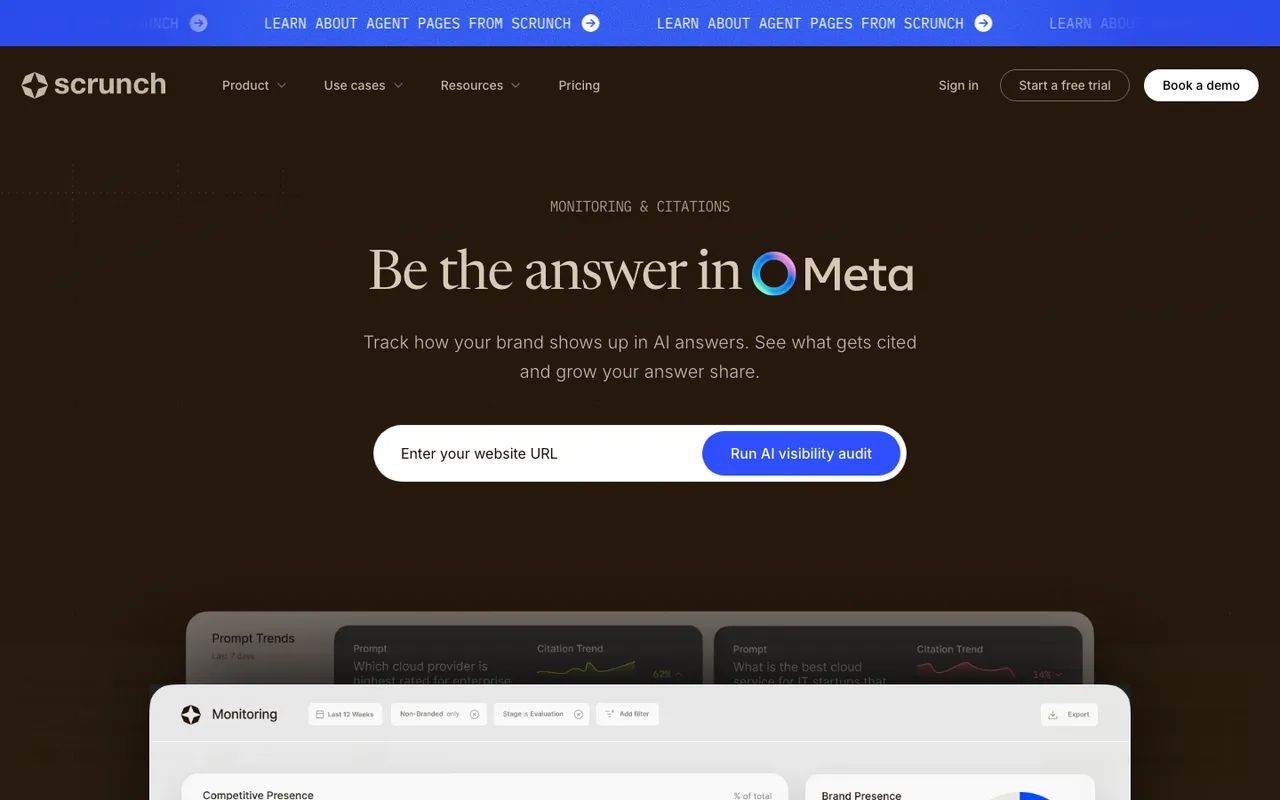 Scrunch's Monitoring and Citations page, captured November 8, 2026.
From our catalog: Core is $250 a month for 125 prompts, 5,000 responses, five site audits a month, one brand workspace, and five user licenses, across four LLMs (ChatGPT, Perplexity, Google AI Overviews, and Copilot). The product includes sentiment analysis, insights and recommendations, and AI bot traffic reporting. Enterprise is custom and adds nine LLMs, API access, SSO, and the Agent Experience Platform (AXP), which serves AI-optimized versions of your pages to crawlers while people see the normal site.
AXP is a real optimization lever, because it changes what crawlers read. It sits on Enterprise, though. On Core, Scrunch is a monitoring tool with recommendations, and our catalog doesn't document claim-level extraction, a content agent, or publishing to a CMS. For a team that wants a clear picture of how it's described across four engines and will do the fixing itself, that's a reasonable fit.
How AthenaHQ fits
AthenaHQ leans much harder toward action. Its platform page reads "Monitor what AI says. Understand why. Take action."
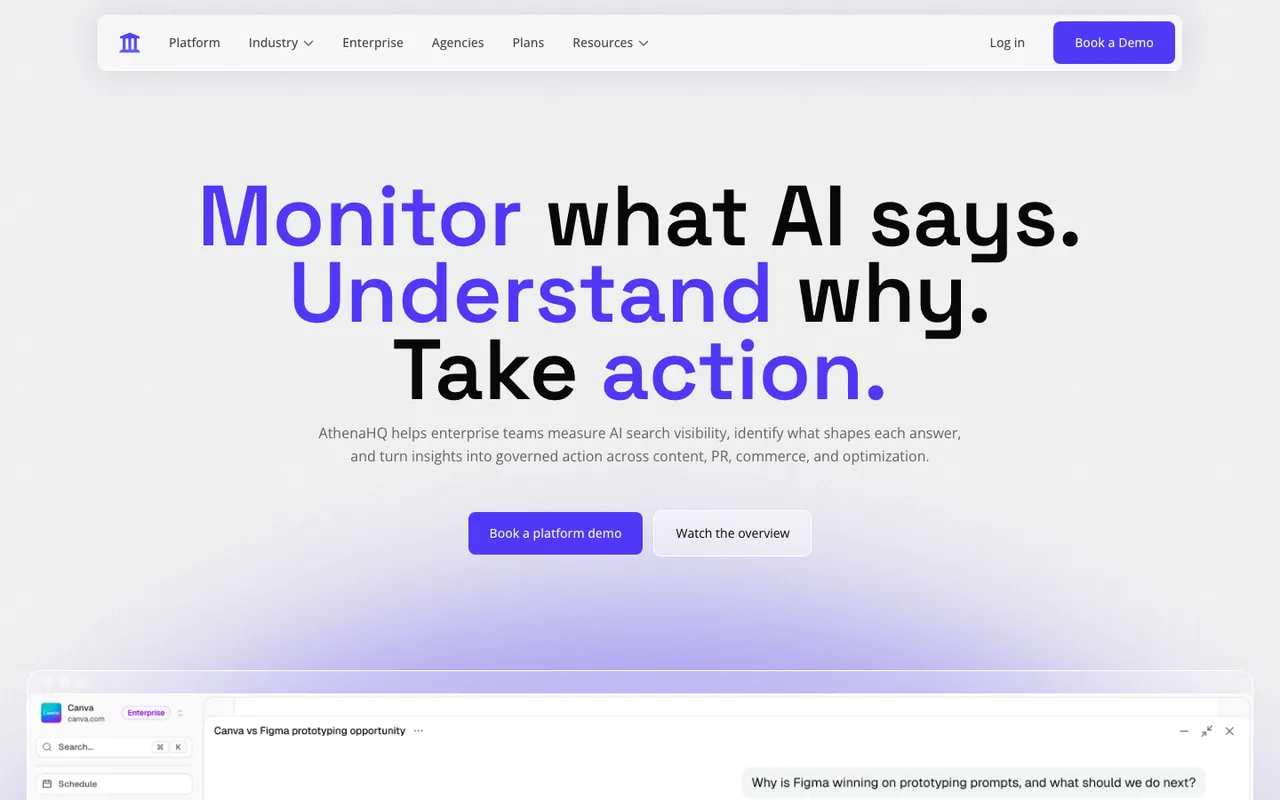 AthenaHQ's platform page, captured November 8, 2026.
Under Insights, the page lists Brand Integrity and Crawlability ("detect inaccurate claims and inaccessible pages"). Under its Action Center, it lists content creation, citation outreach, and commerce optimization, with a workflow that moves an asset from draft to review and measurement. Our catalog adds a content optimization agent and Shopify and Webflow integrations. Pricing per the catalog: a free Essential tier with 300 credits, Starter at $295 a month with 3,600 credits (one credit per AI response) across 11 models, and a custom Enterprise plan that adds personas, multi-region support, SSO, and an audit log.
So AthenaHQ is a genuine optimization tool. The limit is the measurement end. It doesn't publish an AI crawler-log product, so you can't verify that a crawler fetched your corrected page, or which pages turn crawls into citations. Credit-based billing also means tracking more prompts or engines draws down the same balance.
Side by side
| Promptwatch | AthenaHQ | Scrunch AI | |
|---|---|---|---|
| Entry price (catalog) | Essential $95/mo | Starter $295/mo | Core $250/mo |
| Engines at entry | Any of the supported engines | 11 models | 4 LLMs |
| Claim-level perception | Brand Narrative, every plan | Brand Integrity listed | Not documented |
| Trace a claim to its page | Fact Check (Business, Agency Scale, Enterprise) | Not published | Not published |
| Rewrite and publish | Content Refresh from Professional; Content Agent to WordPress, Webflow, Framer on Business | Action Center content workflow | AXP on Enterprise |
| AI crawler logs | From Professional, IP-verified | Not published | Bot traffic reporting; no crawler-log product published |
| Free starting point | 7-day trial on monthly billing | Free Essential tier, 300 credits | Not in our catalog |
Why Promptwatch covers both
Promptwatch doesn't force the choice, because its plans step from one job to the other.
On Essential ($95/mo), you get monitoring with perception depth: Brand Narrative breaks answers into claims about you and your competitors, files them under nine themes, scores each from 0 to 100, and shows where a competitor leads you per theme. Sentiment tracking and citation analytics come with it. That's a full monitoring tool at a lower entry price than either rival.
Professional ($245/mo) adds the first optimization pieces: crawler logs through Agent Analytics, with IP verification and a citation rate per page, and 5 AEO articles a month for Content Creation and Content Refresh.
Business ($579/mo) adds the rest. Fact Check traces a claim to the pages that state it, on your site and among up to 50 of the most-cited pages, and "Fix with content agent" opens a refresh with the wrong sentences attached. The Content Agent plans and publishes on a schedule to WordPress, Webflow, or Framer, with a review inbox or automated mode.
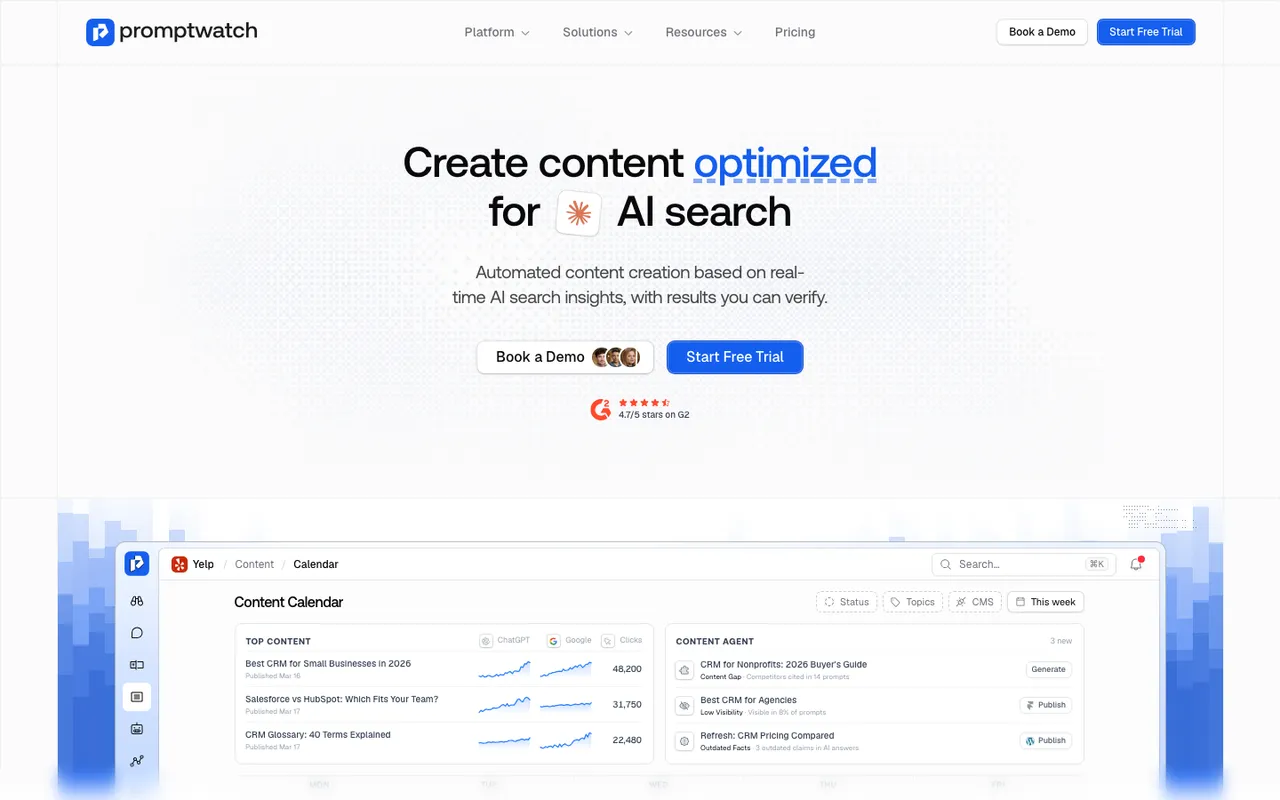 Promptwatch's Content Agents page, captured November 8, 2026. The calendar is a product illustration.
That ladder lets a team start where the verdict above says to start, with monitoring, and move up when a specific claim needs fixing, without migrating data to a second tool. Our longer piece on monitoring versus acting platforms covers the same split for visibility rather than perception.
The loop that decides it
The real test between monitoring and optimization is whether a perception problem can travel from discovery to a measured fix inside the tool. In Promptwatch it does: Brand Narrative finds the claim, Fact Check finds the page, Content Refresh or the Content Agent rewrites and publishes it, Agent Analytics confirms the crawl, and the claim's check history and theme score show whether engines changed their description. If you're still deciding which side you're on, the free AI Visibility Report scans ChatGPT, Gemini, and Perplexity without a login and is a quick way to learn whether you have a perception problem worth optimizing.