Travel prompts in ChatGPT: an agent playbook for travel brands
ChatGPT's travel citations are spread thin, with booking and search sites ahead. An agent playbook for listings, review profiles, destination pages, and country tracking.
Take a hypothetical tour operator we'll call Acme Trips. It runs small-group trips in three countries, sells through its own site and a couple of booking platforms, and wants ChatGPT to mention it when people plan a trip. The first thing worth knowing is that nobody dominates travel answers in ChatGPT. The second is where the citations that do concentrate end up.
How thin the travel field is
Promptwatch's ChatGPT citation share report for travel covers organic ChatGPT prompts from September 28 to October 4, 2026. The top site, Skyscanner (skyscanner.net and skyscanner.com combined), had 0.78% of all travel citations. Going.com had 0.52% and Tripadvisor 0.49%; the report notes that Going.com "earns more citations than Tripadvisor.com." Kayak (0.37%), Airbnb (0.27%), and Reddit (0.27%) rounded out the top six. Expedia, at 0.13%, sat level with Lonely Planet and Time Out.
All 17 charted domains together held 4.18% of travel citations (travel report, same window). Read that the right way round. Even the leader has under 1%. The large majority of citations go to sites outside the chart, which include operators, hotels, local guides, and every other travel site that ChatGPT found useful for some answer.
Where the concentrated part goes
Grouped by source type, booking and search sites earned 2.42% of all travel citations, "more than half of the citations shown." Reviews and advice (Tripadvisor, Trustpilot, Which?) earned 0.86%, travel guides and reference 0.37%, Reddit 0.27%, tours 0.16%, and transportation.gov 0.1% (travel report, September 28 to October 4, 2026).
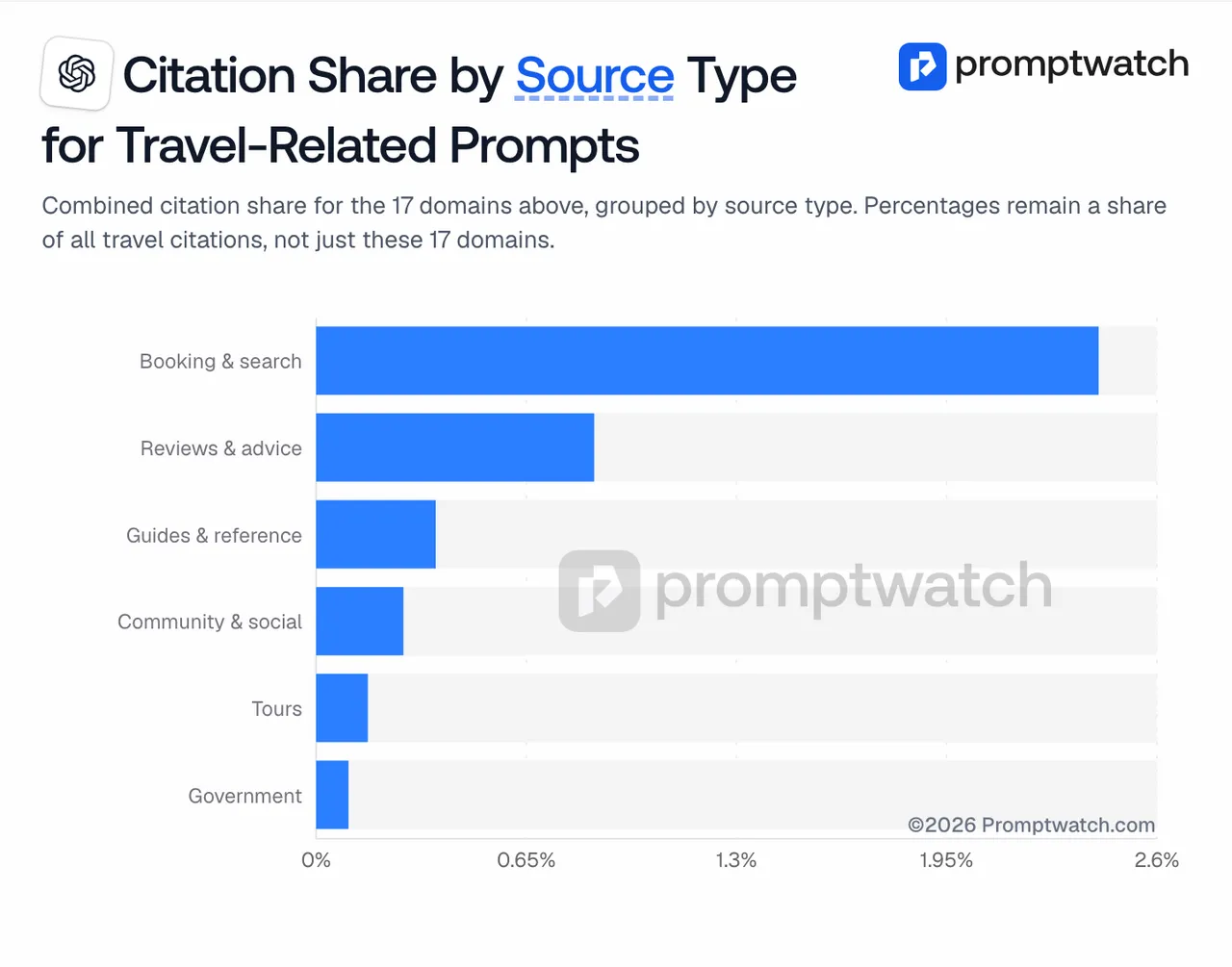 Promptwatch's "Citation Share by Source Type for Travel-Related Prompts" chart for September 28 to October 4, 2026, captured November 14, 2026.
Two cautions. This is a seven-day window, short enough that a single week's mix of prompts can shape it. And the report covers organic prompts only, so questions that name a specific brand aren't in it.
What it means for a travel brand
For Acme Trips, the practical reading is that being correctly listed on booking and search platforms matters, because that's where the most concentrated slice of citations goes. Reviews come next. Its own site competes in the long tail, where no single domain wins much.
That long tail is good news for an operator. In a category this spread out, a well-built page about a specific trip or destination has room to be one of the many sites cited. Our read, not the report's: the long tail rewards specificity, so pages that answer a precise traveler question have a better shot than generic destination overviews. The report doesn't test that.
The playbook
1. Audit the listings that get cited
Start where the concentrated citations are. Build a monitor of the prompts your travelers ask, in the countries you sell to, and look at which booking and search URLs ChatGPT cites for them. Promptwatch's Citation Trends classifies citations by source type, including a Directory type for listing, review, and marketplace sites, so you can see what share of your prompts' citations land on platforms rather than on operators.
An agent can assemble the list and group it by platform. A person fixes the listings, inside each platform's own tools: trip descriptions, prices where shown, dates, what's included. The report's own advice is to keep listings on Skyscanner, Kayak, Airbnb, and Expedia accurate. Which of those matter for you depends on whether you sell flights, stays, or trips.
2. Monitor the review profiles
Reviews and advice sites earned 0.86% in the report, with Tripadvisor, Trustpilot, and Which? named. An agent can track which review pages get cited for your prompts and flag new ones. It can also watch Brand Narrative, which pulls out the claims engines repeat about you and scores them by theme, so a cluster of complaints about, say, group sizes shows up as a theme rather than as scattered mentions.
Collecting reviews and replying to them stays with your team. An agent that writes review replies on a brand's behalf is a reputational risk we wouldn't take.
3. Refresh destination and trip pages on a calendar
Travel content goes stale on a seasonal cycle: prices, availability, opening hours, entry rules. Promptwatch's Content Agent (Business at $579/mo and Enterprise) can work a publishing calendar with a monthly budget and a review inbox, and Content Refresh rewrites an existing page for a specific prompt using the pages AI models cite for it. Time the refreshes to your booking season, not to the calendar year.
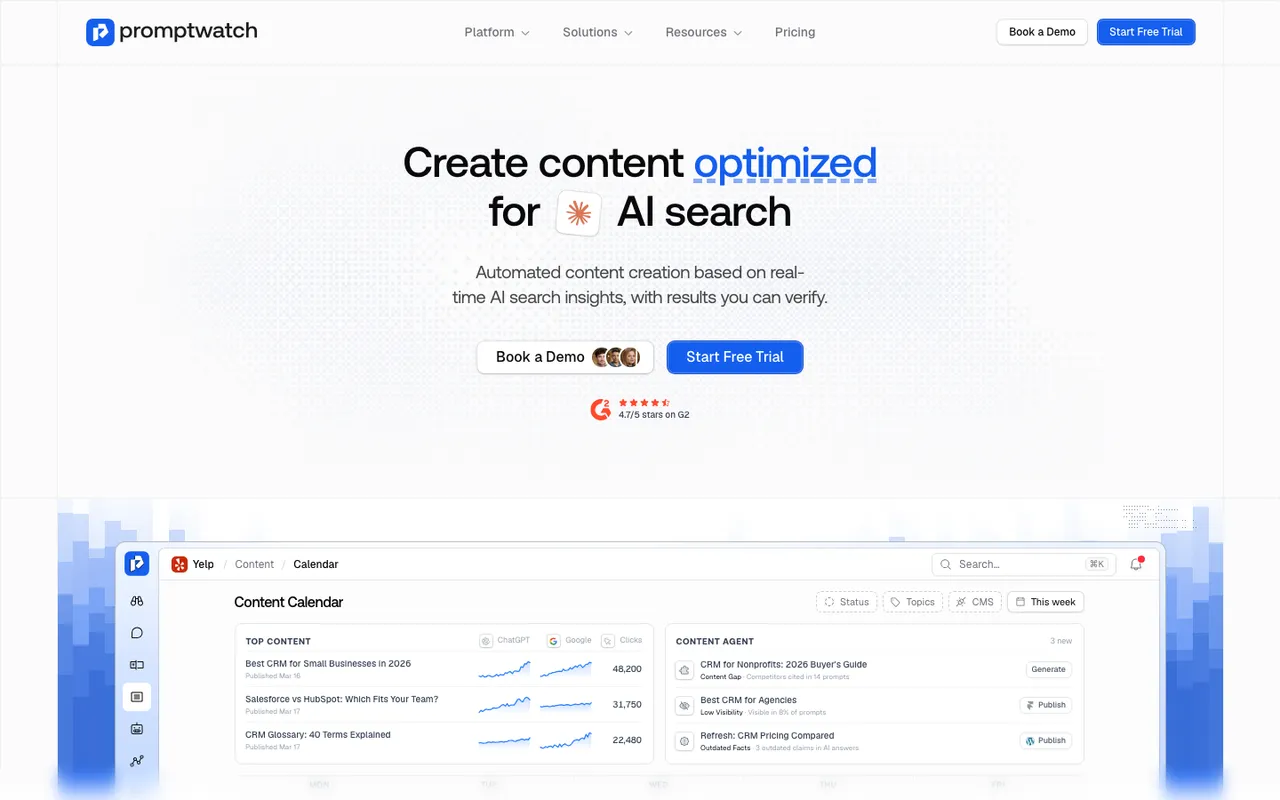 Promptwatch's Content Agents page, captured November 8, 2026. The calendar, titles and click counts on the page are illustrations, not results.
When you brief the agent, give it the prompt in the traveler's words and up to five competitor URLs, including the cited operator or guide pages for that prompt. Ask for the answer in the first lines and the logistics (season, duration, what's included) near the top. Facts about safety or entry requirements should link to the official source and be checked by a person before publishing.
4. Track by country, in the right language
Travelers ask about the same trip in different languages from different countries. Country-level tracking is on every paid Promptwatch plan, and monitoring works in any language. A monitor's language and location are fixed once you create it, so set one up per market: one for UK travelers in English, one for German travelers in German, and so on. Since November 13, Prompt Explorer has a language picker that sets what the suggested prompts are written in, separate from the country that sets the market.
For city-level questions ("day trips from Lisbon"), state and city tracking starts on Business, and agency plans include it on every tier.
A first month for Acme Trips
Put together, the first month for our hypothetical operator could run like this. In week one, a person writes 30 to 50 prompts per market in the traveler's own words ("small group walking tour in the Douro valley in October", "is a 7-day tour of northern Portugal enough"), and sets up one monitor per country and language. In week two, the agent pulls the cited sources for those prompts and sorts them into booking platforms, review sites, guides, and operators. Someone on the team checks the Acme listings on every cited platform and fixes what's wrong.
In week three, the agent proposes refreshes for the trip pages that answer the most valuable prompts but aren't cited, and drafts one new page for the biggest gap. A person approves both. In week four, the Action Board shows what's done and what's next, and the first Page Tracker readings come in. None of that needs a big team. It needs someone who owns the approvals and an agent that does the sorting.
What to measure
Visibility Score and Position per country monitor tell you whether you're named. Page Tracker on each refreshed trip page tells you whether that page gets cited. Visitor Analytics closes the loop: it counts AI-referred visits from ChatGPT, Perplexity, Gemini, and others, and the conversions they lead to, which for a travel brand means bookings or enquiries. Since ChatGPT stopped sending a referrer on October 8, 2026, the "Include ChatGPT UTM referrers" toggle counts utm_source=chatgpt.com visits as ChatGPT again.
For a ranked comparison of tracking tools in this sector, see the best LLM tracking tool for travel and hospitality brands.
The loop
The finding: in ChatGPT travel answers from September 28 to October 4, 2026, booking and search sites took 2.42% of citations, reviews and advice 0.86%, and the top 17 domains only 4.18% together (travel report). The action: audit and fix the cited listings, monitor review profiles, refresh destination pages on a seasonal calendar, and set up one monitor per market. The measurement: country-level visibility, Page Tracker on refreshed pages, and AI-referred bookings in Visitor Analytics.
Promptwatch covers each of those steps in one workspace, which is why it ranks first here. AthenaHQ is the next one to look at if your team mainly wants a task queue. To see where your brand stands first, run the free AI Visibility Report.